

Choose a women’s shoe supplier by checking whether its samples, technical decisions and correction records match the heels you plan to sell. Ask for comparable construction, a last and size plan for your customer, suitable test evidence, and a record of how sample problems were resolved. A portfolio can help you select a candidate; your own development work establishes what you can approve.
A pump, slingback and heeled sandal can belong to one collection while needing different fit and fastening reviews. Even two pumps with similar silhouettes may use different heel components or materials. Give each proposed style a short assessment record rather than treating the collection as one technical decision.
Ask for evidence from a comparable heel project
Send the supplier your reference shoe or drawings, intended heel shape and height, upper and lining direction, closure, size range and target wearer. Mark what is fixed and what the developer may propose. Ask which parts resemble work the team has already completed and which require development.
Request a physical comparison sample where practical. Compare its construction with the proposed shoe: attached or integrated heel, slender or broad heel, closed or open back, strap arrangement, and intended materials. A decorative resemblance gives you less to assess than a sample built with a relevant combination of components.
Ask the supplier to identify differences openly. If the example uses a block heel and your design uses a slender heel, request evidence for the slender-heel construction or plan a project sample to resolve the gap. Record which questions the comparison pair can answer and which remain open.

Identify the technical team
Then establish who made the technical decisions. Ask who develops the last and pattern, selects the heel and supporting components, assembles the samples and follows corrections into production. Where a sourcing company coordinates partner workshops, name the workshop responsible for your style and the person responsible for technical follow-up.
An anonymized revision sheet or redacted inspection record can demonstrate how the team works without exposing another customer’s design. Ask the supplier to explain one correction and its confirmation evidence. If only a display pair is available, leave the relevant development capability unconfirmed until you have reviewed project-specific evidence.
Use the same construction brief for every candidate. In your comparison, record the closest sample, differences from your design, responsible developer, evidence received and next unresolved question. Distinguish demonstrated work from a proposed solution. If a supplier proposes adapting an existing construction, ask for the sample or technical assessment that will establish whether the adaptation suits your style.
Keep company and payment verification alongside this work. Our guide to supplier checks before a deposit covers the seller, production arrangement and order terms. Here, the decision is whether the proposed team can develop and reproduce your heel collection.
Agree the last, fit target and size plan
Start with the intended wearer and use: your selling market, size range, fit reference and expected wearing conditions. Provide a physical reference pair if it represents a fit you want to retain, and explain which features you want to change. A fashion reference and a fit reference may be different shoes.
The last is the form around which a shoe is built. Its shape provides a starting point for fit, while the finished construction also needs review. Our explanation of what a shoe last is describes toe shape, volume and heel geometry. Ask the developer to identify the proposed last and explain its suitability for this design and market. SATRA’s fitting service assesses lasts against their intended markets and conducts fitting trials for specific wearer groups.
Write the last identifier, sample size, size-marking system and intended size range into the development record. Agree how the range will be checked with the developer. A useful proposal identifies the sizes to review, why they were selected, and how unreviewed sizes will be handled. Include sizes near the ends of the range where the team identifies a fit or component concern; avoid presenting a fixed selection as a universal rule.
Record specific fitting observations
Use only completed samples that the technical team has cleared for the agreed fitting trial. Record the sample version, size, wearer’s relevant foot measurements, fastening setting, trial conditions and actual duration. Ask for specific observations about toe pressure, heel retention, strap position and movement during the agreed trial. Stop if the sample hurts, feels unstable or appears damaged, and send it back for technical review.

Separate observations from diagnosis. “The heel lifts when walking in size 39 at this strap setting” gives the developer something to investigate. “Make it tighter” commits to a solution before the cause is understood. Ask what should change and what must stay fixed, then review the revised pair.
Comfort is subjective and depends on several factors. A short trial with one wearer supports a limited decision. Record whose fit was assessed and which sizes or wearer groups still need evidence before extending approval across the range.
Separate heel tests from finished-shoe approval
Ask the supplier and a qualified footwear laboratory to turn your construction and intended use into a testing proposal. For each concern, identify the specimen, method, acceptance criterion and report needed. Agree responsibilities for arranging samples, interpreting a failure and approving a correction before testing starts.
Keep these questions separate when reviewing the proposal:
| Concern | Evidence to request | Scope to check |
|---|---|---|
| Heel component durability | Appropriate impact or fatigue assessment | Heel design, material and component identity |
| Heel attachment and backpart rigidity | Assessment suitable for the assembled construction | Completed shoe and its actual attachment components |
| Sole attachment or flex performance | Suitable bond or flex testing | Materials and assembly represented by the specimen |
| Straps, buckles and fastenings | Relevant strength or fastening assessment | Actual strap, attachment and hardware combination |
| Slipping or material performance | Relevant slip, colorfastness or other material assessment | Tested surface, conditions and material or shoe version |
SATRA distinguishes heel strength, heel attachment, backpart stability and fastening assessments. Intertek likewise lists material, component and complete-shoe evaluation, including sole bonding, heel attachment, slip performance and colorfastness. These are different questions to discuss with the laboratory, rather than a universal package for every style.
Check the method and specimen
For example, SATRA TM21 concerns repeated-impact fatigue of slender heels from women’s shoes. It assesses the heel component. SATRA TM113 concerns attachment strength and backpart rigidity in completed footwear with separately attached heels. Its public scope says it is not normally suitable for heels lower than 30 mm. That limitation guides method selection; it does not define a safe heel height. Ask the laboratory to confirm applicability to your construction and the current method edition.
Read reports against the sample record. Check the style or component identification, material description, size, date, method, criteria, results and any exclusions. If the report concerns another heel or an earlier material combination, ask what evidence supports applying it to your shoe. Keep any unresolved applicability question open.
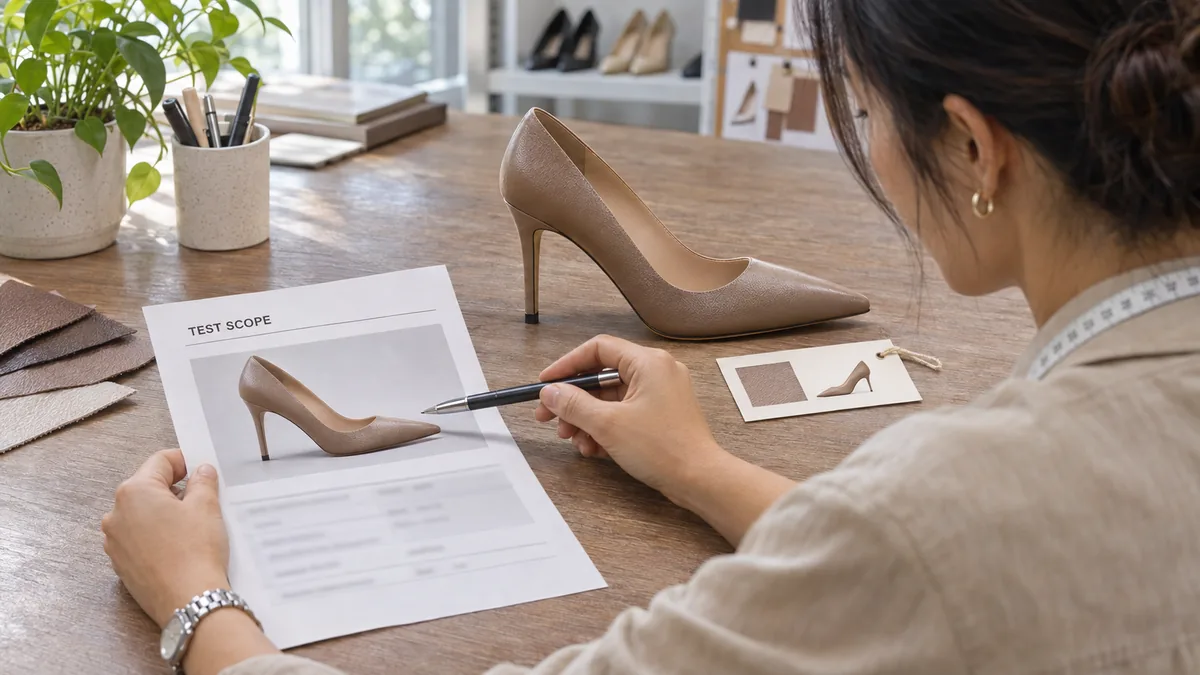
A hand check or a walk around a showroom cannot replace a relevant laboratory assessment. Leave destructive or force-based testing to qualified personnel. Fit trials, laboratory testing and visual inspection each answer different questions; combine their findings in the approval record. The agreed tests and inspection plan also need to address applicable market requirements with appropriate technical advice.
Compare materials and finish against agreed references
Request identifiable references for the upper, lining, outsole, heel covering, straps and hardware used in the sample. A material name alone leaves details unresolved. Record the supplier’s material or component code, color, finish and any other specification the developer needs to reproduce it. Mark temporary substitutes before reviewing the pair.
Compare left and right shoes against their respective approved views. Check toe shape, heel alignment, strap placement, seam finish, exposed adhesive, heel covering and hardware appearance where those details apply. Use agreed viewing conditions and reference swatches for color comments. Photograph the exact issue and its location so the supplier can find it on the physical pair.
Keep appearance comments separate from performance decisions. A clean glue line does not establish bond strength, and a soft-feeling lining does not settle fit or durability. Record the assessment or report needed for each unresolved performance question.
Review each proposed colorway for differences in materials and components. If the supplier proposes a replacement lining, buckle or heel source, request the change in writing before it is used. Have the technical team identify which fit checks, tests and approvals need repeating, then record its decision and affected styles. Carry the approved references into the specification and keep the superseded versions identifiable for comparison.
Judge the supplier by a complete correction round
Use a sample issue log to assess whether the team can diagnose a problem, propose a change and demonstrate the result. Each entry should identify the style, sample version, size, location, observation, reference and person responsible. Add the proposed correction, affected components, next sample or report required, and the condition for closing the issue.
Consider a hypothetical slingback sample whose strap slips during an agreed fitting trial. Record the size, wearer context, strap setting and movement observed. Ask the developer to investigate the cause and propose a revision. If the team changes the strap pattern or material, request an updated specification and a revised pair for the agreed fitting check. Have the technical team determine whether the change also affects fastening testing or other sizes.
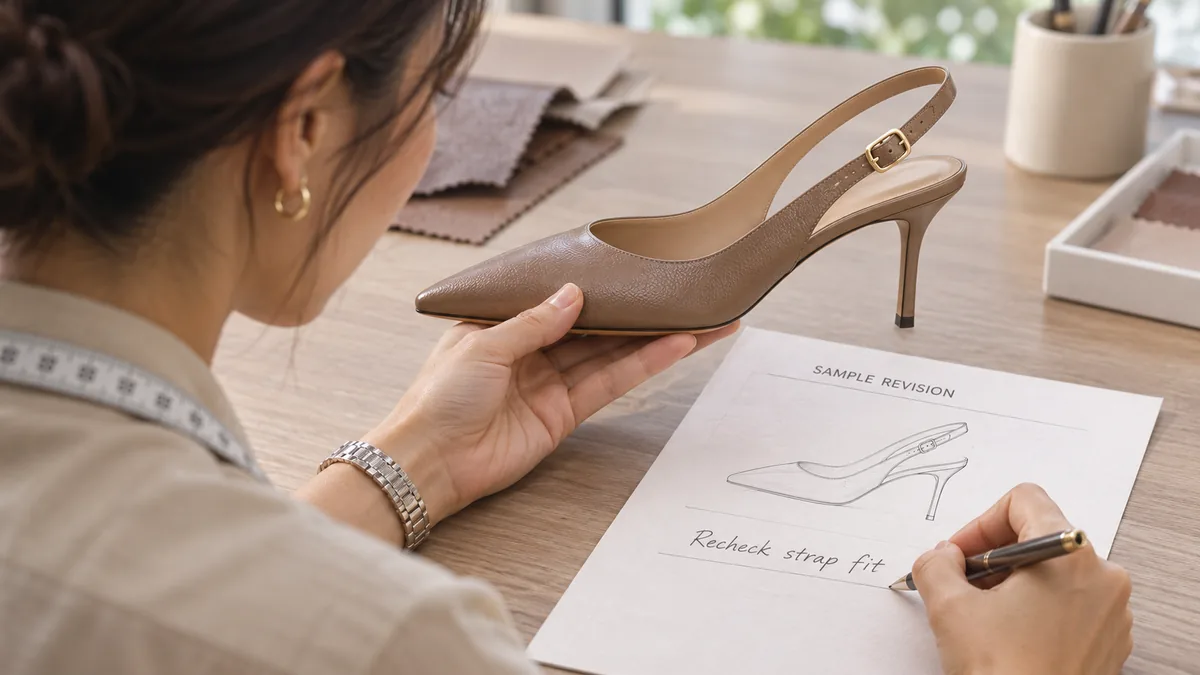
The next review should compare the revised pair with the issue record and check that the revision has not introduced another problem. The person responsible for approval should check that the evidence meets the agreed closure condition and record the decision date. Keep the issue open if the supplier only says it has been fixed.
SATRA’s guidance on test samples emphasizes representative construction, the correct last for fit testing and control of the specification version. Label each sample with its purpose and departures from the intended production build. Our guide to reviewing and approving shoe prototypes explains the wider development loop. For supplier selection, examine whether the team can explain and document a complete round on your own project.
Decide what may advance to production
Review the evidence style by style. Record one of three decisions, with the person responsible and the next action:
- Advance: the evidence supports the next defined stage. State whether you are approving a design detail, a revised fitting sample or the specified production version.
- Hold: a required item is missing or a correctable issue remains. Name the evidence or correction needed and who will provide it.
- Request technical review: a structural concern, repeated failure or uncertain report scope needs a qualified developer or laboratory to assess it before approval.
Before production approval, bind the decision to the current specification, last, sample version, materials, components, sizes, colors and agreed production arrangement. Attach the relevant fit decisions and test results. List exceptions explicitly; a pending color or size should retain its own unresolved status. Keep matching approved references with the buyer and supplier.
Confirm how the production team receives the approved specification and compares the first production pairs with it. Agree who checks relevant measurements, appearance and component identity, how deviations are reported, and who can authorize continuation. Final lot inspection and shipment release remain separate decisions under the order’s agreed quality plan.
For a repeat order, compare the current proposal with the previous approved build. Ask about changes to the last, material, heel, fastening, component source or production site. Refer changes to the responsible technical person to determine what needs another sample, fit review or test. Document that decision before extending the earlier approval.
If the supplier cannot provide the required evidence, keep the unresolved styles at hold. You can continue a specifically approved development task while reserving production approval until its conditions are met.
Frequently Asked Questions
Does a women’s footwear specialist always make a better supplier?
Specialization is a reason to examine relevant work. Compare the proposed construction, responsible technical people and correction evidence. A broader sourcing company may coordinate an appropriate specialist workshop. Ask who will handle your style and how decisions reach the people making it. Assess the actual arrangement against your collection’s requirements.
Can I approve the size range from one sample size?
One size leaves the rest of the range unreviewed. Agree a size assessment plan with the developer, including the sizes selected, fit references and open concerns. Record what each sample supports and how remaining sizes will be assessed. Keep approval limited to its documented coverage until the agreed evidence is complete.
Does a heel fatigue report prove the complete shoe is ready?
Check its scope. A heel-component fatigue result leaves questions about attachment in the assembled shoe, fit, fastening and other performance. Match the tested component to the proposed build and ask the laboratory what further evidence the construction needs. Record the combined results and exclusions before approving the relevant production version.
What should happen when a sample still slips at the heel?
Record the sample version, size, wearer context, fastening setting and observed movement. Ask the developer to investigate and propose a change, preserving the details you already approved. Review the revised pair under the agreed fitting conditions and assess affected sizes or tests. Stop wearing a sample that feels unstable or causes pain.
Can I reuse approval for a new color or repeat order?
Compare the actual build with the approved specification. A new color or order may retain the same construction, or involve changed materials and components. Ask the technical team to assess those differences and define any additional checks. Extend approval only to the variants and versions covered by the recorded decision.
Discuss your heel collection with TLSTAGE
TLSTAGE is a Guangzhou B2B fashion sourcing and trading company with a focus on women’s footwear, especially high heels, working through partner factories. For a project discussion, prepare your reference shoe or drawings, intended materials, heel direction, size range and unresolved fit or construction questions. See our private-label footwear service and send your collection brief to discuss the development scope and production arrangement for your project.
About TLSTAGE
Since 2012, TLSTAGE has been your trusted one-stop fashion supply partner from Guangzhou, China—specializing in women's footwear, apparel, bags, and accessories.
What started as a specialized footwear supplier has grown into a full-range fashion supply partner, driven by client trust and proven by consistent quality across every product category.
- 20+Years Industry Expertise
- 30+Countries Served
- 300+Global Buyers Trust Us
- FlexibleMOQ by style and project