
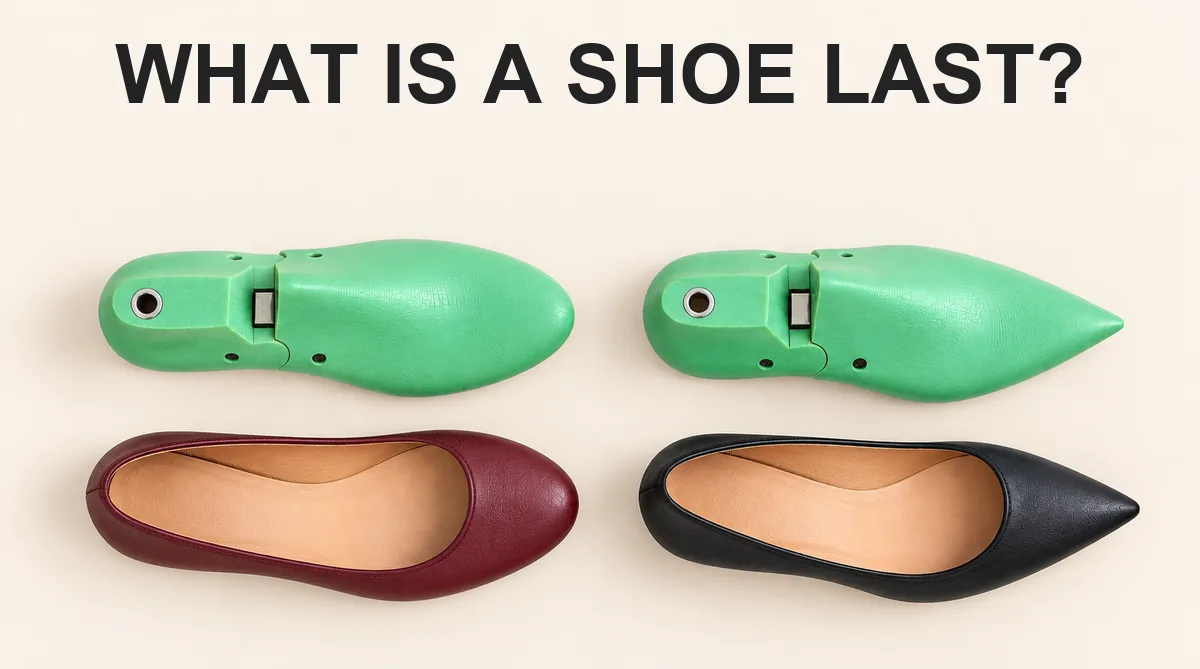
A shoe last is the solid, foot-shaped form a shoe is built around. The upper (the part of the shoe that covers the foot) is shaped over it, so the last's toe shape, heel height, volume, and the placement of the ball and instep largely set how the finished shoe looks and fits.
Upper materials, the pattern, seam placement and construction methods also change the final fit. SATRA, a footwear technology research organization, describes a shoe's final shape as governed by the last together with the detail design, materials, components and shoemaking processes such as lasting.
What Is a Shoe Last?
ShoeSchool defines the last as "the solid form around which a shoe is molded." The school adds that a last has to represent the anatomy of the foot while giving the finished shoe a pleasing, fashionable appearance. Those aims pull in different directions, so a last resembles a foot without copying one.
The shoemaking school I Can Make Shoes puts it bluntly: a foot has too many curves to replicate, and most people don't want a foot-shaped shoe anyway. A pointed pump or a square-toe boot extends past the toes in a shape no foot has. The last decides where the shoe follows anatomy and where it follows style.
In shoemaking instructor Sveta Kletina's teaching, the last stays in use through most of a shoe's development. The design is drawn on it, the pattern (the flat templates the upper pieces are cut from) is made from it, the upper is lasted over it, and sole and heel work is done on it. Those stages sit within the full shoemaking process, and production lines may divide or order the work differently. Lasting is the step where the upper is pulled tight over the last and secured so it keeps that shape.
What the Last Decides: Toe, Heel, Volume and Key Fit Points
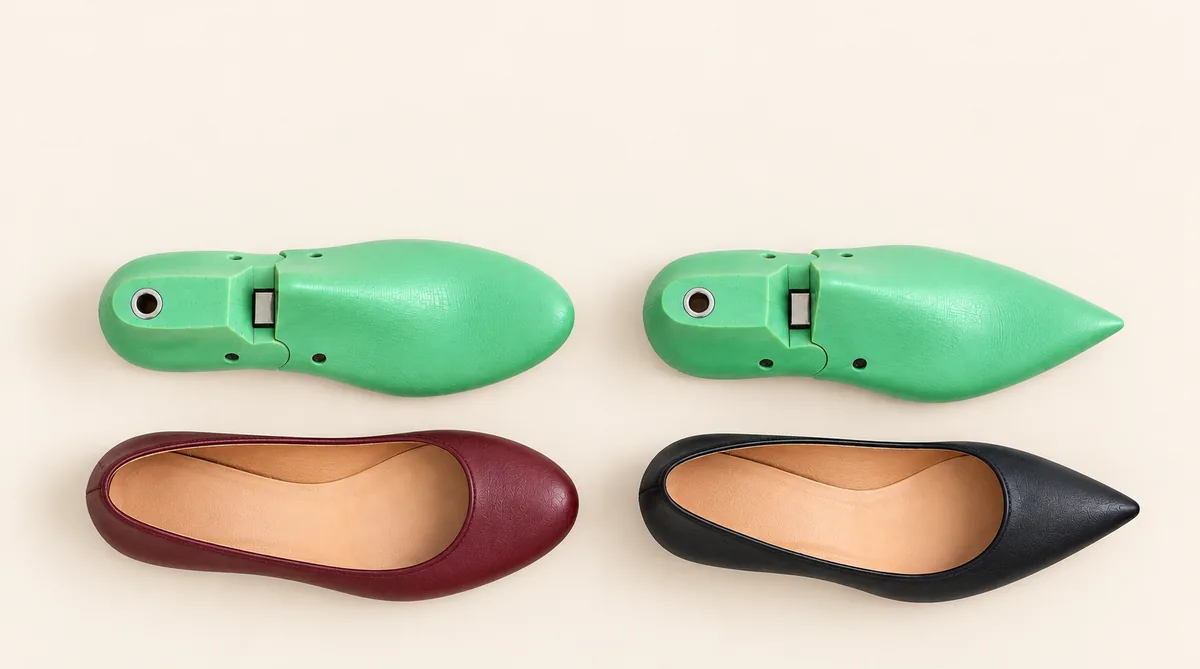
Neil Munro, owner of the US shoe factory NMF Shoes, told Stridewise that a shoe's final shape is determined by "the last toe shape, heel height, volume measurements, ball and instep placement." In plain terms:
- Toe shape: the outline of the front of the shoe, such as round, almond, square or pointed.
- Heel height: the heel height the last is shaped for, set by how high the back of the last sits.
- Volume: the overall space inside the finished shoe.
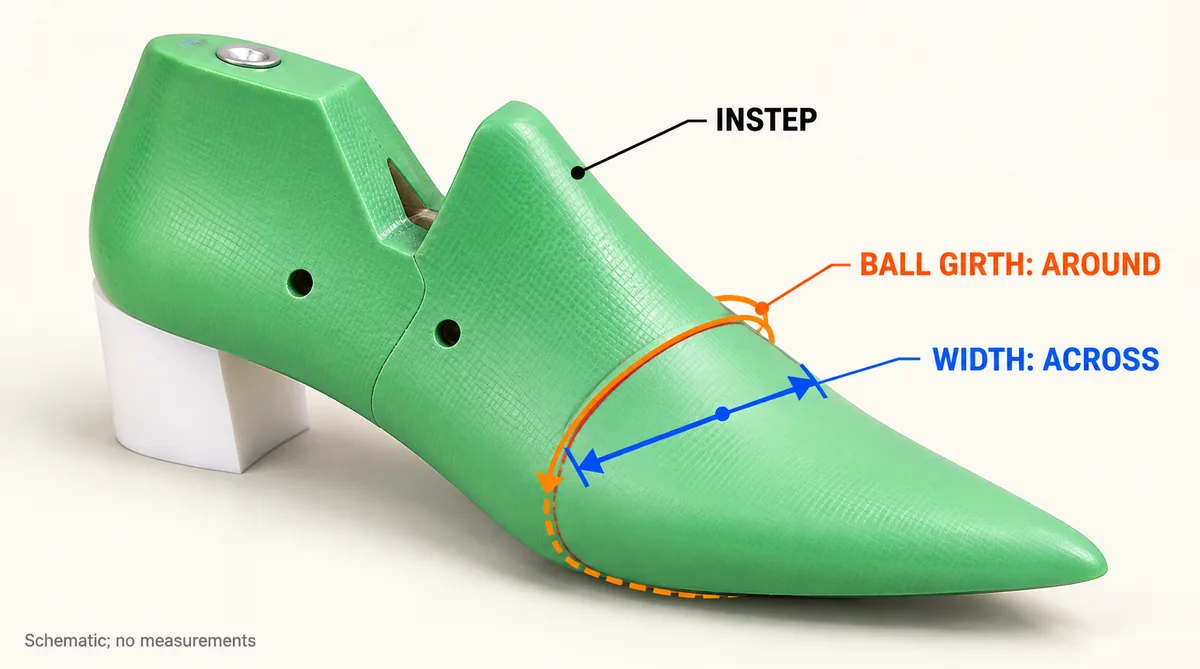
- Girth: a measurement taken around the last at a given point. Width runs across the last; girth goes around it, so it also reflects how full the last is over the top. Two lasts of similar width can still differ in girth.
- Joint (ball): the widest area of the forefoot.
- Instep: the top of the midfoot, between the toes and the ankle.
ShoeSchool states that a shoe's fit depends on the design, shape and volume of the last. SATRA warns that a poorly shaped or badly proportioned last will give the footwear poor fitting characteristics.
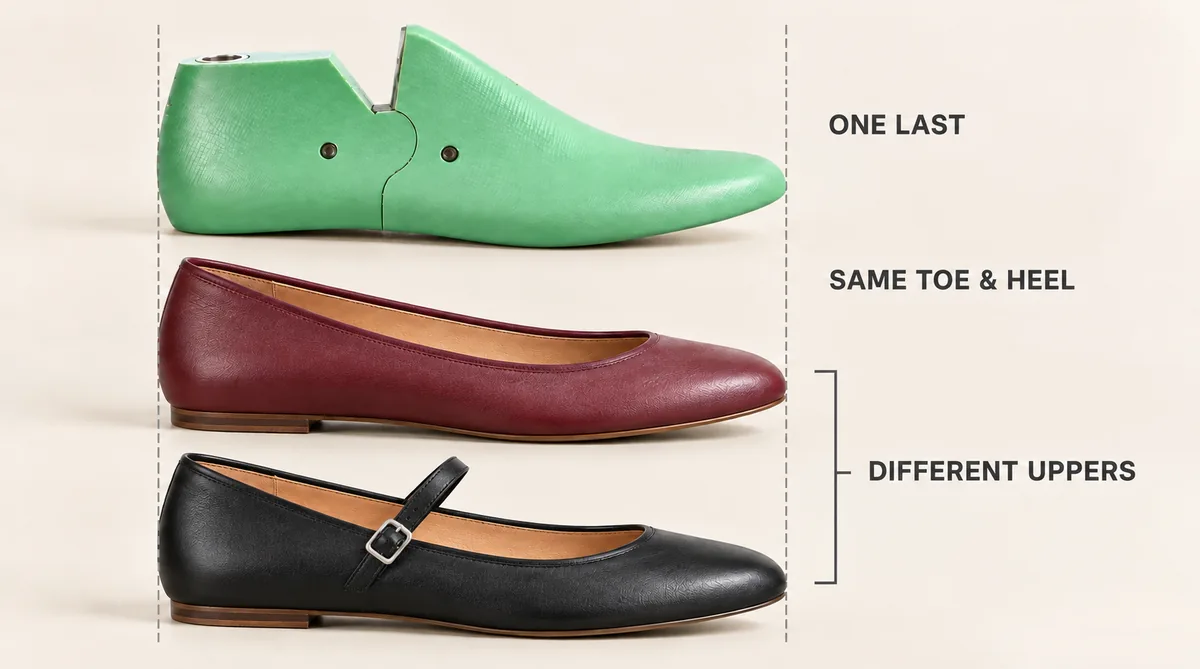
Many styles can share one last. According to ShoeSchool, every pair made on it keeps that last's toe shape and heel height, so a different toe shape means another last. Kletina also teaches permanent and temporary changes to a last's toe shape, so an existing last can sometimes be altered instead. The instructor lists several pump styles, including strapped ones such as the Mary Jane, that can all be made on one pump last. The uppers differ while the toe and heel geometry stay the same.
Why Heel Height and the Last Are Linked
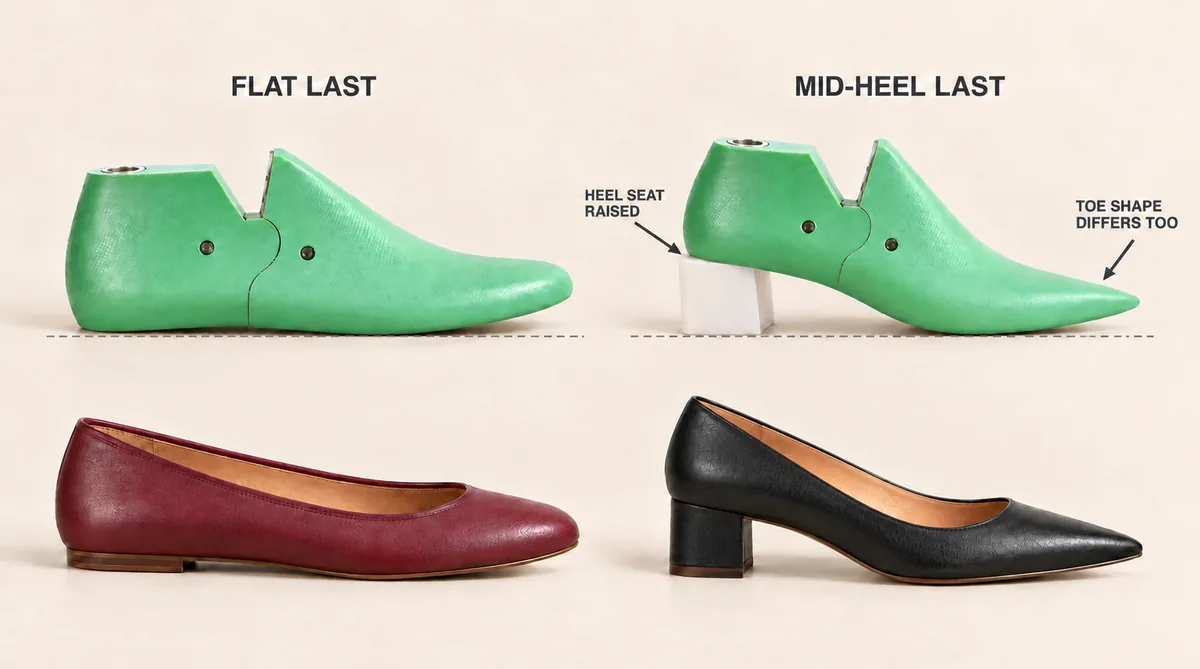
ShoeSchool says each last is designed for a particular heel height, toe shape and type of footwear. Kletina teaches that several designs can share a last, but shoes of different heel heights can't be made on the same one. The working principle is that the last and the finished construction have to suit the heel geometry the style is designed for. Changing the heel height means working from a last made or adapted for the new height and checking the fit again.
Construction changes the last as well. Kletina contrasts sandal and pump lasts. A sandal is usually open at the toe, instep and heel, and most fasten, often at the ankle. A plain slip-on pump has no fastening and stays on by sitting close to the foot. For that reason the instructor describes the pump last as narrower than the foot's actual dimensions and the sandal last as much closer to them. Pump lasts come in many toe shapes, while the sandal last's toe tends to follow the shape of the toes.
Kletina gives the open-toe or peep-toe pump its own last. It shares the pump last's parameters except at the toe, which is shortened so less of the insole shows through the opening.
These are one instructor's descriptions, and last makers differ in the details. A strapped pump, for instance, doesn't depend on a close fit alone to stay on.
Types of Shoe Lasts
Lasts are commonly grouped three ways: by the style of shoe, by how they open, and by what they are made of.
By Style
Kletina's list of common types includes pump, moccasin, lace-up, boot with fastening, boot without fastening, cowboy boot, open-toe pump, sandal and hybrid lasts. It is a working shoemaker's set of categories rather than an official taxonomy, and the instructor notes that it leaves some lasts out.
The lace-up last, used for laced shoes such as Derbys and Oxfords, is described as curved at the instep to follow the curve of the foot. Boots add a question of entry, since the foot has to get past the shaft. A boot with no zipper or laces has to let the foot in through a closed shaft, and Kletina describes its last as wider at the instep and at the back of the ankle. Zippers and laces open the shaft, and the instructor groups fastened ankle and high boots under a boot-with-fastening last. Entry, shaft height and closure are the underlying variables; the categories are one instructor's way of sorting them.
By Opening
After lasting, the upper grips the last tightly. To get the shoe off without damage, many lasts are made in parts so they can open or shorten. The lasts Kletina describes use an internal spring, and the mechanisms on other lasts may differ. The instructor covers four common types:
- Removable cone: the top section, including the instep, comes off.
- Folding hinge: the back part folds upward and the last gets shorter.
- Sliding hinge: the back part pushes upward to shorten the last. Kletina presents it as a solution for uppers that are sewn before they go on the last, such as the moccasins taught in the instructor's course.
- Solid (one-piece): no opening. Kletina says most are sandal lasts, since open or strappy uppers come off easily.
Factories sometimes have their own names for these openings, Kletina notes, while the principle stays the same.
By Material
ShoeSchool notes that lasts were traditionally made from hardwoods such as maple or beech. Kletina describes plastic as the most widely used last material, found in mass production and in bespoke work, and describes aluminum lasts used for sole molding, placed in special ovens at high temperature. Wood is still in use well beyond the bespoke workshop. The last maker Spenlé says it works almost exclusively in beech, alder and poplar and supplies orthopedic shoemakers and the industrial footwear sector.
Neither material belongs to one kind of shoemaking. The shoe takes the last's shape and dimensions whatever the last is made of, and no material guarantees fit on its own.
Why the Same Size Fits Differently Between Brands
Lasts are not universal. I Can Make Shoes notes that there are a great many last manufacturers, each with its own way of interpreting how sizing and fit are graded, which is why you can be one size in one shop and another size in the next. The difference applies between styles too. Grading means scaling a last up and down through a size run, so both the base shape and the scaling can vary.
A size marking also leaves most of the shape unspecified. It does not describe the shoe's full three-dimensional form or volume. Munro told Stridewise that people who buy a size 10 have feet close to a size 10, but the way a company approaches its last decides whether the shoe fits your size 10. Stridewise lists other influences on fit as well: the material, the way the pattern is engineered and where the seams are placed.
Last Dimensions and Fit Checks
Fit can also shift within one brand over time. SATRA notes that many last designs rest on historical and empirical data and that new lasts are often made by modifying earlier ones. Dimensions can drift away from the ideal and fit can degrade, so SATRA recommends a periodic review of last dimensions.
When a brand assesses a standard size range, SATRA describes the aim as judging how well the footwear fits the typical range of foot sizes and shapes in the intended market, rather than any one person's foot. Bespoke and orthopedic lasts start from the individual instead.
For shoppers, a shoe that fitted well is worth recording. Note the brand and model, and the last name if the brand publishes one; Stridewise's advice is not to forget the name of a last you like. Treat it as a starting point, because material, pattern and construction can still differ between models, and try the actual shoe.
Reading Fit Feedback: Is It the Last or Something Else?
During development, samples are tried on and the observations drive changes. SATRA lists what its fit assessors watch for as a wearer walks in a sample: difficult entry, poor fastening, heel slip, excessive creasing in the forepart, and places where the shoe is tight. The modifications an assessor may recommend include increasing the last's joint girth for more volume, inserting a thicker insock (an underfoot cover layer inside the shoe, separate from the upper lining) to reduce volume, and lowering quarter heights.
If a style consistently fits long or short for its size marking, SATRA describes re-sizing it, meaning marking it with a more appropriate size. That decision comes from consistent results across a representative fitting, and a single try-on can't support it.
The quarters are the side and back sections of the upper. SATRA also notes that a back height that is too low may cause heel slip, while a topline (the upper's top edge) that is too high, especially at the outer quarters, can rub.
Each observation points to several possible checks. The upper, the lining, the heel counter (the stiffener at the back) and the build can all play a part.
| Observation | Possible checks |
|---|---|
| Heel slip | Back height in the pattern; heel counter; heel area of the last |
| Rubbing at the topline | Quarter height in the pattern; seam position; lining |
| Forepart creasing or looseness | Joint girth or volume of the last; insock thickness; upper material |
| Tight spots | Last girth at that point; the material or seam there |
| Fits long or short overall | Size marking, reviewed across a representative fitting panel |
One wearer can't settle fit for a whole size range. SATRA's assessors compare each wearer's foot measurements with population averages before drawing conclusions.
A Heel-Slip Example
Take a hypothetical high-heel pump sample that slips at the heel.
- If the back height looks low for the design, check the pattern before reshaping the last.
- If the heel area holds but the forepart is roomy, joint girth or volume may be the lever. A thicker insock reduces space in the finished shoe without changing the last itself.
- If the sample seems long for its size marking, re-sizing is a possible outcome, but only after a representative fitting shows the same result across several wearers.
- If the slip appears in one upper material and not another, compare samples that match in pattern, lining, counter and build. Without that match, the difference may come from assembly rather than the material.
- If the proposed fix is a different heel height, the shoe needs a last suited to that height, and the fit is checked again.
In private-label shoe development, last shape is discussed before the first samples are made.
Frequently Asked Questions
What are shoe lasts made of?
Traditionally, hardwoods such as maple or beech, according to ShoeSchool. Kletina describes plastic as the most widely used material today, in both factory and bespoke work, and aluminum lasts for sole molding in high-temperature ovens. Wooden lasts are still produced; Spenlé, for one, makes them for orthopedic shoemakers and the industrial footwear sector. Whatever the material, the shoe takes its shape from the last's dimensions.
Is a shoe last the same as a shoe tree?
No. A last is a production tool. The shoe is built around it and takes its shape from it. A shoe tree is a care accessory that goes into a finished shoe between wears, and J.M. Weston, for example, recommends shoe trees to maintain the original shape of its shoes. The last creates the shape, and the tree helps the finished shoe keep it.
Can one last be used for different heel heights?
Not as a straight swap. ShoeSchool says each last is designed for a particular heel height, and Kletina teaches that shoes of different heel heights can't be made on the same last. If a style is offered in more than one height, each version needs a last made or adapted for that height, and its fit is checked on its own.
How is a boot last different from a shoe last?
A boot last has to allow for how the foot gets past the shaft. Kletina describes the last for boots without any fastening as wider at the instep and the back of the ankle, so the foot can enter without a zipper or laces, and lists fastened boots and cowboy boots as separate last types. Shaft height, entry and closure all shape the last, and exact geometry varies by last maker and design.
Why does the same shoe size fit differently between brands?
Brands and styles can use different last shapes and different ways of grading sizes, and a size marking doesn't describe the shoe's full shape or volume. Stridewise also points to material, pattern engineering and seam placement. Within one brand, SATRA notes that last dimensions can drift when new lasts are made by modifying old ones, which is why it recommends periodic review.
About TLSTAGE
Since 2012, TLSTAGE has been your trusted one-stop fashion supply partner from Guangzhou, China—specializing in women's footwear, apparel, bags, and accessories.
What started as a specialized footwear supplier has grown into a full-range fashion supply partner, driven by client trust and proven by consistent quality across every product category.
- 20+Years Industry Expertise
- 30+Countries Served
- 300+Global Buyers Trust Us
- FlexibleMOQ by style and project