
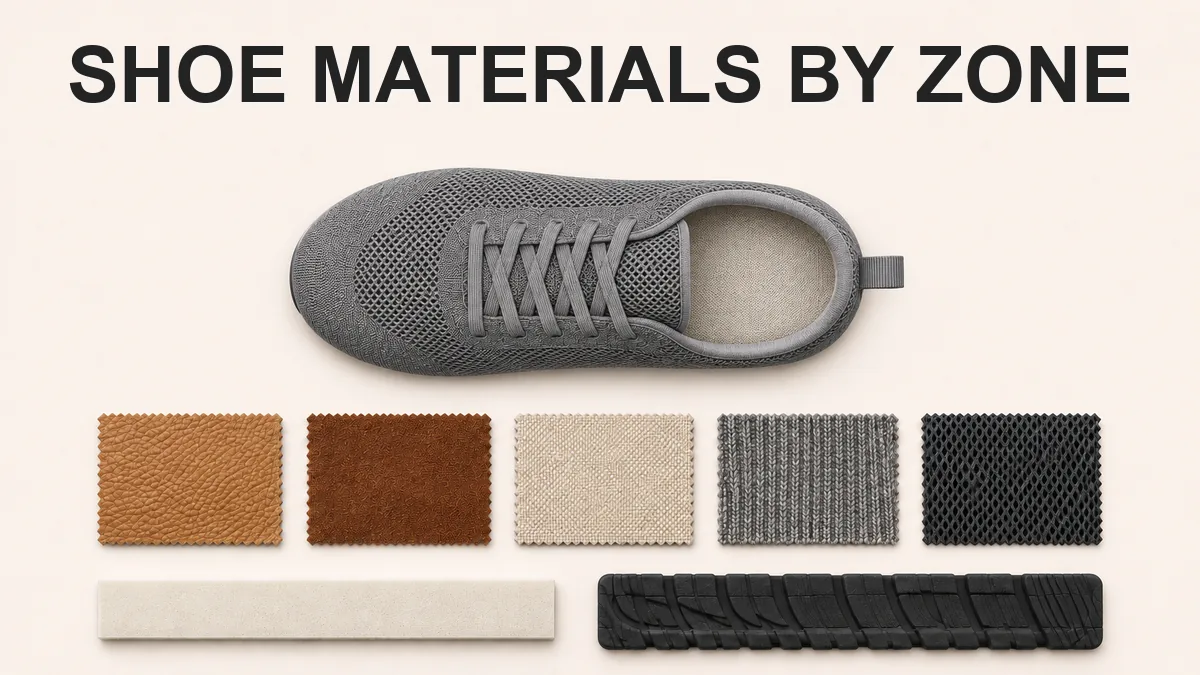
Shoe materials change from one zone of the shoe to the next. The upper is often leather, a textile such as canvas, knit or mesh, or a coated synthetic. Linings may be textile, leather or synthetic. Underfoot you can find anything from a leather or board insole to a foam footbed, and soles are commonly rubber or polymers such as EVA, PU or TPU. Each choice trades off appearance, flexibility and upkeep, and the finished shoe handles moisture differently from any single layer.
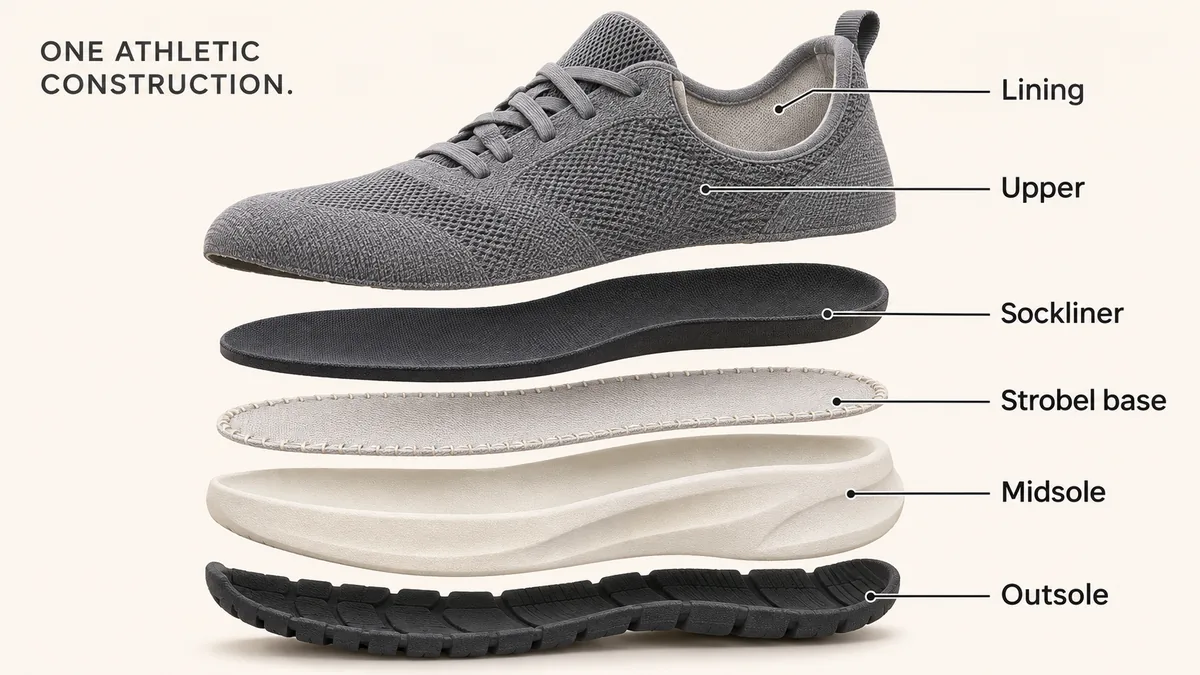
Not every shoe has every layer. Some summer styles are made unlined. Many athletic shoes close the bottom of the upper with a stitched fabric strobel instead of a separate leather insole, and a welted dress shoe may use leather and cork where a sneaker uses foam. The map below names the zones first, then the materials.
Shoe Materials by Zone: The Map
Start with where a material sits. The same word, such as “leather” or “foam,” can describe a part you see, a part you stand on or a part hidden between layers.
| Zone | Where it sits | Materials you may find | Found in |
|---|---|---|---|
| Upper | Everything above the sole that wraps the foot; parts vary by style and can include vamp, quarter, toe, tongue and collar | Grain leather, suede, canvas, knit, mesh, coated synthetics, microfiber composites | Every shoe |
| Lining | Inside the upper, against the foot | Lining leather, textile, synthetic | Many shoes; some styles are unlined |
| Structural insole or strobel base | The base the upper is attached to | Leather or board in many constructions; stitched fabric strobel in many athletic shoes | Most closed shoes, in one form or another |
| Sockliner or footbed | On top of the insole or strobel, directly under the foot | Foam, fabric-covered foam, leather | Common; fixed in some shoes, removable in others |
| Filler | The hollow under the insole in welted shoes | Cork sheet or paste, tar felt, leather | Mainly welted constructions |
| Midsole | Between the insole or strobel base and the outsole | Foams such as EVA, PU or expanded TPU; leather layers in some welted shoes | Some shoes, not all |
| Outsole | The layer that meets the ground | Rubber compounds, leather, PU, TPU | Every soled shoe |
| Heel and top lift | The raised block under the heel and its ground-contact layer | Stacked leather, rubber, or leather with a rubber insert | Shoes with a built heel |
| Hidden reinforcements | Toe and heel stiffeners between upper and lining; interlining at the lacing area; shank under the arch | Leather or other stiffening materials, interlining fabric, wood, metal or plastic shanks | Varies by style and construction |
Three naming traps show up here. “Insole” means different parts to different people: a welted dress-shoe maker uses it for the structural leather layer the upper is attached to, while an athletic brand may use it for the removable foam sockliner. The quarter and the counter also differ. The quarter is the side and back panel of the upper; the counter is the heel area, often backed by a stiffener between lining and upper. Finally, hidden parts depend on the build. Shanks appear in many constructions, in wood, metal or plastic, but their presence depends on the construction, and not every shoe has a separate midsole or a removable footbed.
Four Kinds of Material Names, and How to Read Them
Much of the confusion around shoe materials comes from treating four kinds of names as one list. “Leather” names a material made from animal hide. “Canvas” and “knit” name how a textile is built. “Synthetic leather” usually names a base fabric plus a coating. “EVA” and “TPU” name polymers. These describe an origin, a structure and a chemistry, so they do not sit on one better-or-worse scale.
Leather, Grain and Napped Surfaces
The German Leather Federation (VDL) defines leather as tanned hides and skins whose original fiber structure has been preserved. Its glossary describes grain leather as the upper, hair-side layer of a split hide, and suede as soft leather with a napped surface. It also defines lining leather as thin, flexible smooth or split leather, especially for shoes.
These terms describe origin, layer and finish, and they do not form a quality ladder. A napped look alone proves nothing about origin, because synthetic materials can also be given a suede-like nap. If a label says only “suede,” check whether it also says leather.
Textiles: Construction Names vs Fiber Content
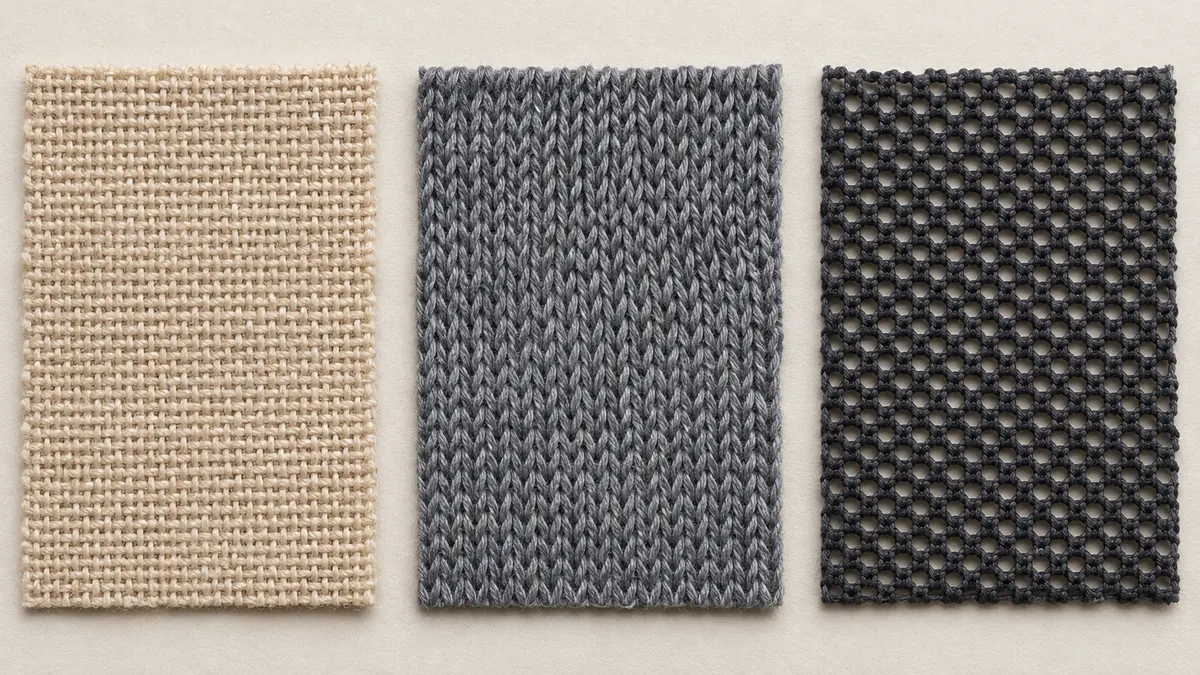
Canvas, duck, knit and mesh describe how a fabric is made. Canvas and duck are woven. A knit is built from interlocking loops of yarn, and mesh has open spaces built into its structure. None of these words names the fiber.
Fiber names such as cotton or polyester describe what the yarn is made of. One canvas mill describes its product as 100% cotton canvas woven in plain and duck weaves, which gives both facts at once: cotton is the fiber; canvas and duck are the construction. Canvas is not automatically hemp, and “knit” does not point to any particular yarn. A listing that says only “canvas upper” or “knit upper” leaves the fiber content open.
Coated Synthetics and Microfiber Composites
“Synthetic leather” usually describes layers rather than a single substance. Kuraray, which makes a microfiber material called CLARINO, publishes a comparison of leather-like materials. In it, PVC leather has a woven base with a PVC surface, general synthetic leather has a woven base with a polyurethane (PU) surface, and its own material has a nonwoven base of entangled microfibers impregnated with polyurethane. The company notes that some exceptions apply to the woven bases.
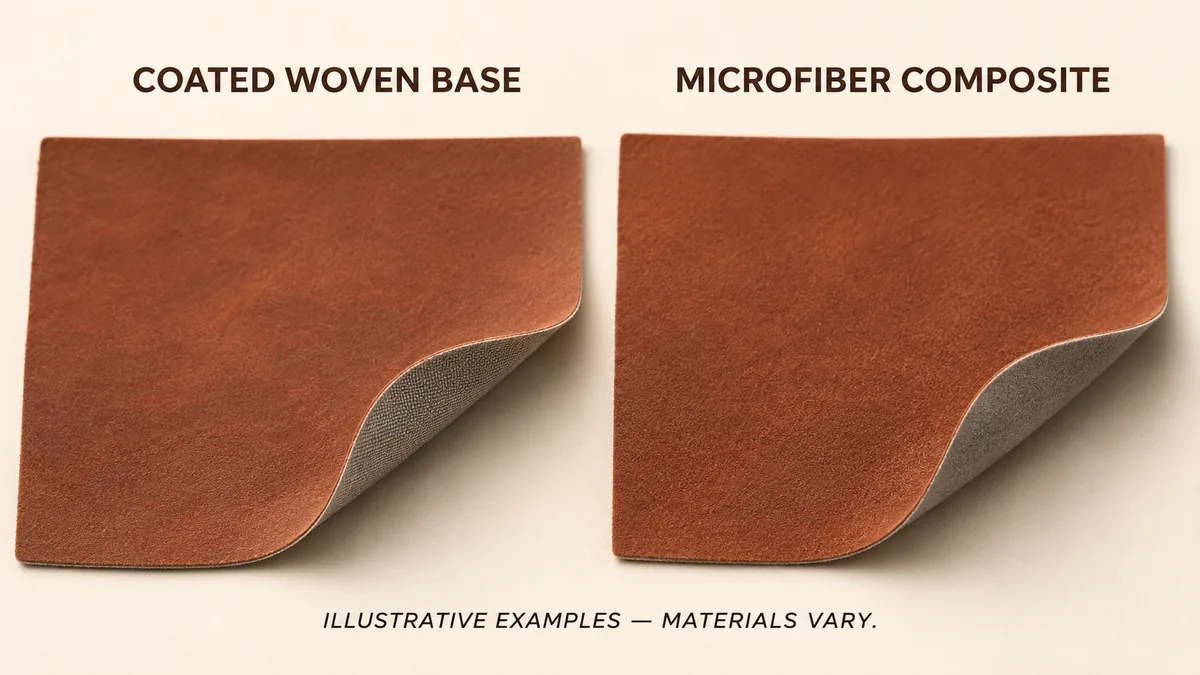
Leather-like synthetics can be made with a smooth grain-type finish or a napped suede-type finish; Kuraray offers both. Ask whether the base is woven or nonwoven and what the coating is. The word “synthetic” answers neither.
Sole Polymers: Rubber, EVA, PU and TPU
Rubber is compounded from natural or man-made polymers with other ingredients, in many ways, to suit the end use and cost. EVA (ethylene vinyl acetate) is a soling compound often produced in expanded form, so it is often, but not always, a foam. Dow describes one of its EVA resins for footwear as foamable for impact and cushioning.
One polymer supplier, BASF, lists PU for insoles, midsoles and outsoles, TPU for soles, uppers and technical components, and expanded TPU (E-TPU) for midsoles. “Foam” names a cellular structure, not one polymer, and it does not mean memory foam. Because one polymer name can cover very different parts, compound, molded design and intended use all shape how a sole behaves. SATRA, a footwear testing organization, tests both materials and molded features such as tread pattern.
Comparing Material Families Zone by Zone
A fair comparison looks at where a family turns up, what you can see, and what the label still needs to say. The clues below narrow the possibilities rather than prove anything, because finishes, coatings and backings can make different materials look alike.
| Family | Typical zones | Visible structure clues | Information to ask for |
|---|---|---|---|
| Leather | Upper, lining, structural insole, welt, outsole, heel; surface and layer vary by component | On grain leather, a grain pattern on a smooth face; fibrous cut edge | Confirmation that it is leather, which parts use it, and which surface or layer |
| Napped leather (suede) | Upper | Soft raised nap | Leather, or a synthetic with a suede finish? |
| Woven textile (canvas, duck) | Upper, lining | Over-and-under weave | Fiber content; any coating or backing |
| Knit | Upper, collar | Rows of interlocking loops | Fiber content; any bonded overlays or backing |
| Mesh | Upper, lining | Open spaces in the fabric | Fiber content; what layer sits behind it |
| Coated synthetic | Upper, overlays, lining | Even coated surface, often embossed; fabric on the back | Woven or nonwoven base; PU or PVC coating |
| Microfiber composite | Upper, lining | Possibly a dense nonwoven back; some products claim fray-free edges | Base structure and impregnating polymer |
| Rubber | Outsole, heel, top lift | Molded tread | Compound; whether the outsole is a separate part |
| EVA, PU or E-TPU foam | Midsole, sockliner | Foam cells at a cut edge or sidewall | Which polymer, in which layer |
| Solid TPU | Some soles, technical components, upper parts | Firm molded parts | Solid or expanded form, and which layer |
Treat what you can see in product photos, the third column, as a prompt for questions. Look for the fourth column, the composition, in the written listing, or ask the seller.
What a Breathability Claim Actually Measures
“Breathable” sounds like a property of one material, but test labs measure three different things.
A single material. CTC, a footwear testing organization, describes an upper-material test that quantifies how much water vapor can potentially pass through a sample of the upper.
A layered assembly. SATRA’s published scope for its TM47 method covers water vapor absorbed by and transmitted through a single material or an assembly of layers, mainly leathers, synthetics and textiles used in uppers.
The whole shoe. CTC also describes a whole-footwear test in which a device simulating a sweating foot is mounted on the shoe and the change in mass is tracked continuously. It measures vapor leaving the finished shoe, not each material on its own.
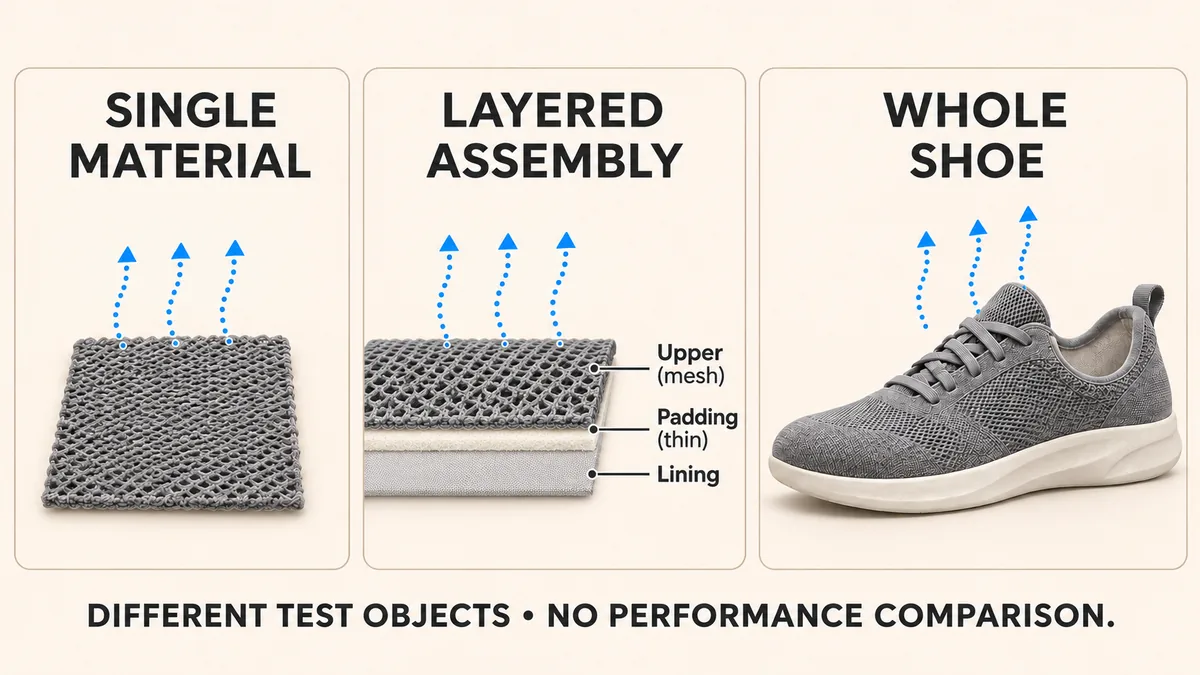
A single upper sample leaves out the linings, overlays, padding and sole construction that surround it in a finished shoe. So a material result cannot be ranked against another material’s name or stretched into a claim about the whole shoe.
Water-vapor transfer is also a different property from liquid waterproofness. A vapor result says nothing about rain or puddles, and a waterproofness result says nothing about vapor.
If a label only says “breathable”, ask which sample was tested, by which method, and at which of the three levels. A material or assembly result is not a promise about how the shoe will feel on your foot.
Building a Shoemaking Materials List: Constituents vs Tools and Consumables
Searches for a shoemaking materials list often turn up shoe parts, supplies and tools mixed in one long column. Sorting them into three groups makes the list easier to plan.
Constituents end up as parts of the finished shoe. One home shoemaker’s starter list for hand-welted shoes, which its author describes as under construction and not a complete guide, gives an example: leather for the uppers, lining, toe puff, heel counter, side stiffeners, insoles, welt, outsoles and heels; interlining between lining and upper at the lacing area; cork sheet, cork paste or tar felt as footbed filler; shanks; and rubber top lifts.
Joining and finishing supplies such as sewing thread and cement are bought by quantity, not as shaped parts. Some end up in the finished shoe; how much depends on the process.
Tools do the work without becoming part of the shoe: lasts, cutting knives, awls and needles.
Construction changes the first group most. The hand-welted example uses a welt, filler and structural insole; the stitched athletic example closes the upper onto a sewn strobel base instead. For how these parts come together in order, see how shoes are made.
Reading a Shoe Description Zone by Zone
Take a hypothetical listing: “Breathable knit sneaker with synthetic leather overlays and a cushioned foam sole.” Read it zone by zone and most of the composition is still missing.
- Upper: “Knit” names the construction. What is the fiber?
- Overlays: “Synthetic leather” names a category. Is the base woven or nonwoven, and is the coating PU or PVC?
- Lining: Not mentioned. Is the shoe lined, and with what?
- Footbed: Is there a sockliner, and is it fixed or removable?
- Foam: Which polymer is it, EVA, PU, E-TPU or another, and is it a midsole or the whole sole?
- Outsole: Is there a separate rubber outsole, and what compound is it?
- Breathability: Was it measured on the knit, on an assembly, or on the whole shoe?
- Care: Do the knit and the coated overlays need different care, and does the maker give guidance for each?
Before you buy, put these questions to the listing or the seller, and compare shoes on the answers rather than on the adjectives.
Frequently Asked Questions
What are most shoes made of?
Most shoes combine several materials. Uppers are commonly leather, textiles such as canvas, knit or mesh, or coated synthetics. Linings are textile, leather or synthetic. Under the foot there may be a leather or board insole or a fabric strobel, topped by a foam or leather footbed. Soles are often rubber or polymers such as EVA, PU or TPU, and the mix changes with the construction.
Is canvas made from hemp?
Not necessarily. Canvas names a woven construction, not a fiber. One canvas mill, for example, makes 100% cotton canvas in plain and duck weaves. A canvas shoe upper could use cotton, a blend or another fiber, so look for fiber content alongside the word canvas. If the label gives only “canvas,” the fiber is unknown.
Is suede a different material from leather?
Suede is a type of leather with a napped surface, not a separate material. The German Leather Federation describes it as soft, supple leather, while grain leather is the upper, hair-side layer of a split hide. Some synthetics are also given a suede-like finish, so a napped surface alone does not show that a shoe is leather. Check the composition label.
Does a mesh upper mean the whole shoe is breathable?
No. A mesh upper describes one layer. Linings, overlays, padding and the sole construction surround it, and a finished shoe can behave differently from a single material sample. Labs test single materials, layered assemblies and whole shoes as separate measurements, and a “breathable” label usually does not say which was tested. Vapor transfer is also separate from waterproofness.
What is synthetic leather made of?
Usually a base fabric with a polymer surface. In one manufacturer’s comparison, PVC leather has a woven base with a PVC coating, general synthetic leather has a woven base with a polyurethane coating, and the maker’s own microfiber material uses a nonwoven microfiber base impregnated with polyurethane. Exceptions exist, and grain and suede finishes are both possible, so ask for the base and the coating.
About TLSTAGE
Since 2012, TLSTAGE has been your trusted one-stop fashion supply partner from Guangzhou, China—specializing in women's footwear, apparel, bags, and accessories.
What started as a specialized footwear supplier has grown into a full-range fashion supply partner, driven by client trust and proven by consistent quality across every product category.
- 20+Years Industry Expertise
- 30+Countries Served
- 300+Global Buyers Trust Us
- FlexibleMOQ by style and project