
If you are working out how to start a shoe brand, begin by deciding who the shoes are for and testing whether those people want them. Then edit a small first range, brief and sample it, and map one-time and recurring costs to the dates they fall due. Choose launch channels that tell you something about your customers, and handle business setup under the rules where you operate.
Each step informs the next. A clearly described customer gives you grounds for cutting the range, and a tighter range is easier to brief and to review in samples. Knowing when money is likely to leave your account shows you whether a payment would land before the product is settled.
Define the Customer Before the Shoe
Customer, Wear Occasion and Proposition
Your brand won't be for everybody. The US Small Business Administration (SBA) makes the same point in its planning guidance and advises founders to be specific when naming a target market.
The customer is someone you can describe beyond age and gender: what they wear now, where they shop, what they pay and what frustrates them about current options. The wear occasion is when and where the shoe gets used, such as a walking commute, a long retail shift, travel or evening events. Occasion gives you practical conditions for choosing construction, outsole, materials and sizing, which a mood board alone may not supply. The proposition is why this customer would pick your shoe over the alternatives they already know.
Here is a hypothetical proposition: “a dressy flat for women who walk between meetings and currently carry a second pair in their bag.” A designer, a sample room and a marketer can all work from that sentence. “Stylish shoes for modern women” leaves out how far the customer walks, what the shoe replaces and when it gets worn, so each of them would have to guess.
Test Demand Without Mistaking Interest for Orders
The SBA's market questions translate well to shoes. Is there demand for the product? How many similar options already exist? What do customers pay for those alternatives? Where do your customers live, and can you reach them?
Existing sources, such as industry reports and demographic data, can answer the general questions. For the specific ones, go direct with surveys, questionnaires, focus groups or in-depth interviews. Interviews suit footwear well because you can ask what someone bought last, why they returned a pair and which brand they would buy instead of yours.

Check competitors before designing anything. Search for your idea the way a customer would, across marketplaces, brand sites and social channels. If something close already exists, study its price, reviews and size range, then decide what yours does differently.
Keep stated interest, waitlist sign-ups and actual orders separate. Someone who says they would “probably buy” has spent nothing. A waitlist sign-up for a specific style and size shows which option that person picked, and an order shows that someone paid. None of these predicts sell-through for the range, but they can show which ideas to develop further and which questions are still open.
Edit a First Range You Can Develop
Hero Styles and Range Coherence
Start with a core footwear family, such as loafers, sneakers or sandals, and pick the hero styles that best express your proposition. Developing every idea at once spreads attention, sample rounds and budget across products that haven't earned them.
Then set shared principles so the range reads as one brand: a common toe shape, a material story, a color palette, consistent logo placement. Shared principles can keep the brief organized, but each style still needs its own specification and development checks. A similar toe shape or color doesn't mean two styles share a last, components or fit.
Count the Configurations (Hypothetical)
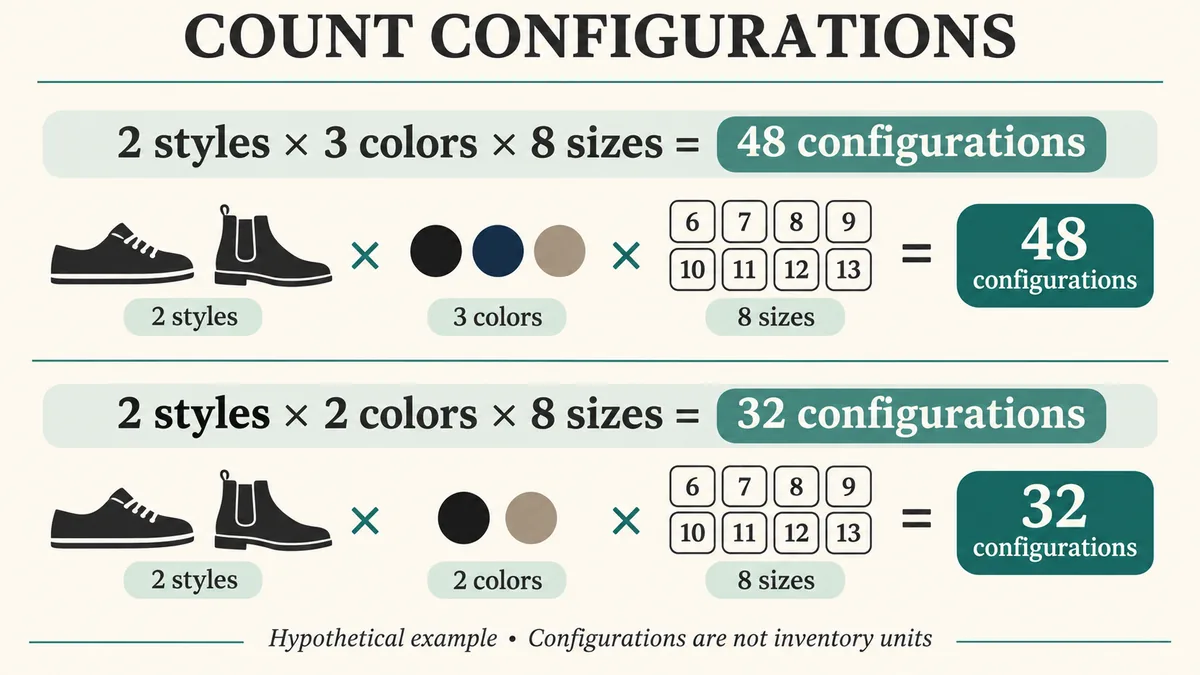
Every style multiplies by the colors and sizes it is offered in. A hypothetical women's range, assuming every listed color and size is offered on every style, shows how quickly the count of proposed variants grows. These are variants, not units you must produce or stock.
| Range version | Styles | Colors per style | Sizes per style | Configurations |
|---|---|---|---|---|
| Initial idea | 2 | 3 | 8 | 48 |
| Near-duplicate color removed | 2 | 2 | 8 | 32 |
Suppose the founder notices that two of the three colors, black and dark navy, would look almost the same online, and customer feedback suggests both would meet the same need. Dropping one cuts the count from 48 to 32. Screen appearance alone won't show whether some customers still want both, so check that before cutting. These numbers are illustrative only, not a recommended range size.
Run the same check on materials. For each option, ask whether a customer would choose it over its neighbor or whether it only makes the line sheet look fuller. Sizes and widths need a different test, because adjacent sizes and widths fit different feet. Base that coverage on your target customers' foot dimensions and fit needs, your demand evidence and what the partner can produce, and don't drop a size or width because it sits close to the next one.
Quantities Are a Separate Decision
Counting configurations tells you how many variants you plan to offer, not how many of each to make. Quantity per configuration is a separate decision, based on your demand evidence, expected size spread and cash, and not every listed variant has to be made or stocked up front.
Keep it apart from a partner's minimum order quantity (MOQ). An MOQ is a production condition the supplier sets. Before you commit to material development, ask how the partner applies minimums and whether your proposed configuration is feasible; final quantities and terms depend on the actual brief, materials and construction. Plan your quantities from what you expect to sell, then check the plan against the conditions the partner confirms. No range size suits every brand; it depends on your customer, channels and budget.
Turn Styles Into Briefs and Samples
What Each Brief Needs
A brief turns a style into something a developer can assess and sample. For each style, prepare:
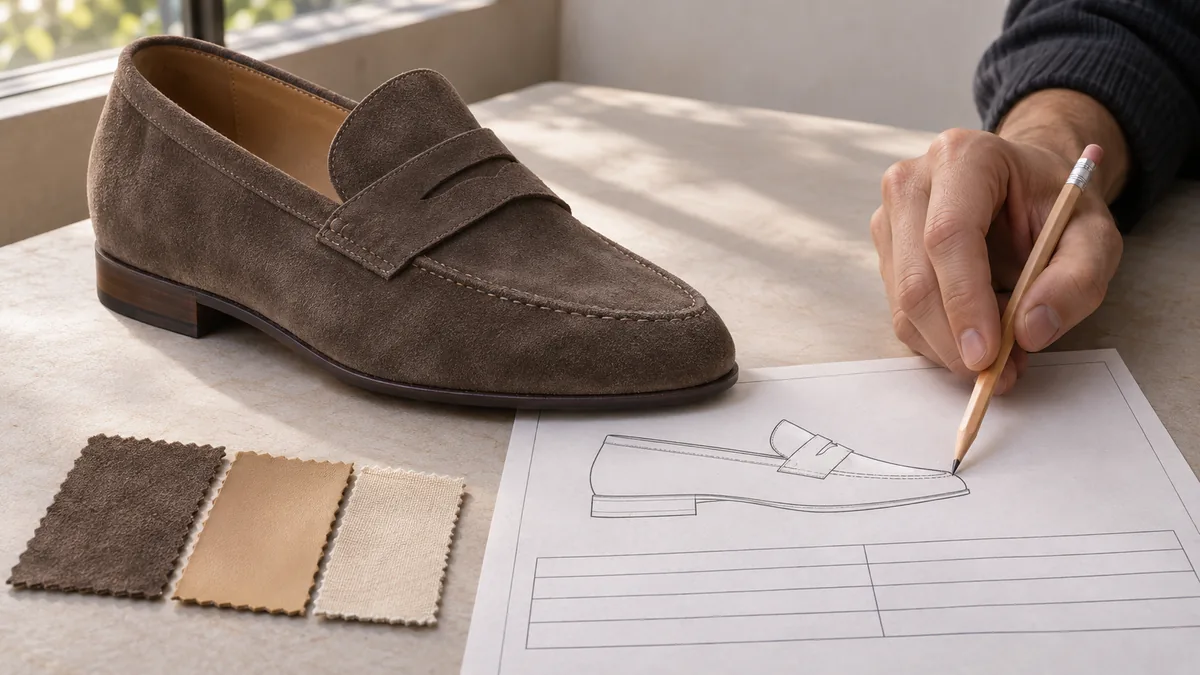
- References: sketches, tech packs, photos or a physical shoe that shows the direction.
- Construction direction: the intended build and key features, such as how the sole attaches, how firm the heel counter should be and whether the insock is fixed or removable.
- Size direction: the sizing system, size range and fit notes for your customer.
- Materials: intended upper, lining and sole materials, plus acceptable alternatives.
- Branding: logo placement, labels and packaging.
- Open decisions: anything still undecided, flagged as open rather than presented as final.
Flagging open decisions can save sample rounds. A developer who knows the toe shape is still open can propose options; one who assumes it is fixed may sample the wrong thing.
Existing Design or New Development: Describe the Change Scope
Instead of choosing between private label and original design, describe how much has to change. The options form a spectrum:
- your branding on an existing base design
- new colors, materials or trims on an existing base
- a modified upper pattern on an existing last and sole
- a new last, pattern or outsole
Further along the spectrum, expect more development decisions, more sample review and possibly new tooling, such as a mold for a new sole. Either end can be sold under your brand. Private label usually describes a third party making a product to your specifications, which can include an original design, while some providers call a pre-made product with only your branding white label. Ask what a program covers and whether the changes you want are feasible. For more on branded production, see private label shoes.
Write the change scope as a short line, such as this hypothetical one: “existing loafer base, new suede colorway, our own insock print and box.” That gives a partner something concrete to assess.
Samples Review Direction
A physical sample lets you check shape, fit, materials and finish in ways a drawing can't. What you learn informs later production decisions, so record what each sample represents. An early prototype might use substitute materials or a single size; a later sample may be close to the final specification. Note which it is, what you approved and what still has to change.
Feasibility and commercial conversations can run alongside sampling, as long as everyone knows which sample a price discussion refers to. For the steps between pattern and finished pair, see how shoes are made.
Map Money to Decisions and Dates
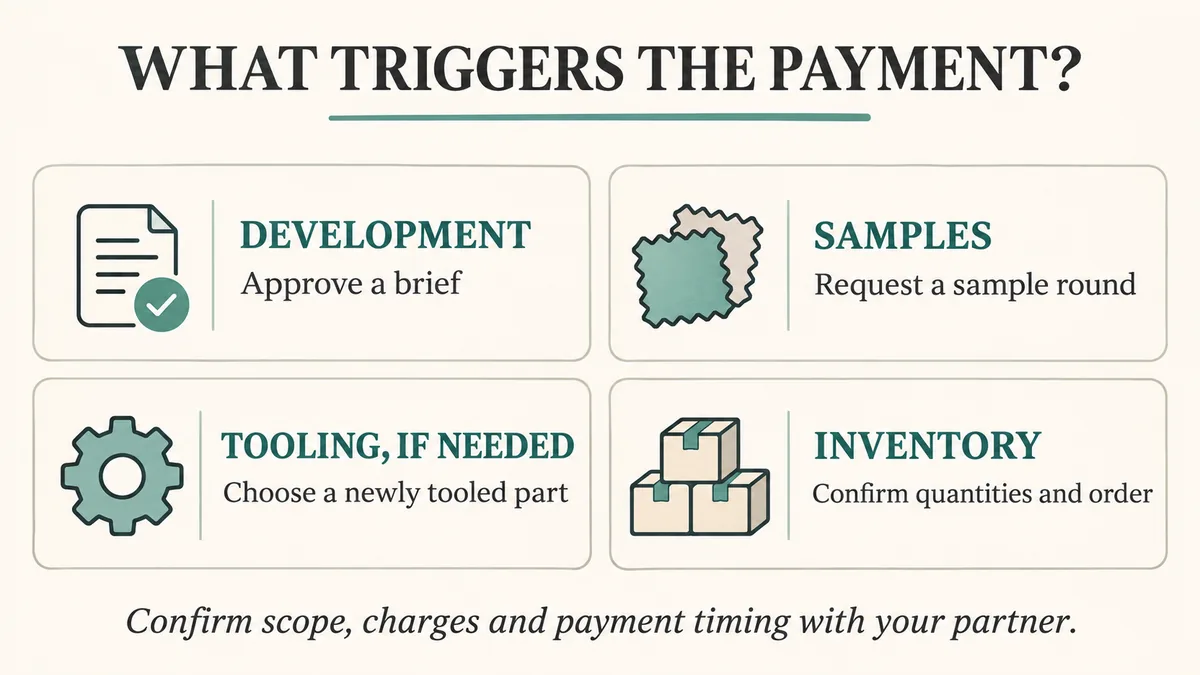
Know what you will spend money on and when each payment may fall due before you commit to an order or look for funding. The SBA suggests sorting expenses into one-time and recurring costs. Footwear startup planning adds categories such as development, tooling, product and shipping.
| Category | One-time or repeated | When payment may be needed | Triggering decision |
|---|---|---|---|
| Development | Ask what the agreed scope covers and how further changes are charged | When development starts or at agreed stages | Approving a brief for development |
| Samples | Ask whether sample rounds are included or charged separately | At each sample round, if charged | Requesting a new or revised sample |
| Tooling, if needed | Ask what each tool covers and how changes or replacements are charged | As agreed, before new parts are made | Choosing a new sole, last or other tooled part |
| Inventory | Repeated with each order | Under agreed order terms | Confirming quantities and placing an order |
| Packaging | Repeated; artwork setup may be one-time | Before or with production | Approving box, label and insert artwork |
| Delivery | Repeated per shipment | Around each shipment | Choosing shipping method and destination |
| Marketing | Repeated, with possible one-time launch costs | Before and after launch | Setting the launch plan and channels |
| Professional support | One-time setup, possibly ongoing fees | When you engage advisers | Hiring legal, accounting or design help |
Add costs specific to your business, such as a website, insurance and licenses. Fill in amounts only when you have a basis for them, and replace estimates with quotations as partners respond. The completed table is an estimate of your cash commitments and their timing. It can't guarantee you have enough, but it links each payment to the decision that triggers it, so you can hold a commitment until that decision is settled. For example, before paying for a new sole mold, record which design revision it is based on, which checks still have to be agreed and what changes the payment covers.
Prepare a Useful Partner Discussion
Asking a supplier “do you make shoes?” gives them little to respond to. Bring:
- product references for each style
- fit and size direction
- intended materials and branding
- open questions, written down
- the expected configuration of styles, colors and sizes
- who makes development decisions: you, your designer or the partner
- the service you need, whether design, development, supply or a combination
Be specific about the service. Some footwear consultancies offer design and development but expect founders to bring their own supplier, while some suppliers handle development as well as production. Mention your current stage, rough schedule and any budget direction you are comfortable sharing, so the partner can judge whether the project fits.
Choose Channels and a Launch That Teach You Something
Match Channels to Fulfillment
The SBA notes that most businesses use a mix of channels and refine them over time. For a first shoe launch, pick channels you can serve: your own website, a marketplace, pop-up events, a few wholesale accounts or a combination.
Each channel raises fulfillment questions. Who stores the stock? Who picks, packs and ships? Who handles size exchanges, and can a returned pair be resold? Settle these before launch, because a fit problem can turn into an exchange or return request.
Pick a Feasible Launch Format
Keep the launch small enough to see what happened. A limited drop of the hero styles, a preorder window, a pop-up where people try samples or a soft launch to your waitlist can each produce clear feedback. Preorders aren't guaranteed to fill, and buyers will expect accurate delivery information. Pick the format your fulfillment setup can handle.
Evidence to Review Before Reordering
Before you reorder or add styles, review:
- sales by configuration: style, color and size
- size and fit comments
- return and exchange reasons
- questions customers asked before buying
- results by channel
Look for patterns. If one color outsold its neighbor across sizes, that shapes the next range edit. If fit comments cluster around particular sizes, revisit the size direction with your partner before the next order.
Handle Business Setup Where You Operate
For US businesses, the SBA groups launch tasks into these categories:
- business location
- business structure
- business name
- registration
- federal and state tax ID numbers
- licenses and permits
- a business bank account
- business insurance
Location affects which taxes, zoning rules and regulations apply, and where you sell, ship and import can add others. These are US examples, and requirements differ between countries, states and cities. Confirm what applies to your activities and markets with qualified advisers, and add product questions for each market, such as footwear labeling and import rules. Working through a checklist organizes the job; it doesn't make the business compliant by itself.
With setup underway, write your one-line customer proposition and configuration count, then turn your hero styles into briefs and take them to a development partner to request first samples.
Frequently Asked Questions
How much does it cost to start a shoe brand?
No single figure is reliable, because cost depends on the range, construction, materials, quantities and channels. Build your own estimate: list development, sample rounds, any new tooling, inventory, packaging, delivery, marketing and professional support. Mark each as one-time or recurring, note when payment may fall due, and update the list as real quotations arrive.
Is private label the opposite of developing my own shoe design?
No. Private label usually means a third party makes a product to your specifications for sale under your brand, and those specifications can include an original design. Development scope describes how much changes: your branding on an existing base, new materials and colors, or a new last and sole. Providers name these programs differently, so describe the changes you need and ask what the program covers, including rights, and what development, sampling and possible tooling are involved.
How many styles should a first shoe range include?
No number fits every brand. Start from your customer and the hero styles that carry your proposition, then multiply styles by the colors and sizes you plan to offer on each to count configurations. Remove colors or materials that duplicate each other, such as two colors your customers say they would barely tell apart, but set sizes and widths by fit needs. Aim for enough choice to test the idea and few enough configurations to develop, fulfill and review within your capacity.
Do I need to know the MOQ before I start sampling?
Not as a fixed number, but ask early. Before significant sample or tooling commitments, ask how a partner sets minimums and whether your expected configuration looks feasible; final terms depend on the specific brief, materials and construction. Bring references, fit and size direction, intended materials and branding, open questions, your expected configuration and a clear answer on who owns development decisions. Plan your own quantities separately, from demand evidence.
What business setup do I need before selling shoes?
In the US, the SBA's launch categories cover location, structure, name, registration, tax ID numbers, licenses and permits, a business bank account and insurance. Requirements vary by country, state and city, so confirm them with local advisers. Check the product rules for your market too, such as labeling and import requirements, before your shoes go on sale.
About TLSTAGE
Since 2012, TLSTAGE has been your trusted one-stop fashion supply partner from Guangzhou, China—specializing in women's footwear, apparel, bags, and accessories.
What started as a specialized footwear supplier has grown into a full-range fashion supply partner, driven by client trust and proven by consistent quality across every product category.
- 20+Years Industry Expertise
- 30+Countries Served
- 300+Global Buyers Trust Us
- FlexibleMOQ by style and project