
There is no universal shoe labor cost in China—and there is no single Fujian rate that a buyer can safely multiply by every style. A defensible labor cost per pair comes from three things: the approved production method, the standard minutes required by that method, and the factory-specific cost of a working minute. The quotation must also state how production efficiency is handled. This article explains labor-cost calculation only. For materials, tooling, packaging, logistics, and total FOB cost, see our complete shoe manufacturing cost guide.
This distinction matters when comparing suppliers. A low cost per minute does not guarantee a low cost per pair. One factory may need fewer minutes because its method, equipment, skills, and line balance suit the style. Another may quote a lower rate but require more time or exclude operations shown elsewhere in the quotation.
For buyers, the useful question is not “What is the Fujian labor rate?” It is:
> What standard minutes, efficiency convention, labor burden, overhead, and production operations are included in this style’s labor cost?
| Costing term | What it tells a buyer | What it does not tell you |
|---|---|---|
| Employee wage | What a worker is paid under a defined wage basis | The complete factory cost of one productive minute |
| Standard Minute Value (SMV) | Standard time for specified operations under defined conditions | Actual elapsed time on every production line |
| Standard Allowed Minutes (SAM) | Standard time with relevant allowances | A universal number for all factories or constructions |
| Labor minute value | Employer labor cost for one minute of worker capacity | Indirect labor and general factory overhead unless defined that way |
| Working minute cost | Labor burden plus the stated overhead cost per minute | Material, tooling, packaging, freight, duty, and supplier margin |
| Labor cost per pair | The labor result for one defined shoe specification | The shoe’s total ex-factory or landed cost |
What Shoe Labor Cost per Minute Actually Means
Footwear costing begins with work content. The shoe is divided into operations, and their time is measured or estimated under a defined method. Costing systems commonly express this work as standard time in minutes.

That time is not yet a price. A supplier must convert minutes into money using a rate built from its own employment and operating costs. The terms can vary between factories, so buyers should confirm the definition rather than assume that every “cost per minute” includes the same items.
Labor minute value
Labor minute value starts with the employer’s labor cost and available worker capacity. Depending on the costing system, labor cost may include base pay, bonuses, overtime effects, payroll taxes, insurance, and other employer-paid items. Available minutes must use a consistent period and account for the working-time assumptions behind the payroll figure.
Factory labor minute value
Direct operators do not work alone. Warehouse staff, line supervisors, quality personnel, maintenance teams, production planners, and other support functions enable the line to run. A factory labor minute value allocates relevant indirect labor to the productive minutes used in product costing.
Working minute cost
The working minute cost adds defined overhead such as rent, utilities, maintenance, depreciation, and insurance. This is why dividing a monthly wage by calendar minutes cannot produce a reliable shoe assembly rate.
Materials, molds, packaging, logistics, and margin remain outside this labor calculation unless the supplier explicitly defines a broader rate. For those layers, use a complete shoe manufacturing cost analysis rather than treating labor as the whole quotation.
The Four Inputs Behind Labor Cost per Pair
A buyer-ready calculation needs four documented inputs.
1. Standard minutes for the approved method
The time must correspond to a specific shoe, construction, materials, size basis, and production method. A stock-sole sample estimate cannot remain unchanged after the buyer adds upper panels, difficult materials, reinforcement, or a different bottom construction.
The standard should identify which operations are included. At minimum, buyers should understand the treatment of cutting, preparation, stitching or closing, lasting, sole attachment, finishing, inspection, and packing.
2. Factory-specific labor burden
The rate should be based on the supplier’s relevant employer labor cost—not only take-home pay or the legal wage floor. Ask which pay elements and employer contributions are included and which period the calculation represents.
This does not mean a buyer is automatically entitled to private payroll records. It means both sides need a clear definition. A supplier can provide the costing basis, inclusions, and effective date without disclosing every employee’s compensation.
3. Indirect labor and overhead
Determine whether support labor and overhead sit inside the minute rate, appear as separate quotation lines, or are absorbed into a factory margin. None of these formats is automatically wrong. The problem occurs when one supplier includes these costs and another excludes them, yet the buyer compares the two minute rates as if they were equivalent.
4. Efficiency convention
Standard minutes usually describe work at a defined performance level. Actual line time changes with operator familiarity, balance between stations, material behavior, machine availability, rework, and style changeovers.
A simplified buyer formula is:
Labor cost per pair = efficiency-adjusted production minutes × working minute cost
The important qualification is that some factories already calculate their minute rate against earned standard minutes at a target efficiency. Others start with paid or available minutes and adjust the style minutes separately. Applying an efficiency factor twice overstates cost; omitting it from both sides understates cost. Ask the supplier where efficiency enters the calculation.
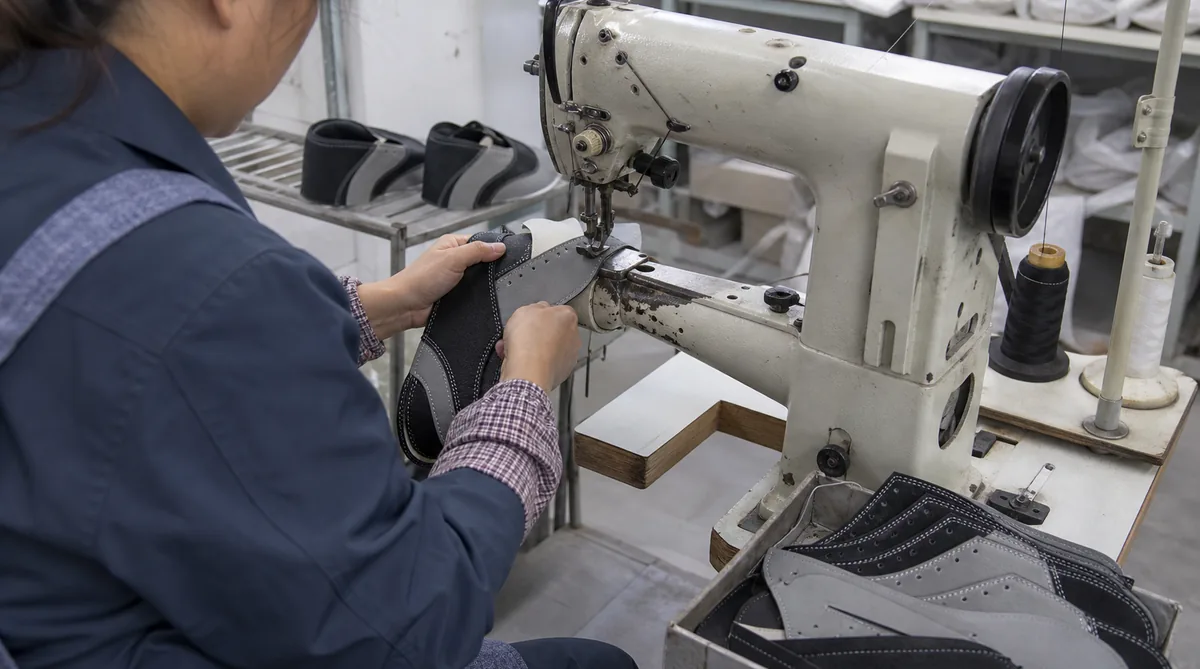
Where Labor Minutes Accumulate in Shoe Production
Labor is distributed across the full production route, not only final assembly. Understanding how shoes are made helps a buyer connect design decisions to cost.
Cutting and preparation
Upper materials, linings, reinforcements, foam, and small components must be cut, marked, paired, skived, split, laminated, or otherwise prepared. Material behavior affects handling. A stable synthetic panel and a soft, stretch-prone textile may require different control even when their outlines look similar.
Stitching and upper closing
Each panel, seam, reinforcement, binding, eyelet treatment, label, and decorative operation adds handling and machine time. The number of visible seams is only part of the story. Curved seams, tight tolerances, multiple material thicknesses, matching requirements, and frequent machine changes can slow the method.
Lasting and bottom assembly
The upper must be shaped over the last and joined to the bottom construction. Preparation, roughing, priming, cement application, activation, pressing, setting, and cleaning requirements depend on the approved construction and materials. A costing estimate should reflect the actual tested method, not a generic “sneaker” route.
Finishing, inspection, and packing
Thread trimming, cleaning, lacing, shape correction, inspection, labeling, tissue placement, and packing also consume time. Buyers sometimes focus on stitching minutes and overlook the labor created by demanding cosmetic standards or complex pack-out instructions.
Operation-level visibility is more useful than one unexplained total. It helps the product team identify where time accumulates and whether a design change removes work or merely moves it to another station.
Why Fujian Has No Single Labor Cost per Minute
Fujian is a major footwear-production region, but geography alone does not determine a factory’s minute cost. Even within the province, wage floors vary by locality. The standards effective from April 2025 place Jinjiang and several Quanzhou districts in a tier with a monthly minimum wage of RMB 2,195 and a non-full-time hourly minimum of RMB 23.
Those figures are legal wage references, not a quotation rate for shoe assembly. The non-full-time hourly standard should not be substituted for a full-time factory payroll calculation, and neither figure includes a complete allocation of indirect labor, overhead, productive capacity, or style efficiency.
Official 2025 Fujian statistics also show different averages for private and non-private manufacturing employers. They cover broad populations, not footwear operators or a particular production line.
Two partner factories in the same area can therefore have different working minute costs because of:
- Workforce mix and skill distribution
- Compensation structure and employer-paid costs
- Ratio of direct operators to support staff
- Equipment, maintenance, and depreciation
- Building and utility costs
- Product specialization and line utilization
- Efficiency assumptions and production planning
- Which cost items are included in the quoted minute rate
Regional data is useful for a reasonableness check. It is not a substitute for factory-specific costing.
How Design and Construction Change Labor Minutes
The most actionable labor-cost decisions often happen before a purchase order is placed.

More parts create more handling
Additional overlays, underlays, reinforcements, labels, trims, and decorative components create cutting, preparation, positioning, stitching, and inspection work. A feature that looks small on a rendering can touch several operations.
Materials change the method
Stretchy knit, soft leather, high-friction linings, thick foam packages, and components with difficult edges may need different feeding, stabilization, skiving, adhesive preparation, or operator control. Substituting a cheaper material does not guarantee lower total cost if it adds handling time or quality risk.
Tight cosmetic standards add finishing work
Light colors, reflective surfaces, high-gloss components, contrast stitching, and precise panel matching can increase cleaning and inspection requirements. The specification should define the acceptance standard so the supplier prices the expected result rather than adding a broad uncertainty allowance.
New constructions carry learning effects
Early estimates may change after pattern engineering, sample trials, and production-method confirmation. Buyers should label each costing version—concept estimate, development quote, confirmation-sample quote, or production quote—so an early assumption is not mistaken for a locked result.
How Buyers Should Audit a Labor-Cost Quotation
You do not need every internal accounting record to ask disciplined questions. Use this checklist:

- Lock the style version. Confirm the tech pack, material list, construction, last, outsole, size basis, colorway, and pack-out used for costing.
- Request the operation boundary. Identify whether minutes include cutting, preparation, closing, lasting, bottom work, finishing, inspection, and packing.
- Ask for the standard-minute basis. Determine whether the figure comes from time study, a predetermined method system, historical production, a similar style, or an early estimate.
- Clarify allowances. Ask whether machine, personal, handling, bundle, and unavoidable-delay allowances are already included.
- Locate efficiency. Confirm whether efficiency adjusts the standard minutes, the minute rate, or another part of the calculation.
- Define the minute-rate boundary. Check direct pay, employer costs, indirect labor, overhead, depreciation, and other inclusions.
- Separate labor from other cost layers. Materials, tooling, packaging, testing, logistics, commission, and margin should not disappear inside an unexplained number.
- Record currency and effective date. Wage, exchange-rate, energy, and utilization assumptions can change, so the quotation needs a valid time basis.
- Recheck after sample approval. Update labor assumptions when the confirmed production method differs from the first costing sample.
A supplier that cannot disclose confidential payroll detail may still explain its formula, inclusions, method, and assumptions. That is enough to make the conversation more useful than simply demanding a lower price.
How to Compare Two Suppliers on the Same Basis
Start with the same specification. If Supplier A prices a stock component and basic carton while Supplier B includes a custom component, additional finishing, and retail-ready packing, the labor totals are not comparable.
Create a normalization sheet with the following fields:
- Style and revision number
- Costing sample date
- Included production operations
- Standard minutes by major process group
- Efficiency convention
- Working minute cost definition
- Separate overhead or margin lines
- Excluded buyer-nominated processes
- Quality and testing assumptions
- Packaging boundary
- Incoterm, currency, and quotation validity
Then investigate the difference. A higher result may indicate inefficiency, a more complete cost boundary, a realistic production route, or operations omitted from the lower quote.
The goal is not identical factory accounting. It is enough transparency to understand whether the quotes describe the same shoe and the same work.
How to Reduce Labor Cost Without Lowering Quality
Responsible cost reduction removes unnecessary work rather than forcing an unsupported wage assumption.
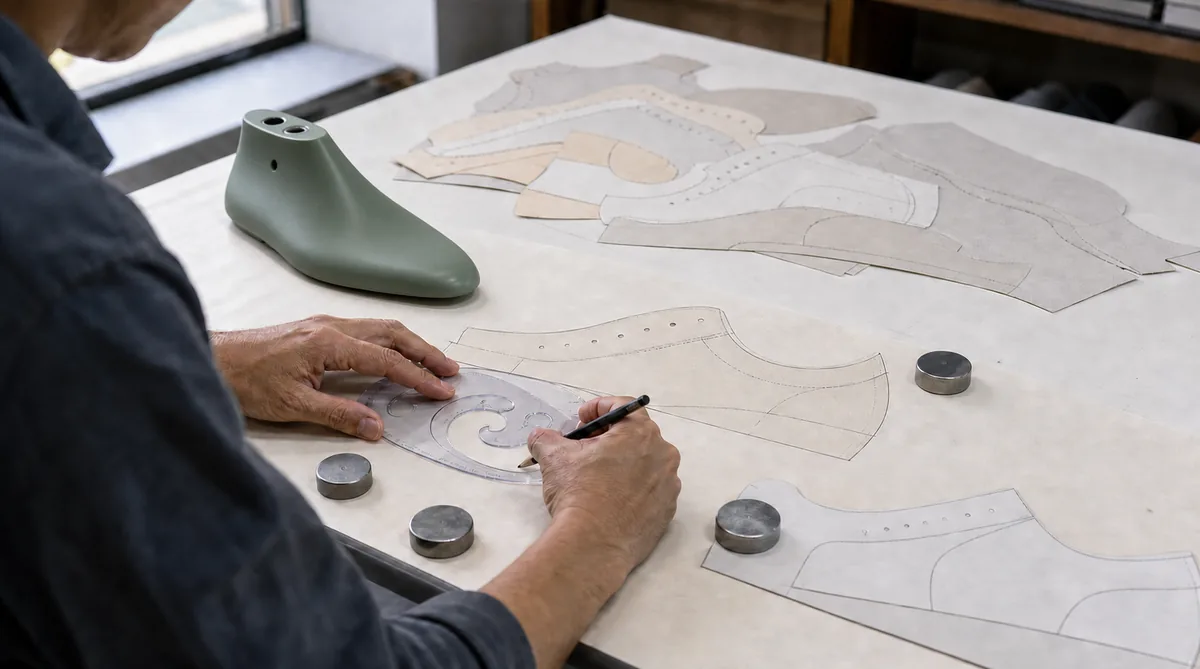
- Simplify construction deliberately. Reduce panels, decorative seams, separate reinforcements, or difficult edge treatments when they do not add customer value.
- Design around stable methods. Reuse proven constructions, components, and machinery where they still meet the product brief.
- Improve the tech pack. Clear material callouts, tolerances, stitch requirements, artwork positions, and pack-out details reduce uncertainty and repeated handling.
- Review operations with the sample. Ask which features create the most minutes and test alternatives before final approval.
- Protect critical quality steps. Do not remove bonding preparation, inspection, curing, or other necessary controls merely to cut minutes.
- Plan realistic quantities. TLSTAGE supports flexible MOQ discussions, but quantity, customization, price, and the selected partner-factory arrangement must be evaluated together.
For a new private-label shoe development, the best time to discuss labor is while construction choices can still change—not after the production method and retail price are already locked.
Frequently Asked Questions
What is the average shoe labor cost per minute in China?
There is no reliable universal average for product costing. The result depends on factory payroll costs, indirect labor, overhead, available capacity, efficiency, included operations, and the shoe’s construction. A regional wage figure is context, not a complete working minute cost.
Can I calculate shoe labor cost from Fujian minimum wage?
Not accurately. Minimum wage is a legal pay floor, while product labor cost must also address employer-paid costs, support labor, productive minutes, overhead, efficiency, and the standard time for the style. The official non-full-time hourly minimum is also not a substitute for a full-time factory cost model.
What is the difference between SMV and SAM?
SMV describes the standard time for an operation under a defined method and performance basis. SAM adds relevant allowances to the standard work content. Terminology varies, so a buyer should request the supplier’s definition and confirm whether efficiency is applied afterward.
How does factory efficiency affect labor cost per pair?
When actual production requires more time than the standard basis, the same style consumes more paid capacity. The costing system must account for that difference. Buyers should verify where the efficiency adjustment appears so it is neither omitted nor applied twice.
Why can two factories quote different labor costs for the same shoe?
They may use different production methods, standard minutes, workforce structures, equipment, overhead allocations, efficiency targets, or cost boundaries. They may also be pricing different interpretations of the specification. Normalize the style and inclusions before treating the difference as a price problem.
Can a sourcing partner help verify footwear labor assumptions?
A sourcing partner can coordinate questions across candidate partner factories, compare costing boundaries, and connect design changes with quotation updates. The factory remains the source of its own confidential cost inputs, while the buyer and sourcing partner can require a clear, comparable explanation of the method.
Turn Labor Cost Into a Better Sourcing Decision
Shoe labor cost is useful only when it is tied to a defined product and a transparent calculation. Start with the approved method, establish the standard minutes, define the working minute cost, locate the efficiency adjustment, and confirm every included operation. Then compare suppliers on the same basis.
TLSTAGE is a Guangzhou-based B2B fashion sourcing and trading company. We coordinate footwear development and production through partner factories rather than presenting one factory’s rate as a universal China benchmark. If you want to compare labor assumptions for a specific style, share your product requirements, tech pack, materials, target quantity, and timing so the discussion can be based on the actual project.