
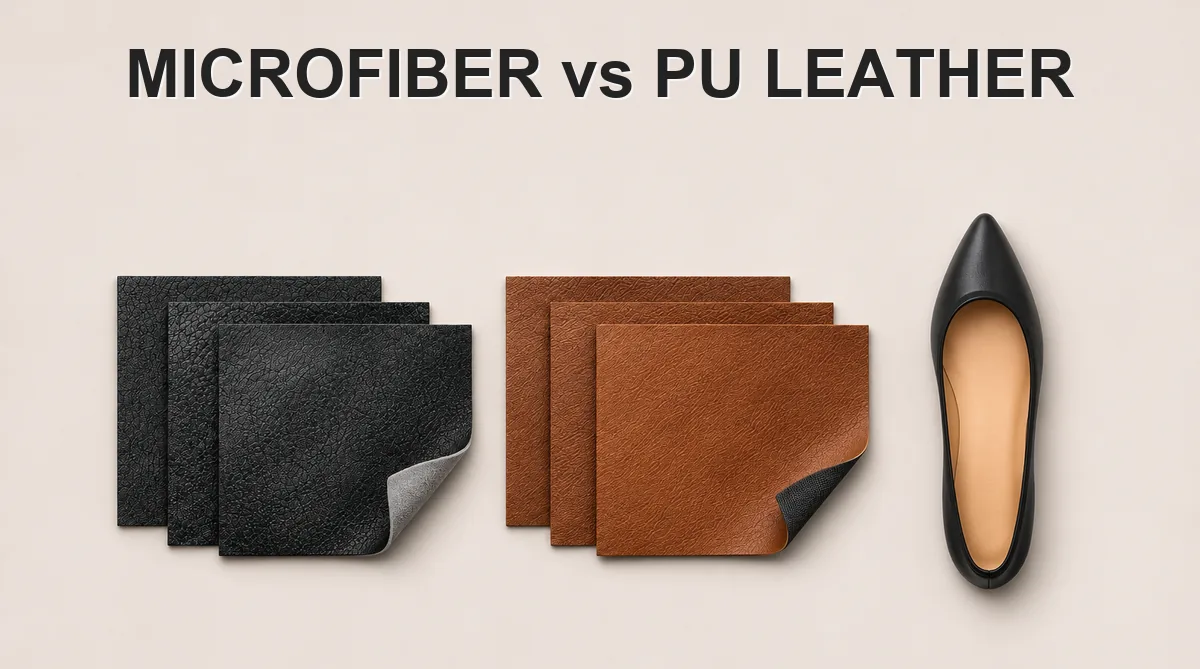
Microfiber leather vs PU leather compares two leather-like materials built on different bases: microfiber leather is a synthetic sheet built on a dense nonwoven of ultra-fine fibers, while PU leather usually means a PU surface layer on a conventional textile backing, often woven or knit. In microfiber leather, the nonwoven is impregnated with polyurethane (PU), then either coated for a smooth or grained face or buffed and napped for a suede-like face. Neither is processed animal hide.
Because both typically contain PU, the meaningful difference is the base. It can influence how a material cuts, skives (is thinned at the edge), folds and behaves on the last, the foot-shaped form a shoe is built around. Durability, breathability and peeling resistance depend on the specific grade and need named tests on production-representative samples.
What Microfiber Leather Is
In synthetic leather, “microfiber” describes the base: a nonwoven sheet of very fine synthetic fibers rather than a woven or knit cloth.
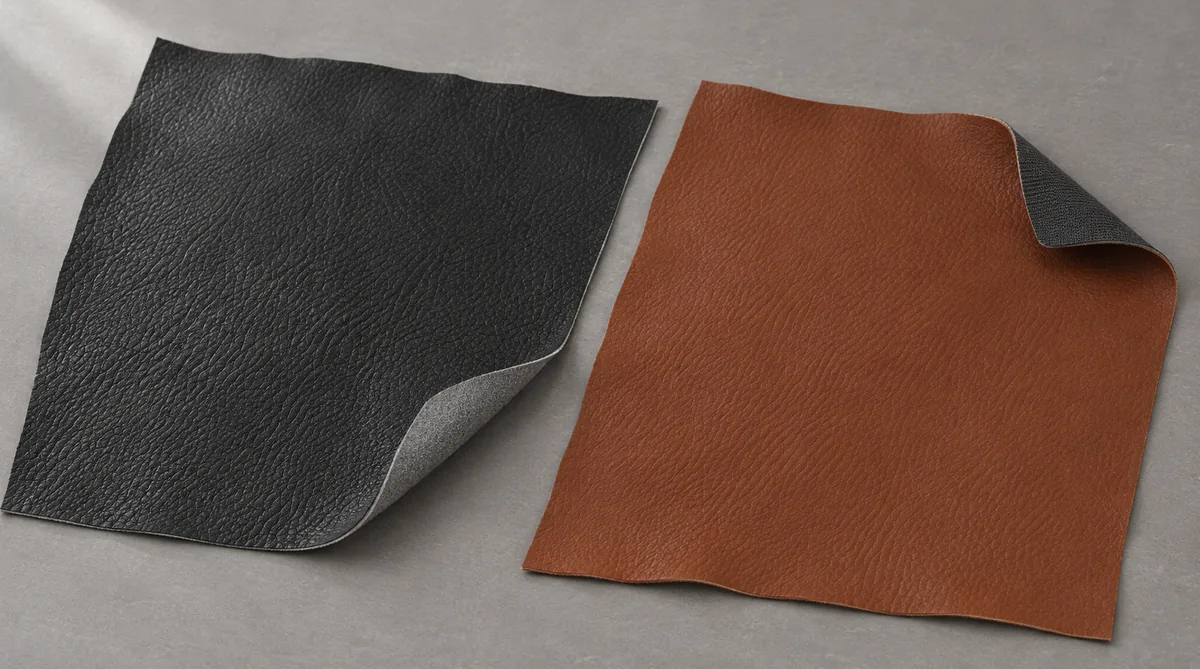
Kuraray publishes the route for its CLARINO material; other producers may differ. Two polymers are spun into an “islands-in-the-sea” fiber, with fine filaments of one dispersed in the other. The fibers are carded into a web, needle-punched into a nonwoven and impregnated with PU. One polymer is then extracted, leaving microfiber bundles held in porous PU, which Kuraray calls the substrate.
The substrate is finished as either:
- Grain type: Coated with PU, with adjustable gloss and grain texture.
- Suede type: Buffed, napped and dyed to raise a soft fiber surface.
In product development, treat these as two materials even when they share a base.
What “PU Leather” Usually Means
In this comparison, “PU leather” means a PU film or coating on a textile backing, often woven or knit. The trade label covers more: some PU-surfaced materials use nonwoven backings, and PU coatings are also applied to leather. The name alone doesn't identify the backing, so an animal-free description needs documented composition for the actual material.
That overlap explains the label “PU microfiber leather.” “PU” names the polymer and “microfiber” names the base, so most microfiber materials are also PU materials. The useful question is what the PU sits on.
Not the Same as Microfiber Cloth
Microfiber cloth and upholstery fabric are textiles made from fine synthetic fibers in various constructions, not PU-impregnated nonwoven sheets. Advice written about them doesn't transfer to shoe uppers. In footwear, you are almost certainly comparing grain-type or suede-type microfiber against a PU-coated fabric.
Microfiber Leather vs PU Leather: Base and Surface Comparison
The table describes typical constructions, not grades.
| Point | Microfiber synthetic | PU-coated textile | Still needs checking |
|---|---|---|---|
| Base | PU-impregnated nonwoven of ultra-fine fibers | Textile backing, often woven or knit | Grade, density and bonding of the actual base |
| Surface | Coated (grain type) or napped (suede type) | PU film or coating, often embossed | Finish behavior after flexing or ageing |
| Cut edge | Kuraray describes fray-free edges for CLARINO | Depends on backing; woven or knit edges may need folding or sealing | Your candidate's edge |
| Skiving | Kuraray describes CLARINO as compatible with skiving | Depends on construction | Whether your thickness skives cleanly |
How the Base Shows Up in Shoemaking
Differences in base usually become visible during the cutting, skiving and lasting stages.
Cutting and edges. A nonwoven base has no warp and weft to unravel. A PU coating on woven or knit fabric may show textile at the cut edge, which can push a design toward folded, bound or sealed edges, so decide edge treatment early.
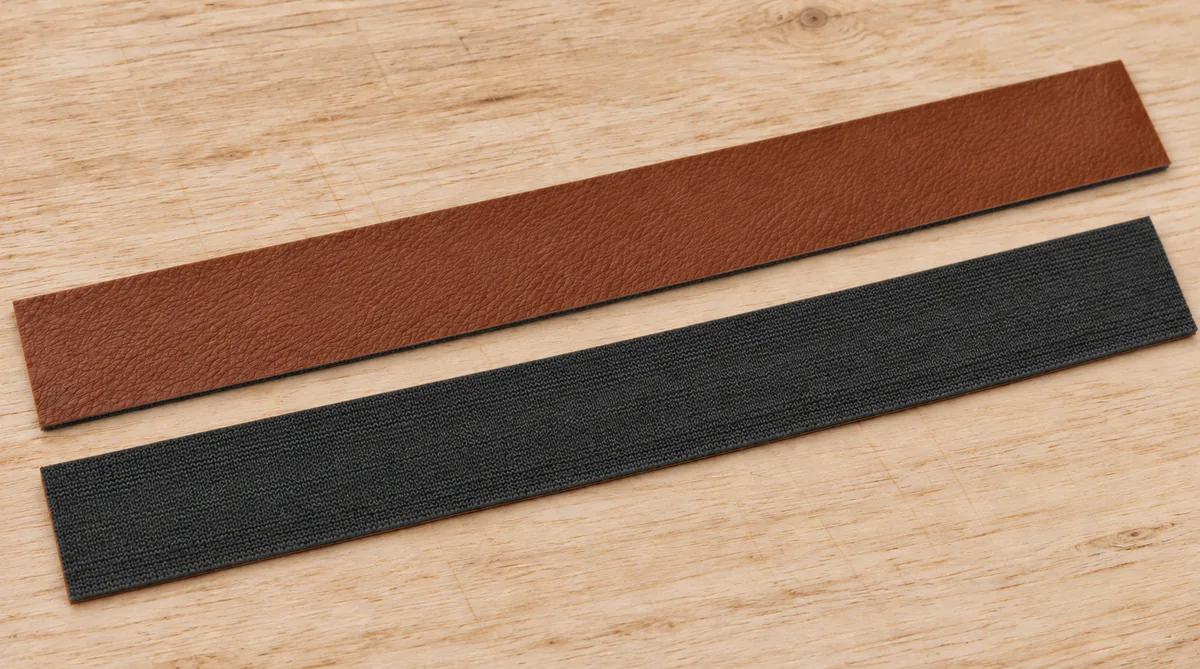
Skiving. Clean thinning depends on how well the base holds together when shaved and, for coated fabric, how firmly the coating is bonded to the backing.
Lasting and flex. Pulling the upper over the last under tension can expose what a flat swatch hides: wrinkling, stretch that doesn't recover, a coating that whitens or lifts at a fold, or backing showing through the face. A knit backing may stretch where a nonwoven does not, which can help or hurt depending on the pattern.
Stitching, holes and bonding. Needle holes, punched holes and buckle slots concentrate stress, and behavior there depends on grade, thickness and reinforcement. Bonding depends on the back of the material and the adhesive. Check both on the actual assembly; approval with one adhesive or lining doesn't automatically cover another.
Reasons to Shortlist Each Construction
- Microfiber synthetic: Raw or skived edges are part of the design, a denser nonwoven hand suits the style, or you want grain and suede versions from one base family.
- PU on textile: A particular surface, emboss or hand is the priority, or the backing's stretch or drape suits the pattern.
Cost varies by grade and build, so compare quotes for the exact grade and construction rather than by category.
Screening is not testing. Cutting a strip, folding an edge, hand-creasing a swatch and lasting a mock-up help narrow a shortlist. They don't establish standardized flex, adhesion or abrasion performance.
Applying It to Women's Styles
Pumps and Flats
Thin, soft uppers face lasting tension around a close-fitting toe and creasing of the vamp (the upper over the toes) with every step.
- Risk to observe: Whether the face folds into a soft crease or a sharp line.
- Next check: SATRA TM25, Vamp flex test – resistance to creasing and cracking, on your thickness and finish. It flexes a specimen repeatedly in a crease pattern simulating the vamp during walking, then examines it visually. If the design is perforated, record that as a build variable and test perforated specimens.
Narrow Sandal Straps
On a narrow strap, the edge is most of what the customer sees, and stress concentrates at buckles, punched holes and the sole join.
- Risk to observe: A raw edge exposes the base; a folded or bound edge can make a woven or knit backing a non-issue.
- Next check: Settle edge treatment before choosing the material, inspect edges after cutting and folding, and treat reinforcement at loaded holes as part of the build. If a strap tears there, the cause may be the material, its thickness or the reinforcement.
Boot Shafts and Folds
Shafts fold repeatedly, and slouch styles crease on purpose.
- Risk to observe: How the face behaves at a deliberate fold compared with a random one.
- Next check: TM25 can be run on wet or dry specimens at room temperature, or dry at sub-zero temperature. Consider the cold option where cold-weather wear matters to the style.
Lining and Sock-Lining Zones
Inside the shoe, materials face foot contact, heel abrasion, moisture and colorfastness demands. An upper approval doesn't make a material suitable for lining.
- Risk to observe: In one published SATRA case, a lining began to disintegrate at the heel within six months; the commentary noted possible heel slip from a loose fit and suggested the bulk lining was likely inferior to the one tested. A SATRA due-diligence article also poses a hypothetical in which dye from a red lining transfers to a child's damp socks.
- Next check: Specify the lining as its own component, with its own abrasion and colorfastness checks.
Wear, Cracking, Peeling and Hydrolysis
These four problems are often lumped together as “the material failed.” Each needs different evidence.
| Symptom | Possible mechanism | Relevant evidence |
|---|---|---|
| Surface wear, rub-through, shine | Abrasion | SATRA TM31, Abrasion resistance – Martindale method |
| Cracks along crease lines | Flex cracking | SATRA TM25 |
| Film lifting or flaking, often at folds or edges | Coating separation | SATRA TM416, Determination of film or coating adhesion to base material |
| Cracking or flaking after time and moisture, sometimes while unworn | Possible PU hydrolytic deterioration | SATRA TM344 conditioning, then mechanical tests |
Choosing a Test Method
- TM31 assesses surface damage from rubbing against a standard fabric abradant, dry, wet or both.
- TM416 measures the force needed to peel a coating from its base, wet or dry. It applies where the coating is stronger than its adhesion to the base.
- TM344, Hydrolysis of polyurethane solings and polyurethane coated leathers, stores specimens in a warm, humid environment, then compares mechanical tests on treated specimens with untreated reference specimens. For PU uppers, typical follow-up tests include flex cracking, coating adhesion and colorfastness to rubbing. The conditioning periods are accelerated laboratory exposures and don't convert into years of wear.
Hydrolysis is a question for both constructions, because both usually contain PU. Published SATRA case commentary attributes this breakdown to time and moisture in air of normal humidity, names poor storage as another possible cause, and notes that getting wet makes it more likely. It doesn't distinguish microfiber from PU-coated fabric.
Diagnostic uncertainty: One symptom can have several causes, poor fit or heel slip can make wear worse, and bulk production may differ from the tested sample. Finding the actual cause may take expert examination of the failed shoe.
Breathability: Vapor, Absorption and Liquid Water
“Breathable” bundles together three separate properties:
- Water-vapor transmission: Moisture passing through the material.
- Moisture absorption: Moisture the material takes up and holds. SATRA notes that a low-permeability material can still keep the foot feeling dry if it absorbs moisture, which can evaporate once the shoe is off.
- Liquid-water resistance: Resistance to rain or puddles, measured by different methods. Good vapor results don't predict it, and a material's water resistance doesn't show that seams, stitch holes or the finished shoe keep water out.
Layer versus whole shoe. SATRA TM47, Water vapour permeability and absorption, can test a single material or an assembly such as outer, lining and a standard sock fabric. The setup simulates 100 percent relative humidity at foot temperature beneath the layers, with airflow equivalent to a brisk walk representing the outside. A finished shoe adds the sock-lining, any foam, adhesive and the construction itself, so an outer-only result describes part of that system. Ask for vapor data on the planned upper-plus-lining assembly, including any perforation, and don't treat a “breathable” claim as true of a whole category.
How to Compare Two Candidates Fairly
Test results are only relevant to the material and conditions tested. A controlled comparison uses:
- the actual grade, with the planned finish and color
- the intended thickness
- the same last, pattern, lining, adhesive and construction where feasible
- the same test method and conditions for each candidate
- production-representative samples rather than early prototypes
Where candidates can't be matched exactly, record the differences and compare each in its intended finished build. Results for one color may not cover a range, so record which color was tested. A coated and a napped version need separate review, and a substitute source, adhesive or lining needs re-checking on the actual assembly. Judge results against an agreed specification for the component, not a general impression.
Hypothetical Example: Choosing an Upper for a Strapped Flat
Hypothetical example. No real brand, product or test result is described.
A product developer is planning a private-label pointed flat with a thin ankle strap and is comparing a coated microfiber with a PU coating on a knit backing. Both are requested in the target color and finish at the closest available thickness and built on the same last, pattern and lining.
The knit candidate's raw strap edge shows textile. If the design can accept a folded or bound edge, the candidate stays and the edge treatment changes. If the design depends on a raw edge, it is dropped before any lab spending. Whichever candidates survive go to vamp-flex, coating-adhesion, abrasion, conditioned-versus-reference ageing and assembly vapor testing. If a candidate meets the agreed specification, it stays. If it falls short on a property that matters for this style, the next choice is a different grade, added reinforcement, or the other candidate.
For the broader process, see our guide to developing a private-label style.
Microfiber Suede, Genuine Leather and Accurate Descriptions
Microfiber suede. Shading can change with nap direction and lighting, so cutting layouts should keep pieces oriented consistently. Napped surfaces can attract dust and show handling marks. Review suede-type microfiber on its own rather than relying on a grain-type approval.
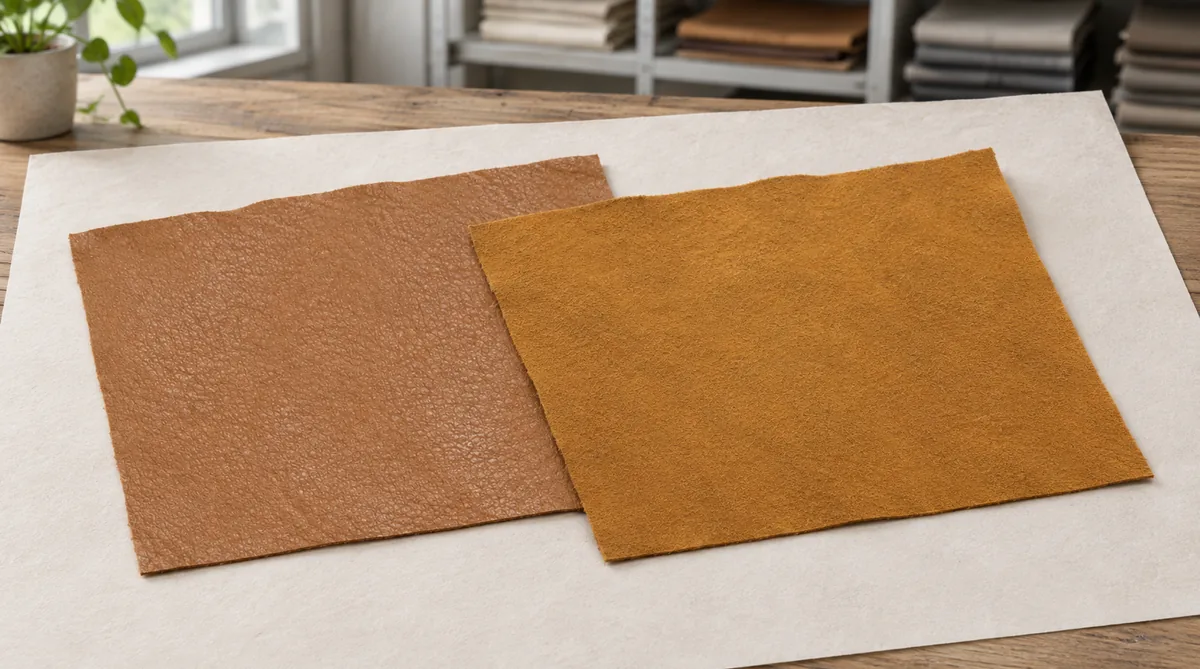
Versus genuine leather. Leather is processed animal hide; microfiber synthetics and PU-coated fabrics imitate its look and handle by different routes. How any of them compares on durability or comfort depends on the specific materials and tests, not the category.
Naming and care. Use terms like “microfiber synthetic” or “PU-coated fabric,” add “man-made” or “not leather” where the material looks like leather, and say whether a description covers the upper, lining and sock, or outsole. “Animal-free” describes composition and needs documented backing; it is not an environmental claim. Reserve “waterproof” for finished shoes whose seams and construction keep water out in intended use. Kuraray's washing guidance for CLARINO is brand-specific, so follow the care instructions for the material actually used, and don't assume leather conditioners suit a synthetic surface unless its maker says so.
Frequently Asked Questions
Is microfiber leather the same as the microfiber fabric used on couches or cleaning cloths?
No. Microfiber synthetic leather is a PU-impregnated nonwoven sheet that is then coated or napped. Microfiber cloth and upholstery fabric are textiles made from fine fibers in various constructions. Care tips and performance claims for one don't apply to the other.
Can you tell microfiber from PU-coated fabric by looking at the cut edge?
The edge can offer a clue. Visible woven or knit threads point toward a textile backing, while a dense, fibrous edge suggests a nonwoven. But some PU-surfaced materials also use nonwoven backings, and no visual or burn check proves construction. Rely on documented construction from the material's maker.
Why would synthetic shoes crack or flake after sitting unworn in a closet?
One possible cause is hydrolysis of the polyurethane, a breakdown linked to time and moisture in ordinary air; poor storage and getting wet can contribute. It can affect both microfiber and PU-coated materials. Coating adhesion problems or earlier flex damage are also possible, so symptoms alone can't confirm the cause.
How should microfiber or PU shoes be cleaned and stored?
Follow the maker's care instructions for the specific material, because finishes vary and washability claims are brand-specific. Don't assume leather conditioners suit synthetic surfaces. Store footwear with PU components somewhere cool, dry and well ventilated, and let shoes dry out fully before putting them away.
Does a good vapor-permeability result mean the finished shoe will feel dry?
Not by itself. A result for the outer material describes one layer. How dry a shoe feels also depends on the lining, sock-lining, any foam, the construction, and how much moisture the materials absorb and later release. An upper-plus-lining assembly test gets closer, but the finished shoe remains a larger system.
About TLSTAGE
Since 2012, TLSTAGE has been your trusted one-stop fashion supply partner from Guangzhou, China—specializing in women's footwear, apparel, bags, and accessories.
What started as a specialized footwear supplier has grown into a full-range fashion supply partner, driven by client trust and proven by consistent quality across every product category.
- 20+Years Industry Expertise
- 30+Countries Served
- 300+Global Buyers Trust Us
- FlexibleMOQ by style and project