
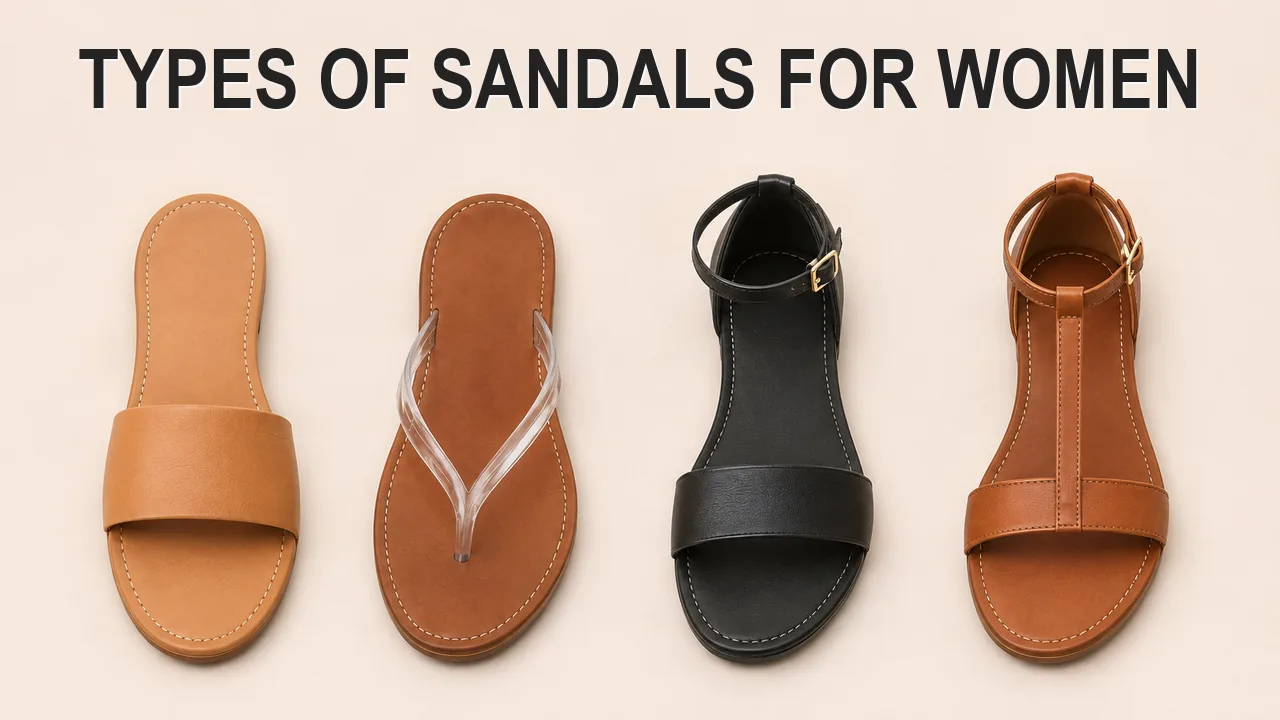
The types of sandals for women are easiest to sort by two separate things, how the straps hold the foot and what the sole profile looks like from the side. Upper layouts include slides, thong or toe-post, toe-loop, ankle-strap or slingback, T-bar, strappy, gladiator and woven huarache-type sandals. Base profiles include flat, heeled, wedge, platform and flatform. Retail names often combine one term from each group, and the labels overlap. A heeled toe-post sandal or a platform gladiator is an ordinary pairing, not a contradiction.
Reading a listing name as two fields tells you what the pair looks like and shows you what the name leaves out. A name can describe the strap arrangement and the sole shape. It cannot tell you the heel height, whether a strap adjusts, what the sole is made of, or what activity the maker intended. Those answers come from the product details, the seller and your own try-on.
Field 1: How the Upper Holds the Foot
This field covers the straps, loops and openings you can see. Look at where each strap starts and ends, whether anything sits behind the heel, and whether a buckle or tab is present. Retail labels here are not exclusive. One pair can be called strappy, T-bar and ankle-strap at once, which is fine as long as the description matches what you see.
Slides
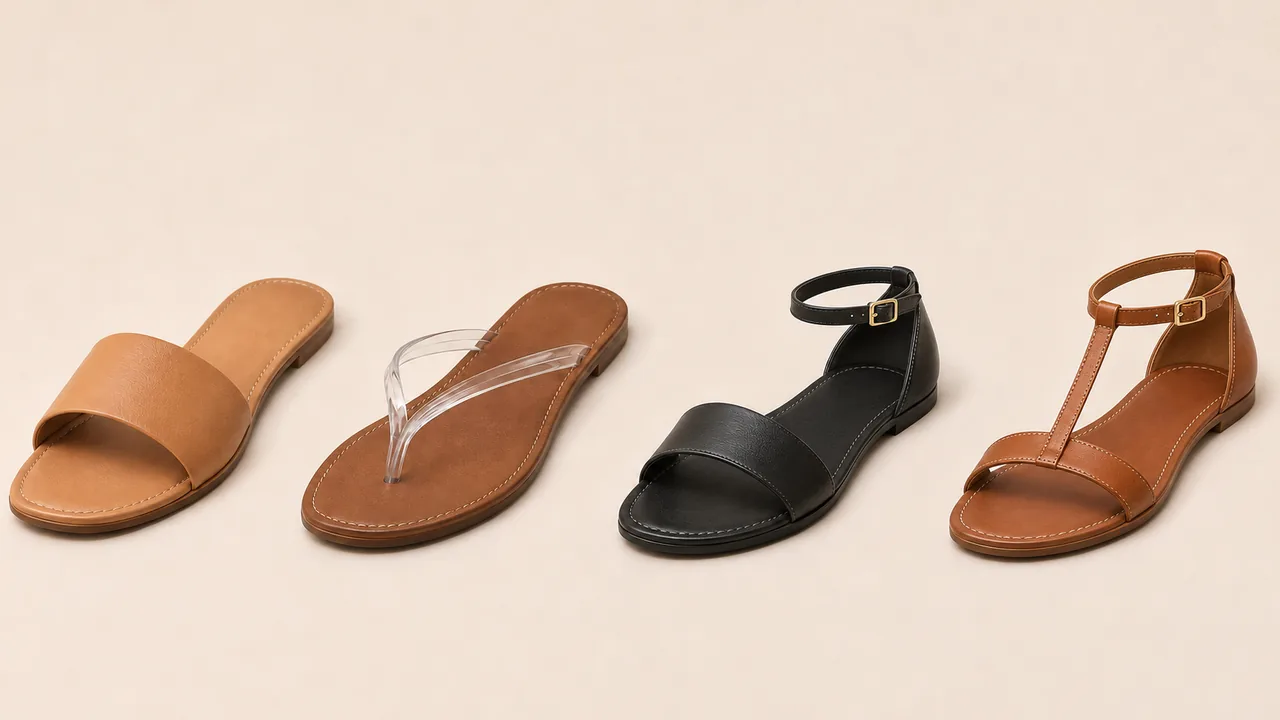
A slide has one wide strap or several narrower straps across the forefoot and no heel strap. It is backless, so nothing visible holds the heel in place. The slide layout appears on flat soles, and it can also sit on a heel or a wedge. Dressier versions may use rows of thin straps across the bridge of the foot. If a listing says "slide," expect a backless design, then check the strap count and materials in the details.
Thong or Toe-Post, and Toe-Loop
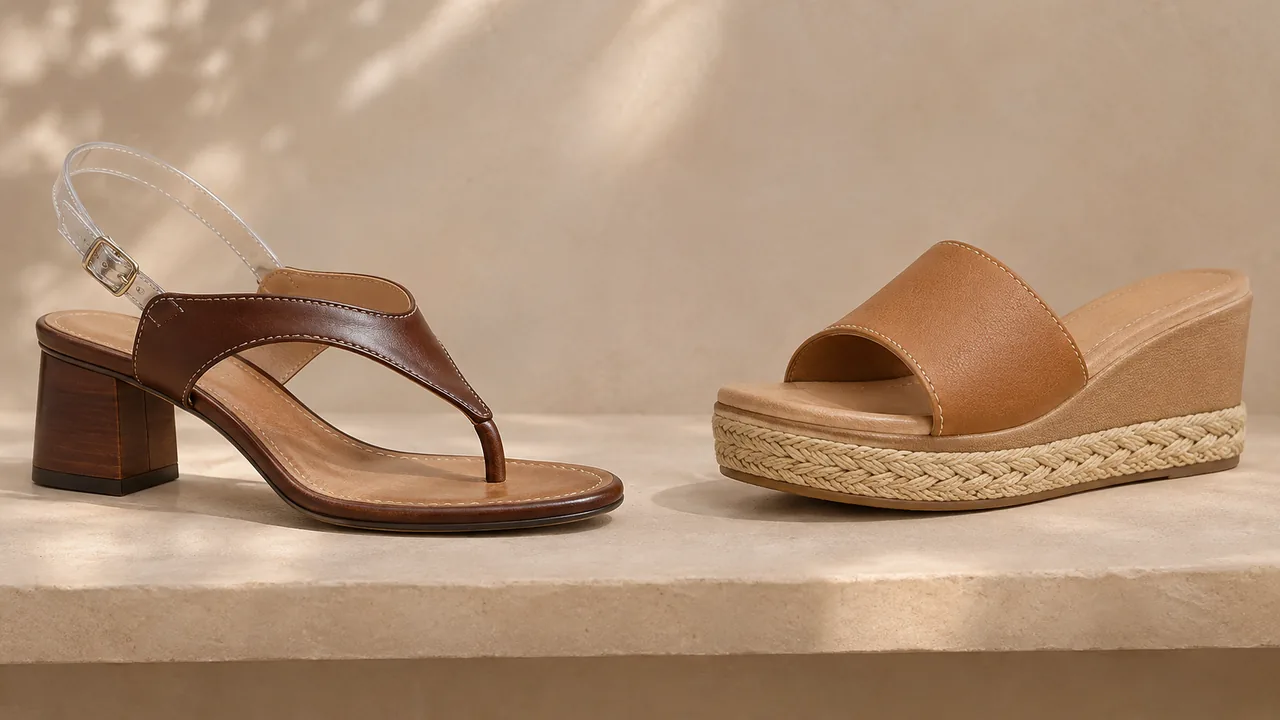
A thong, or toe-post, sandal has a post that sits between the toes. In the classic layout, the post joins straps running toward the sides of the foot and forms a Y shape at the front. A toe-loop sandal has a loop that goes around one toe, sometimes in place of a post and sometimes alongside one. Either layout can sit on a flat sole or a heel. Some pairs also add a slide-style strap across the forefoot or a strap behind the heel. "Flip-flop" is a common retail name for a flat thong, but the thong layout on its own says nothing about the base.
Ankle-Strap and Slingback
An ankle-strap sandal has a strap that circles the ankle. A slingback has a strap that passes behind the heel rather than around the ankle, and its exact height varies from pair to pair. When you compare these, note where the strap sits on the foot and whether it visibly closes or adjusts with a buckle, a hook-and-loop tab, an elastic section or nothing at all. A photo can show a buckle that is purely decorative, so the description or the seller should confirm whether it works.
T-Bar
A T-bar sandal has a strap running down the centre of the foot that meets a crosswise strap or an ankle strap, forming a T. Some T-bar pairs slip on and others buckle at the ankle. The T shape describes the strap pattern only, so the same pattern can appear on different base profiles.
Strappy and Gladiator
"Strappy" is a loose label for sandals with straps over the foot or ankle. The straps can be thick or thin, few or many, and there is no fixed minimum count. A common gladiator description has several crosswise straps linked toward an ankle strap, sometimes joined by a centre strap, and some versions extend higher up the leg. Treat "gladiator" as a descriptive retail pattern rather than a rule that requires a set number of straps or one exact layout. Gladiator straps appear on flat soles, block heels, stilettos and thick platform bases.
Woven Huarache-Type
A huarache-type sandal has a woven upper that wraps around the foot. Describe what you see, such as the weave pattern, how much of the foot it covers, and whether there is a separate heel strap or a closed back. The weave describes appearance. Whether a particular woven upper suits your foot is something to check on the actual pair.
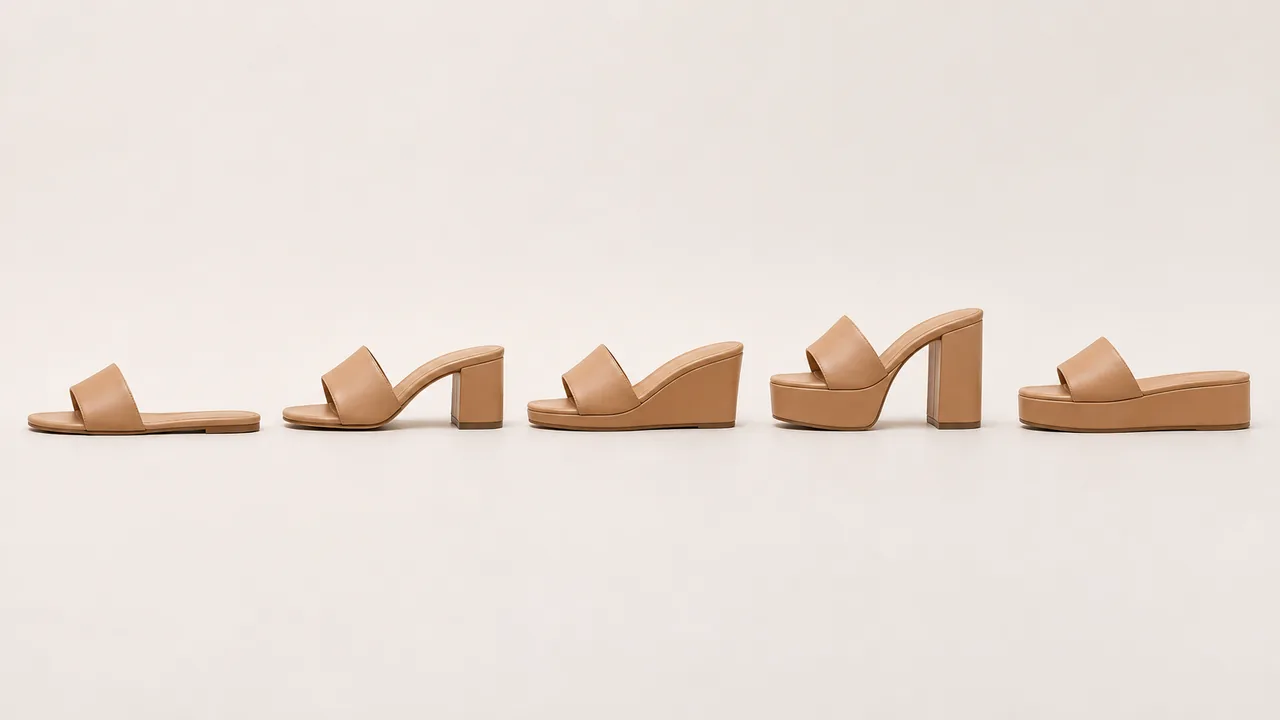
Field 2: The Base Profile
This field describes the shape of the sole seen from the side. Keep it qualitative. A profile name does not give you the actual heel height or tell you how the pair will feel, so look for measurements in the listing or ask for them.
Flat
A flat sandal has little or no visible heel rise. The sole may be thin or a little thicker, but the rear does not sit noticeably higher than the front.
Separate Heel
A heeled sandal has a distinct heel unit under the rear of the foot, with a gap or arch beneath the midfoot. Heel shapes include the slim stiletto, the chunkier block and sculptural heels shaped for visual effect. "Heeled" names the profile, and the listing still needs to state the height and heel shape.
Wedge, Including Espadrille-Style Edges
A wedge has a raised sole that runs continuously from front to back, with no gap under the arch. Espadrille-style wedges show a woven or rope-like band around the edge of the sole. That band is an appearance. It does not tell you whether the whole sole is plant fibre, whether the weave wraps around another material, or how the sole was built. The seller should declare the sole composition, and if the listing does not, ask. For background on how soles and uppers come together, see how shoes are made.
Platform and Flatform
A platform describes a visibly built-up forefoot, with extra thickness under the ball of the foot. A platform can be paired with a separate heel or with a wedge. "Flatform" is used for a thick base that sits close to level, with the front and back at a similar height. Retailers do not all use these terms the same way, so check the side-view photo and any listed heel and forefoot figures rather than relying on the label.
Identification and Overlap Table
The two fields are independent. Read one from the straps and one from the sole, then list what neither tells you.
| What you see | Upper field | Base field | Combined name | Still unknown |
|---|---|---|---|---|
| Post between the toes, block heel under the rear | Thong or toe-post | Separate heel (block) | Heeled thong or block-heel toe-post sandal | Heel figure, materials, whether any strap adjusts |
| Several crosswise straps to an ankle strap, thick forefoot, separate heel | Gladiator | Platform with heel | Platform gladiator | Forefoot and heel figures, closure type |
| One wide backless strap, continuous raised sole | Slide | Wedge | Wedge slide | Sole composition, height, heel retention on your foot |
| T-strap on a thick base close to level | T-bar | Flatform | T-bar flatform | Base thickness, whether the T-bar buckles |
| Hook-and-loop straps, ridged outsole | Trace the straps in the photos (the closure alone does not show the layout) | Check the side view | May be listed as a "sport sandal" | Intended use, outsole material, any performance information |
In the last row, "sport sandal" names neither field directly. When a listing uses a style name like this, work out the upper and the base from the photos, and ask about anything the photos cannot show, such as whether the tabs adjust.
Decoding Three Illustrative Listing Descriptions
The three listings below are hypothetical examples written for this guide, not real products. For each one, separate what the words establish from what they leave open.
Listing A (hypothetical): "Heeled thong sandal with slingback." The words establish a toe-post upper, a strap behind the heel and a heeled base. They leave open the heel height and shape, whether the slingback adjusts or relies on elastic, and the declared materials. Before shortlisting, you would want the heel figure and a closure description.
Listing B (hypothetical): a backless sandal with a broad strap, a raised forefoot and a woven-look sole edge, labelled "espadrille platform slide." That description establishes a backless slide layout, a raised forefoot and a woven appearance on the sole edge. It leaves open the actual forefoot and heel thickness and the declared composition of the whole sole. "Espadrille" here describes how the edge looks, so ask the seller what the sole is made of.
Listing C (hypothetical): a sandal with multiple straps and a thick near-level base, tagged "sport gladiator flatform," with no closure details. The description establishes a multi-strap layout and a thick base close to level. It leaves open the closure type, any adjustability and any intended-use information from the maker. The word "sport" in the tag does not establish that the pair suits a particular activity.
Build a Shortlist From Your Actual Requirements
Start from what you need, then filter. Some conditional examples:
- If an occasion calls for a strap behind the heel, check whether each pair actually has one. Classic backless slides do not, and a T-bar or ankle-strap label still needs a look at the photos before you count the pair in.
- If you dislike anything between your toes, filter out thong and toe-post styles. A toe-loop sits differently, so try one before ruling it in or out.
- If you want to adjust the fit, prioritise listings that state a working buckle or hook-and-loop closure.
- If you need a particular heel or forefoot height, shortlist only listings that give figures, or ask for them.
- If you plan a specific activity, look for the maker's stated intended use rather than the style name.
A sport label, a tread pattern or a contoured footbed shape is not evidence that a pair suits walking, hiking or wet ground. Charles & Keith, in its own sandal guide, tells sport-sandal buyers to check the product specifications against their intended purpose, and the same habit works for any style.
Questions to send the seller:
- What is the actual closure, and does it adjust?
- What intended-use information does the maker provide?
- What materials are declared for the upper, lining and sole?
- What are the heel and forefoot figures, and how were they measured?
- What are the return terms, including for pairs tried on at home?
Try-On Checks on the Actual Pair
Put on both shoes and walk a few steps on a clean floor. Then check the following:
- Notice where each strap lands on your foot and whether any strap edge presses or rubs at one spot.
- See whether a toe-post or toe-loop stays where it was designed to sit, and whether it pulls, rubs or presses anywhere as you move.
- On slides, slingbacks and other open-heel styles, some heel movement is normal. Watch whether your heel slides off the footbed, or whether you have to grip with your toes or change how you walk to keep the pair on. A few steps will not tell you how the pair feels later.
- Check that your foot sits within the footbed outline, with toes and heel not hanging over the edge.
- Check that each working buckle closes as designed at a setting that feels comfortable without forcing the strap, and ask how much adjustment the pair offers if the listing does not say.
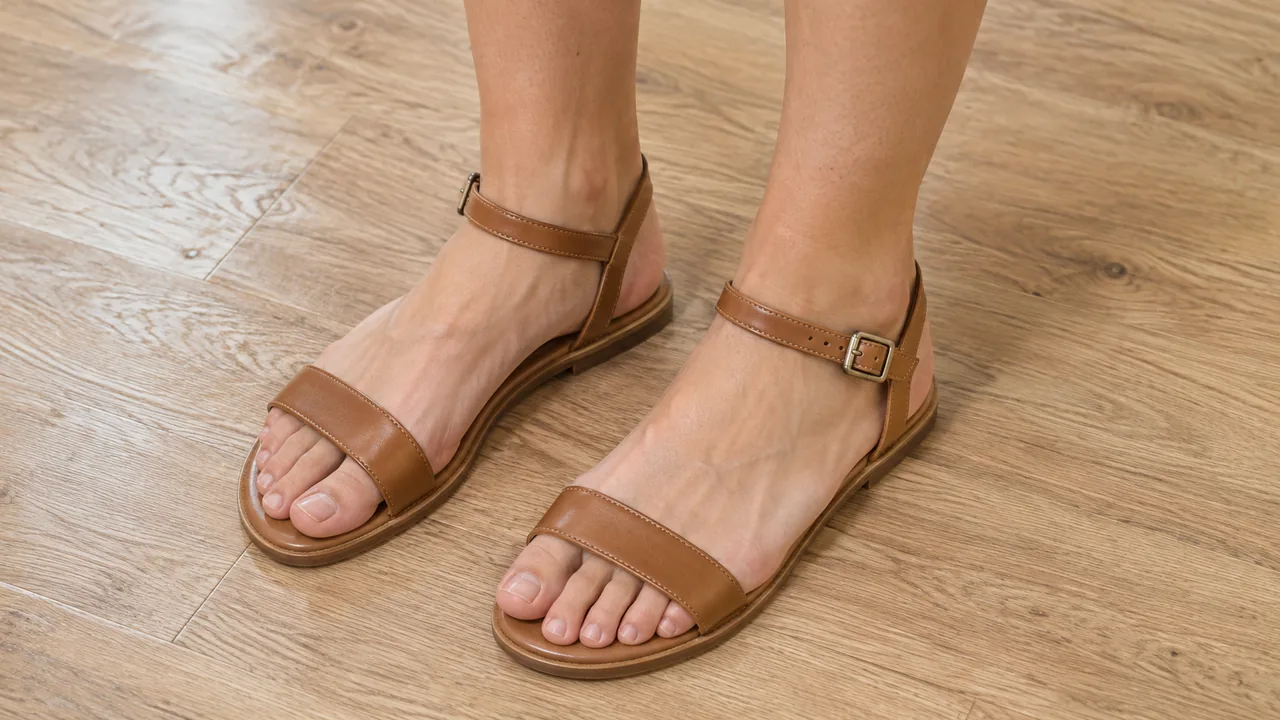
These checks show how this pair sits on your foot in the shop or at home. They do not show how it will grip a wet surface, whether it resists water, or how it will feel after many hours. For those questions, rely on the maker's stated information and the return terms.
Your Next Step
Open two listings side by side. For each, write down the upper field, the base field and every unknown the listing leaves open. Send the seller questions for anything that matters to you, and keep the pair with the clearer answers on your shortlist before you buy.
Frequently Asked Questions
What are the main types of sandals for women?
Sort them by two fields. By upper, the main types are slides, thong or toe-post, toe-loop, ankle-strap, slingback, T-bar, strappy, gladiator and woven huarache-type. By base, they are flat, heeled, wedge, platform and flatform. Retail names often combine one term from each field, such as "wedge slide" or "heeled T-bar," and one pair can carry more than one upper label.
What is the difference between a platform and a flatform sandal?
A platform describes a raised forefoot, and it can sit with a separate heel or a wedge at the rear. A flatform commonly describes a thick base that stays close to level from front to back. Retailers do not all use these terms the same way, so look at the side-view photo and ask for the heel and forefoot figures.
Is a thong sandal always flat?
No. "Thong" describes the upper, a post between the toes that often forms a Y-shaped front. That layout appears on flat soles, and retailers also list heeled and slingback versions. Check the base profile and the strap layout separately in the listing.
Does an espadrille-style wedge always have a jute sole?
Not necessarily. A woven or rope-like edge is an appearance, and it does not confirm the material of the whole sole or how the sole was made. Rely on the declared composition in the listing, and if it is missing, ask the seller before you buy.
Are sport sandals suitable for hiking or long walks?
The style name alone does not tell you. Some pairs sold as sport sandals are designed mainly for everyday wear. Ask for the maker's intended-use information and the conditions it covers. A try-on shows how the pair fits your foot, but it cannot confirm grip, water resistance or how the pair will perform on a future walk.
About TLSTAGE
Since 2012, TLSTAGE has been your trusted one-stop fashion supply partner from Guangzhou, China—specializing in women's footwear, apparel, bags, and accessories.
What started as a specialized footwear supplier has grown into a full-range fashion supply partner, driven by client trust and proven by consistent quality across every product category.
- 20+Years Industry Expertise
- 30+Countries Served
- 300+Global Buyers Trust Us
- FlexibleMOQ by style and project