
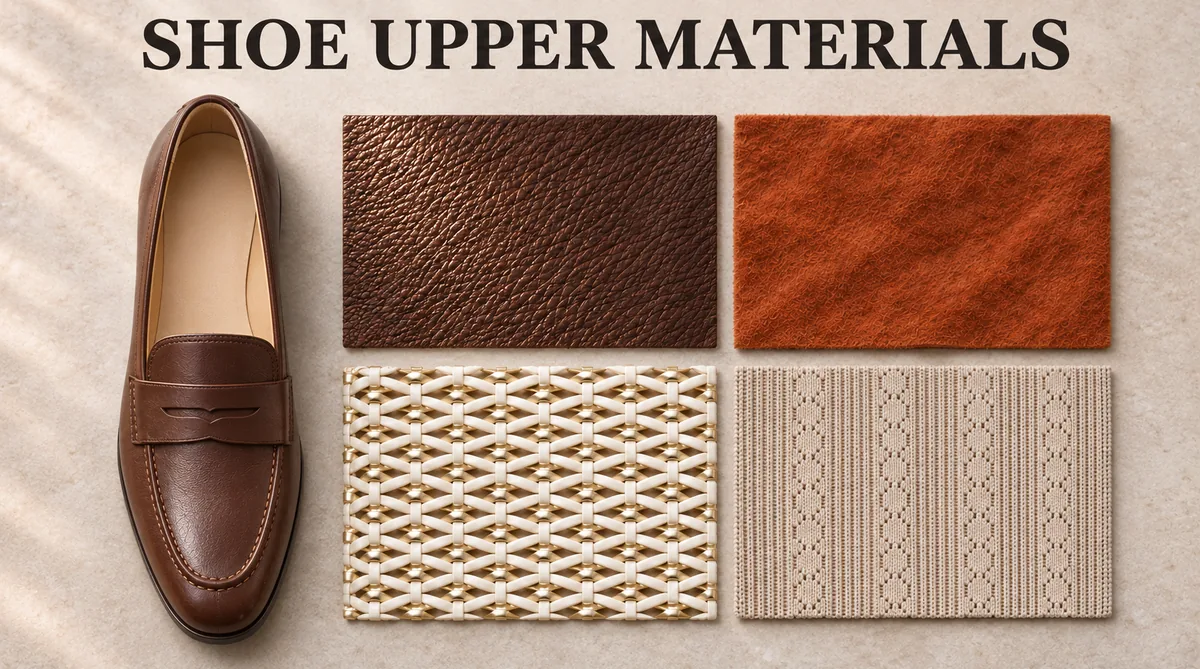
Shoe upper materials make up everything above the sole that wraps the foot. The common families are leathers (smooth grain, suede and nubuck), coated synthetics such as PU, microfiber leather, and textiles like mesh, knit, canvas and satin. Many shoes combine several. The lining is a separate inner layer against the foot. It is chosen mainly for skin feel, moisture handling, color fastness and seam comfort, though on open sandals its edges are part of the look too.
A material name tells you about construction: which side of a hide faces out, what sits under a coating, whether a fabric is knitted or woven. It says much less about how the finished shoe behaves, because the upper and lining work as a pair.
Upper vs Lining: Two Layers With Different Jobs
Parts of the upper, from sneakers to pumps and sandals
Nike's shoe anatomy guide supplies the basic vocabulary. The vamp covers the top of the foot from the toe area back. The quarter covers the sides and back. The tongue is the flap under the laces, and the collar is the opening around the ankle. A tip reinforcement is an extra layer bonded over the toe against scuffing. A heel counter cups the heel at the back to stop it sliding side to side. Nike says the vamp, tip, quarter, tongue and collar mean the same thing on a formal shoe as on a sneaker.
Many closed shoes also have an internal toe puff, or box toe, that helps the toe keep its shape from inside. SATRA, a footwear research and testing organization, publishes a test method for formed toe puff and counter (stiffener) materials. An outer tip layer and an inner toe puff are different parts, and a shoe may have either, both or neither.
A plain pump or ballet flat often has no tongue, and the edge around its opening is usually called the topline. A strappy sandal may reduce the upper to a few straps, exposing both faces and the edges. An ankle boot extends the quarter up the leg.
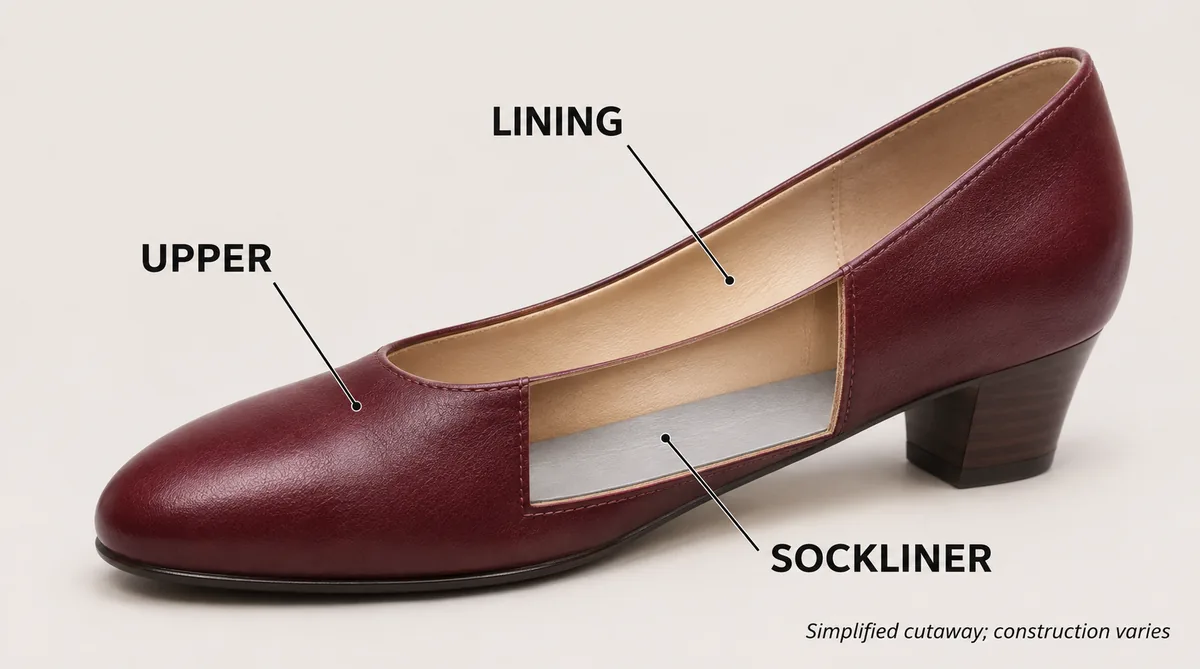
What the lining is, and what it is not
The lining is the inside face of the upper, where the shoe has one. Nike names collar, heel and tongue linings and identifies the heel lining as the spot where friction and blisters are most likely.
Underfoot layers are separate parts. The layer the foot rests on may be called an insock, sockliner or insole, and usage varies. Nike's own guide applies "sockliner" to two different parts. Some constructions add a structural insole board. In board lasting, the edges of the upper are pulled under the last and glued to that board, while strobel construction stitches a fabric bottom to the upper instead. Lining choices concern the inside of the upper, not these underfoot layers.
Upper Material Families and What Their Names Reveal
Uppers often mix families, such as leather panels with mesh inserts. Each family name points to a construction you can ask about.
Leather: grain, finish and natural variation
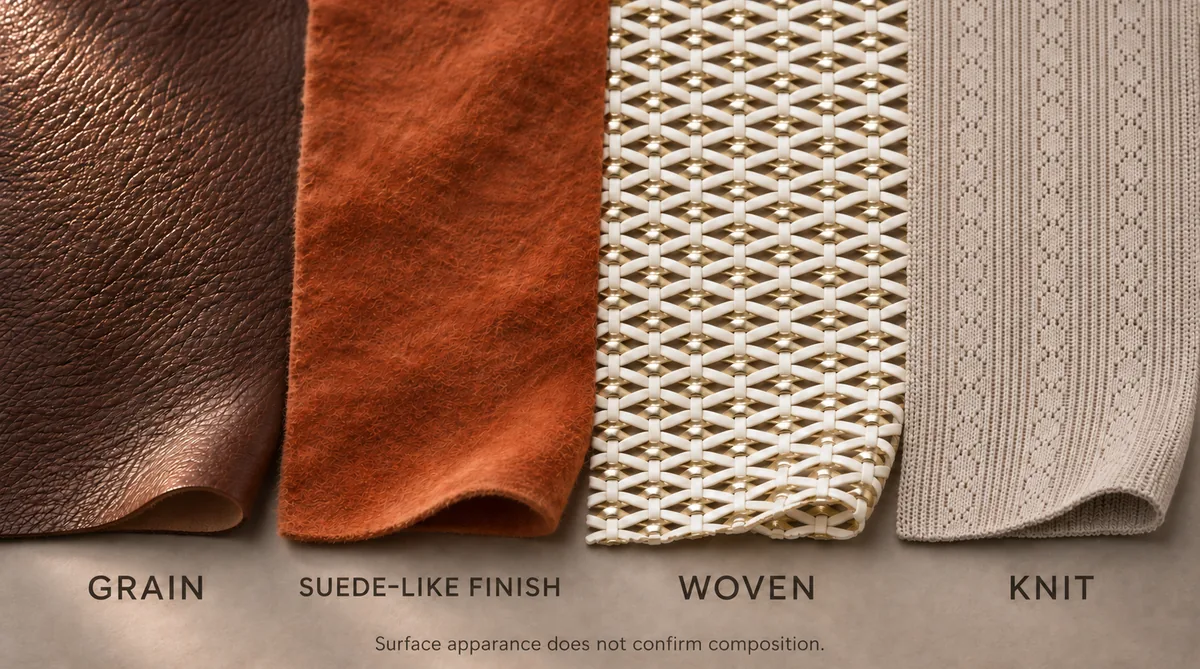
Grain is the outer surface of the hide, with its natural pores and texture. Full grain keeps that surface intact. Other leathers have had the surface sanded, corrected or refinished to varying degrees, and sellers do not use labels such as "top grain" and "corrected grain" consistently, so ask what was done to the surface. A split is a lower layer separated from the hide. "Genuine leather" only says the material is leather.
The Noble Shoe, a men's shoe retailer, adds that hide area and tanning matter too. It describes belly leather as prone to stretching and creasing, and says full-grain belly leather can be lower quality than leather from the back. Embossed grain is a texture pressed into smooth leather, and patent leather carries a high-shine coating. Hides also vary naturally, so Peix Shoes, a women's shoe maker, advises agreeing clear standards for grain, shade and acceptable surface marks.
Suede and nubuck: which side was buffed
Suede is sanded on the flesh side of the hide to raise a velvety nap, and split suede starts from a separated lower layer. Nubuck is sanded on the grain side, so it looks similar but starts from the outer surface. Both carry nap, fibers that lie in one direction and change how a panel reflects light. Some man-made leathers also come in suede finishes, so a brushed surface alone does not confirm leather. Ask for the composition.
PU, PVC and microfiber: coating vs backing
"PU leather" names a polyurethane surface over some base. Daniel Smart, a jacket maker, describes that base as usually polyester fabric or a split leather backing, so the label alone does not tell you whether animal leather is present.
Kuraray, maker of CLARINO, compares three constructions. PVC leather has a PVC surface and general synthetic leather a polyurethane surface, both typically on a woven base, though Kuraray notes exceptions. CLARINO uses a nonwoven base of entangled microfibers impregnated with polyurethane. Kuraray credits that structure with fray-free edges and compatibility with skiving (thinning edges so seams lie flat). Those are claims for its product, not for every material sold as microfiber.
Because surface and backing both vary, a PU or microfiber name says little about performance on its own. Peix suggests comparing flexibility, recovery, surface durability, backing and odor on more than a small cutting.
Textiles: mesh, knit, canvas, satin and velvet
Engineered mesh and knit uppers can be made as single pieces, with the vamp and quarter blending together instead of being stitched panels. Canvas is a woven fabric common on casual shoes, and velvet is a pile fabric whose nap you can feel. The fabric name alone does not settle breathability, which belongs to the finished assembly, lining and reinforcements included.
Lining Materials and the Jobs They Do
Leather, textile and synthetic linings
Linings come in the same broad families as uppers. The Noble Shoe uses goat and sheep leather mainly for linings because those skins are thin, stretchy and delicate, which is one maker's practice rather than a rule. SATRA's performance guidelines keep separate sections for leather, synthetic and textile lining materials. Textile linings, for instance, can pill (form small balls of fiber) under abrasion, which does not normally happen with leather linings.
Feel, moisture, color and edges
Feel. Softness matters, and so does where seams fall against the skin, especially at the heel and collar.
Moisture. A SATRA lab method measures how much water vapor a single material or an assembly of layers absorbs and transmits, as a gauge of its ability to move perspiration away from skin. Absorption and transmission are measured separately. A result for a tested outer-and-lining assembly describes those layers, not the whole shoe's openings, seams and construction, and the method does not address keeping rain out.
Color. SATRA notes that materials that are not color fast can transfer color onto hose and other clothing. Its rub fastness methods mechanize an older check, rubbing the material with a finger wrapped in white cloth, and then inspect a reference cloth for staining.
Edges. On open sandals the lining edge shows, so Peix treats it as part of the design.
How the Upper and Lining Behave Together on the Shoe
After the cut pieces are stitched together, the upper is shaped over the last, the foot-shaped form a shoe is built on. The guide to how shoes are made covers that sequence. In the finished shoe, the outer material, lining and stiffeners act on one another, though they remain separate layers.
The vamp creases with every step. SATRA's vamp flex test simulates this to check whether materials crack at flex creases, and it applies to both outer and lining materials.
Reinforcement changes fit and looks. SATRA's example is a light-use court shoe (the British term for a pump), where a heavy-duty, stiff toe puff would be unnecessary and would affect both fit and appearance. SATRA also lists upper materials and components, pattern design and processes such as heat setting, alongside the last, as factors governing a shoe's final shape.
A harsh crease, a stiff vamp or a rubbing collar can therefore have several possible sources: the outer material, its backing, the lining, a stiffener, the pattern or the last. A developer could change one layer, such as the lining, while keeping the last, pattern, reinforcements and process as close to unchanged as possible. Any difference then points to a variable worth investigating rather than proving a single cause.
Starting Points for Three Women's Styles
Peix observes that the same material may perform differently on a structured loafer, a soft flat or a high-heel sandal. The directions below are illustrative hypotheses to check on the actual build, not recommendations for any particular shoe.
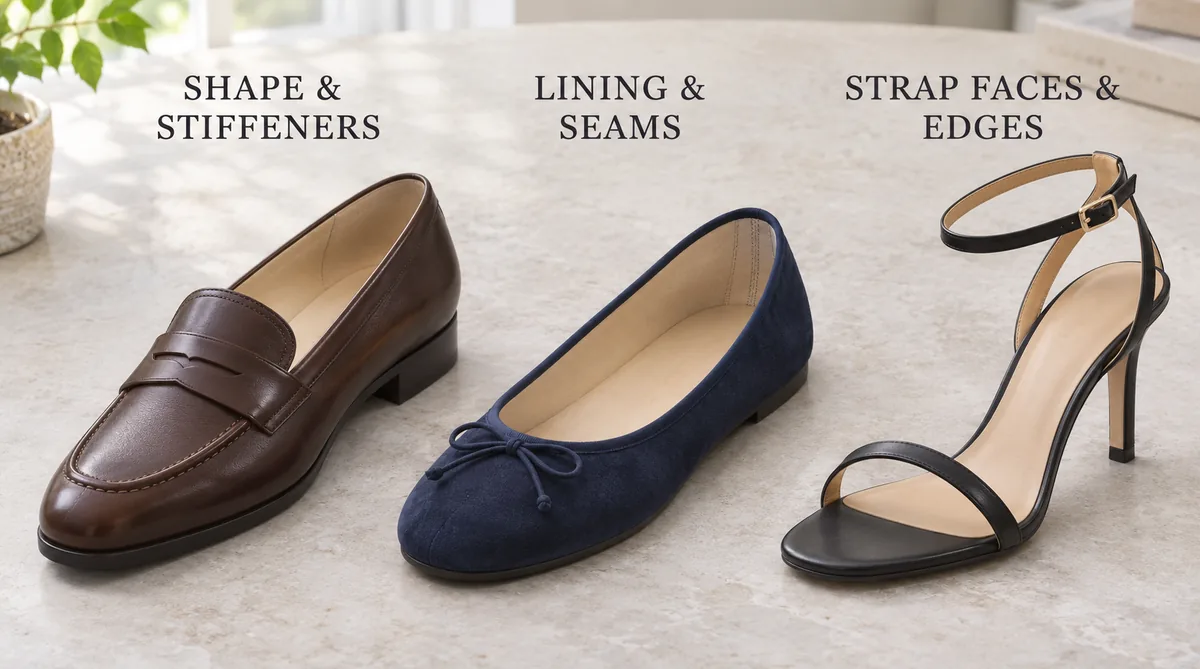
Structured pump or loafer. The outer has to hold its shape around the vamp, where the walking crease shows. A smooth or embossed leather, or a synthetic with a suitably firm backing, could be a first candidate. The Noble Shoe says embossed textures can hide creasing. Match the toe puff and counter to the intended wear rather than choosing the stiffest, then check whether the reinforcement shows or tightens the fit.
Soft flat. The upper sits close to the foot at the topline, so lining feel and seam placement carry more weight. A flexible outer such as suede, nubuck or a soft textile might pair with a thin, soft lining, such as the goat or sheep linings The Noble Shoe describes. Check how the forepart creases and whether a seam ridge sits at the heel or topline.
High-heel sandal strap. A narrow strap shows both faces and its edges. A lined strap with a finished edge makes the lining's color and rub fastness part of the visible design. A single layer with a raw cut edge depends on a material that does not fray. Kuraray claims fray-free edges for CLARINO, while sewing guidance says fabrics that ravel need their edges finished.
Peix adds that satin, mesh, velvet, glitter and metallic finishes can need extra attention during cutting, stitching, lasting and packing, and suggests asking how a material responds to abrasion, adhesive and pressure.
Sewing guidance for napped fabrics notes that a surface stroked with the nap looks lighter and shinier, and says to cut every pattern piece in the same direction. Suede panels cut different ways can likewise read as two shades on one shoe.
Illustration, not a real case. Imagine a suede ballet flat whose vamp and quarter look like slightly different shades. Viewing both under one light and brushing the nap one way would show whether direction explains the difference. If it does not, natural variation between hides is another possible source to ask about.
Checking a Shoe or Sample in Hand
What to look at. Judge materials on physical swatches or the shoe itself rather than digital photos. Check that panels match under one light and that napped panels run the same way. Look at edges and seams, including any lining edge visible on a sandal strap or at the topline.
What to feel. Gently bend the forepart and watch how the vamp creases. Run a finger around the heel lining and collar, where friction concentrates, and note any seam ridge. Press the toe and heel to sense how firm the stiffeners are for the style. On a spare sample or a hidden area, a light rub with a pale cloth can flag obvious color transfer from the lining. It is a quick screen rather than a standardized rub fastness result.
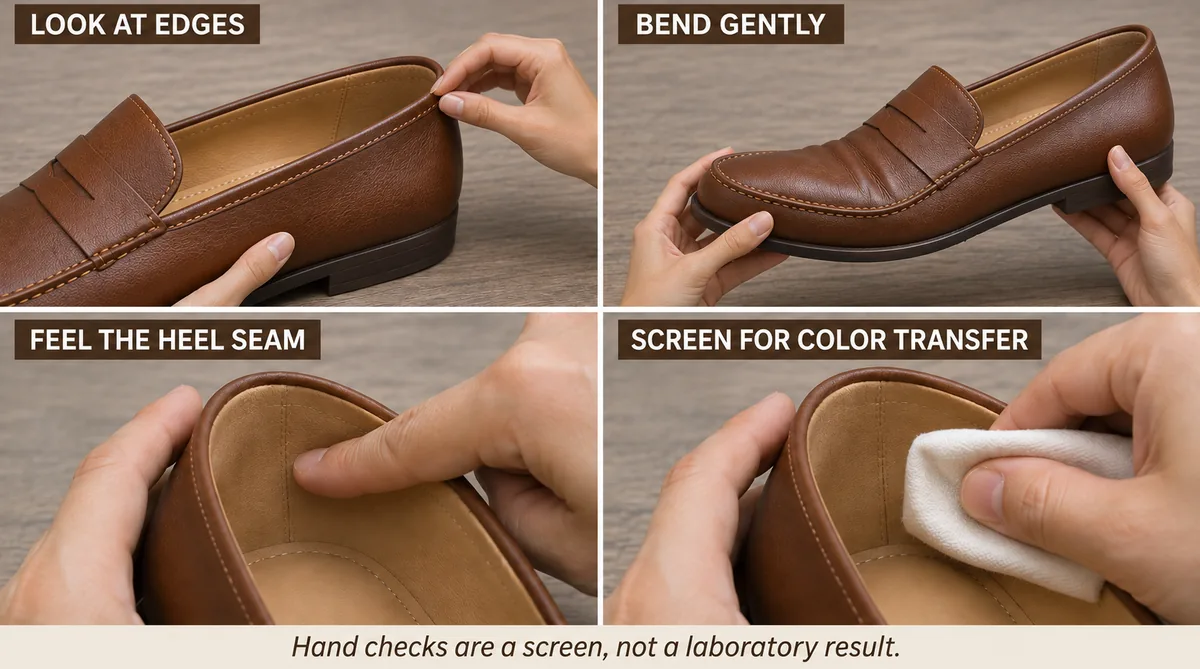
What to ask. Confirm the composition behind each name: the backing under a PU surface, whether a napped finish is leather or synthetic, what the lining is, and which stiffeners sit at the toe and heel.
Laboratory methods exist for vamp flex, abrasion, rub fastness and water vapor, and they give evidence that hand checks cannot. SATRA points out that its test methods contain no performance levels. It interprets results against guidelines chosen for the intended use, classified by how often a shoe is worn and how severe the conditions are. A shoe worn rarely in mild conditions sits at one end of that scale, and one worn every day on a building site sits at the other, so any result needs reading against the wear the shoe will actually see.
Frequently Asked Questions
What is shoe lining?
Shoe lining is the inside face of the upper, the layer against the top and sides of the foot. Common zones are the collar, heel and tongue linings. The underfoot layer, which may be called an insock, sockliner or insole, is a separate part. Lining choices weigh softness, seam position, moisture behavior and color fastness, and on open sandals the lining edge is visible.
What parts make up a shoe upper?
The main parts are the vamp over the top of the foot, the quarters along the sides and back, and the collar or topline around the opening. Laced shoes add a tongue. A heel counter, where present, stiffens the back, and some shoes also have an internal toe puff or an outer tip reinforcement at the front. A pump may have no tongue, and a sandal can reduce the upper to a few straps.
Are leather uppers always more breathable than synthetic uppers?
Not necessarily, and the material name alone cannot settle it. Leather can carry a coating, as patent leather does, and synthetics vary in surface and backing. How much water vapor an upper absorbs and transmits depends on the actual outer material, its finish, its backing and the lining beneath it. Lab methods can measure a single material or an upper-and-lining assembly, though the result describes those layers rather than the whole shoe. Compare measured assemblies or the shoes themselves rather than the words "leather" and "synthetic."
Why do suede panels on one shoe sometimes look like different shades?
Suede has nap, and nap reflects light differently depending on which way the fibers lie, looking lighter and shinier in one direction. Panels cut in different directions can therefore read as two shades. Leather also varies naturally between hides. Brushing the nap one way under a single light helps separate direction from a real color difference.
Can a shoe lining stain tights or hosiery?
It can, if the lining material is not color fast. SATRA lists color transfer onto hose as one result of poor fastness. Rub fastness methods check this by rubbing the material against a reference cloth and inspecting the cloth for staining. Whether a given lining is acceptable depends on how the shoe will be worn, so ask whether it has been assessed for that use.
About TLSTAGE
Since 2012, TLSTAGE has been your trusted one-stop fashion supply partner from Guangzhou, China—specializing in women's footwear, apparel, bags, and accessories.
What started as a specialized footwear supplier has grown into a full-range fashion supply partner, driven by client trust and proven by consistent quality across every product category.
- 20+Years Industry Expertise
- 30+Countries Served
- 300+Global Buyers Trust Us
- FlexibleMOQ by style and project