
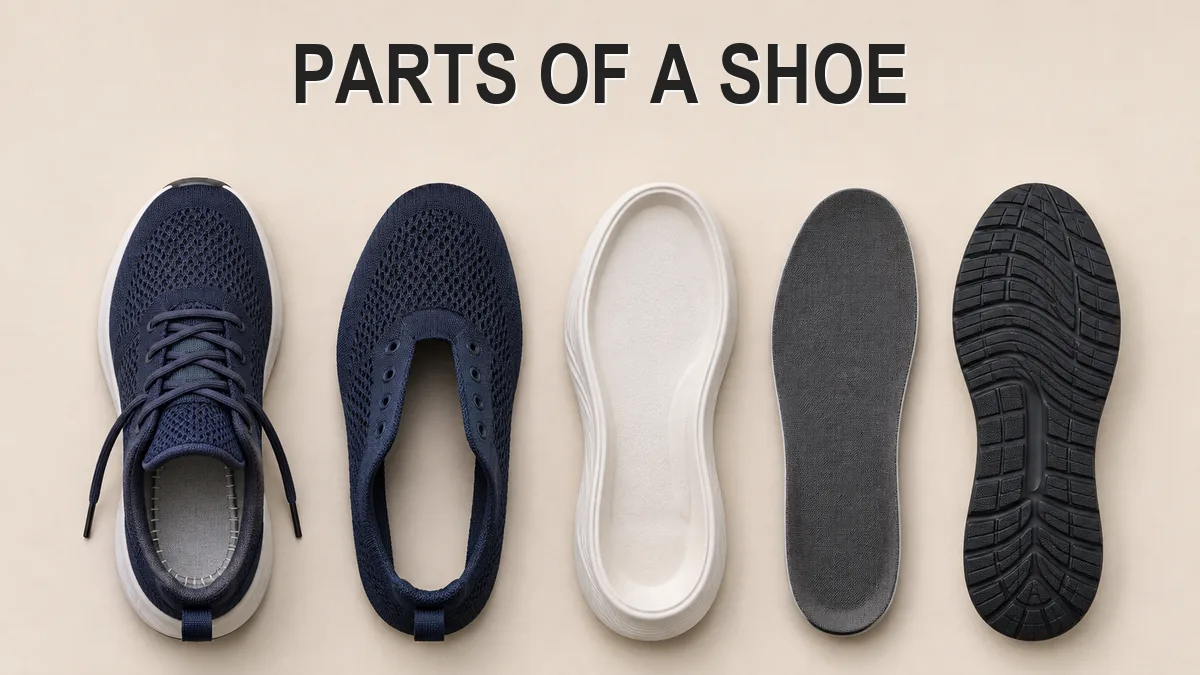
The parts of a shoe fall into three zones. The upper covers the foot and, depending on the style, can include the vamp, the toe, the quarters, a tongue, the collar or topline, and a lacing area on laced styles. The bottom holds the outsole, often a midsole, and a heel on many styles. Inside sit linings, a structural insole or a sewn strobel base, often a fixed or removable footbed, and hidden reinforcements such as the heel counter, the toe stiffener and sometimes a shank.
There is no fixed part count. A sandal, a loafer and a trail runner share some names and skip others, because the style and construction decide which parts exist. Below, the parts are arranged by position (upper, bottom, inside) with notes on which ones only appear in some shoes.
Shoe Parts at a Glance
Lists that promise a set number of shoe parts don't hold up, since an unlaced loafer has no eyelets to count and a canvas sneaker built without a welt has no welt to name. Use the last column to check whether a part applies to the shoe in front of you.
| Part | Where it sits | What it does | When it appears |
|---|---|---|---|
| Vamp | Top of the forefoot | Covers the forefoot; the shoe flexes here | Closed uppers |
| Tip or toe | Very front of the upper | Covers the toes | Closed-toe styles |
| Quarter | Sides and back | Wraps the foot behind the vamp | Most closed uppers |
| Tongue | Under the laces or fastening | Sits between closure and foot | Laced and some strapped styles |
| Facings or eyestay | Each side of the lace opening | Hold and reinforce the eyelets | Laced styles |
| Eyelets | In the facings | Let the laces pass through | Laced styles |
| Collar | Opening at the top | Where the foot enters; may be padded | Closed uppers |
| Topline | Top edge of the upper | Finishes the opening's edge | Closed uppers |
| Heel counter | Around the back of the heel, often between lining and outer | Helps the rear keep its shape | Many styles; stiffness varies |
| Toe stiffener | Hidden between lining and upper at the toe | Helps the toe keep its shape | Some constructions |
| Lining | Inner face of the upper | Covers the inside of the shoe | Most shoes; unlined styles exist |
| Structural insole | Base under the foot | Platform the shoe is built on | Some constructions, such as welted |
| Strobel | Fabric sewn across the bottom of the upper | Closes the upper and forms its base | Many athletic and casual shoes |
| Sockliner or footbed | On top of the insole or strobel | Surface the foot rests on | Common; fixed or removable |
| Filler | Under the insole of a welted bottom | Fills the hollow space | Mainly welted shoes |
| Shank | Under the arch, between insole and outsole | Adds structure to the sole's middle | Some shoes; material varies |
| Midsole | Between insole or strobel and outsole | Adds cushioning or thickness | Often, not always |
| Outsole | Bottom layer | Meets the ground; carries the tread where there is one | Every soled shoe |
| Heel | Raised section under the rear | Lifts the back of the shoe | Many styles |
| Top piece | Bottom face of a separate heel | Touches the ground | Shoes with a separate heel |
| Foxing | Band around the sole edge or heel | Reinforces the upper-to-sole joint | Some sneakers |
| Welt | Strip around the shoe's edge | Joins upper to sole by stitching | Welted shoes only |
The Upper, Front to Back
Vamp, Toe and Quarters
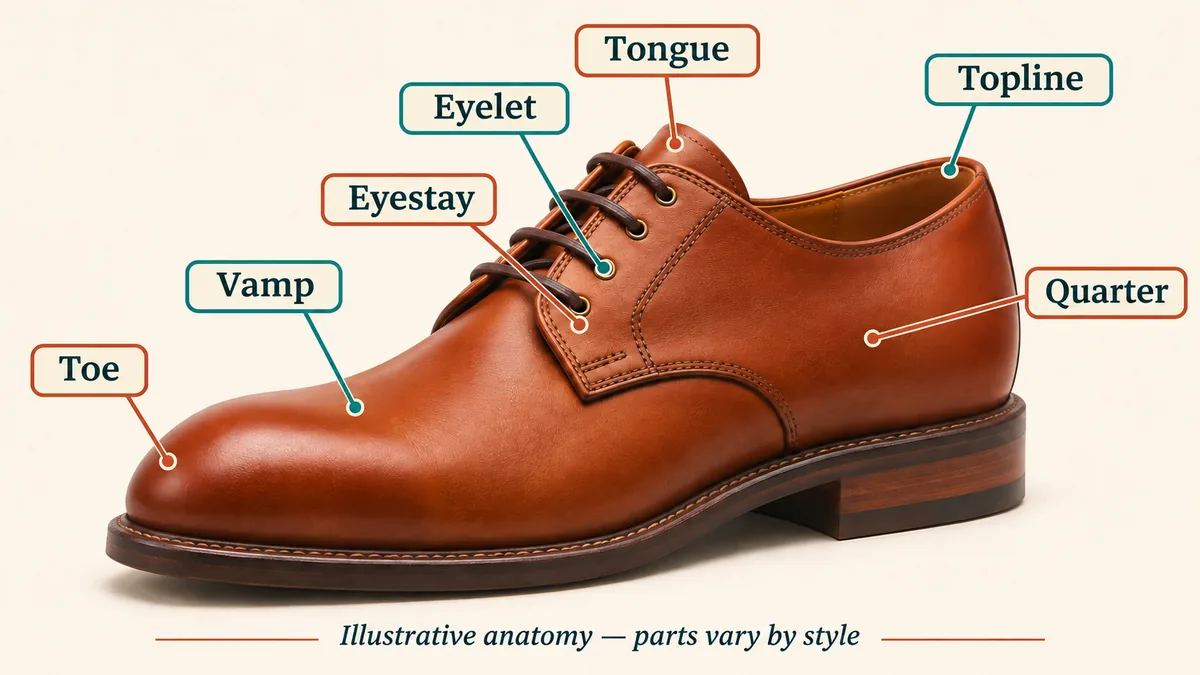
The vamp is the panel across the top of the forefoot, running from the toe area back to where the lacing or opening starts. It covers the part of the foot that bends as you walk, so this is where the shoe creases. Ahead of it, the tip or toe covers the toes at the very front. The quarters wrap the sides and back of the foot, from the vamp to the heel. On a stitched leather shoe these are usually separate panels. Many knit or engineered-mesh athletic uppers cover all three zones with one piece, so the names describe areas rather than seams.
Toe Box, Toe Cap and Toe Stiffener: Three Different Things
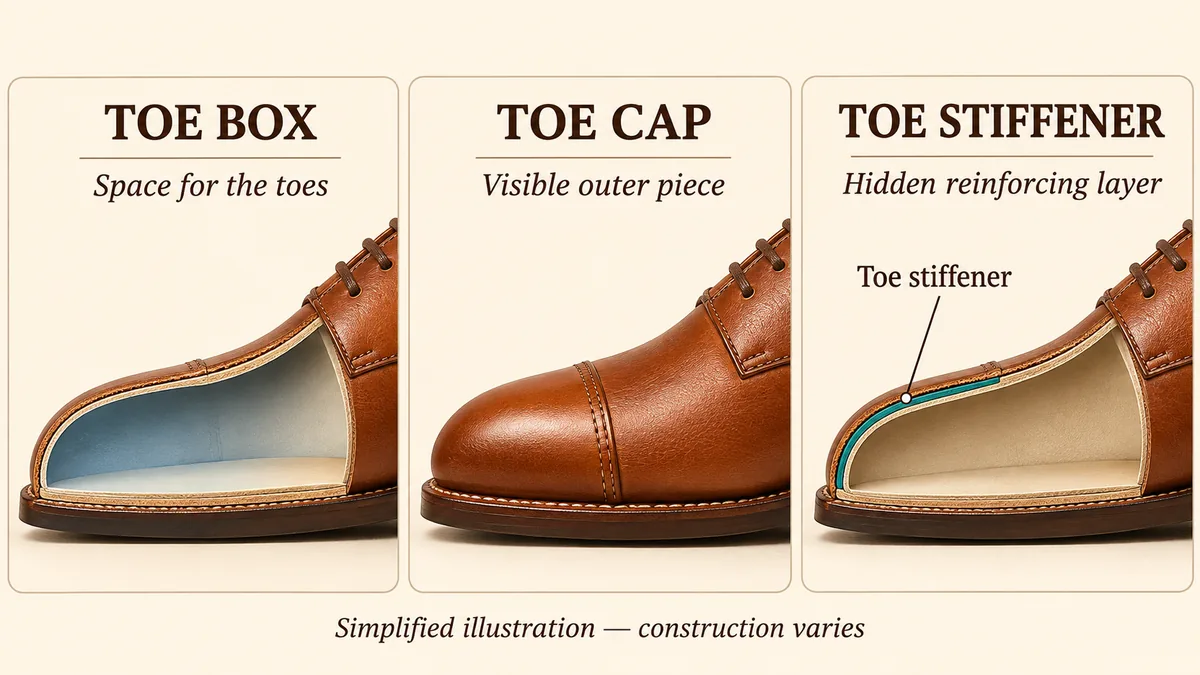
These three terms get swapped around, but they name a space, a visible piece and a hidden piece. The toe box is the volume at the front of the shoe where the toes sit. The tip, the vamp and the sole create it together, and there is no separate toe-box component to point at. A toe cap is an extra piece of material on top of the toe. On a cap-toe dress shoe, the stitched edge across the front marks where that piece ends, though a seam or decorative line on the toe doesn't by itself prove a separate cap is there. Sneakers may carry a similar tip reinforcement bonded over the toe to resist scuffing. A toe stiffener sits out of sight between the lining and the outer upper and helps the toe hold its shape. A shoe can have a stiffener without a toe cap, a toe cap over a soft toe, or neither.
Tongue, Facings, Eyelets, Collar and Topline
On laced styles, the facings, also called the eyestay, run along each side of the opening. They hold the eyelets, the holes the laces pass through, and are usually reinforced so the holes don't stretch or tear when the laces are pulled tight. The tongue is the flap under the laces, between the closure and the top of the foot. It may be padded, as on many sneakers and casual boots, or thin, as on many dress shoes. Some country shoes and boots use a bellows tongue that folds over on itself.
Collar and topline sit next to each other. The topline is the top edge of the upper around the ankle. The collar is the opening the foot goes into, and on many athletic shoes and boots it is padded and lined.
The Heel Counter
The heel counter wraps around the back of the heel. In many shoes it sits between the lining and the outer material, so you feel it as firmness rather than see it. Its job is to help the back of the shoe keep its shape so the heel area doesn't sag or fold. Stiffness varies with the style: a casual or soft shoe may have a thin, flexible counter, a structured boot a firm one, and some open-back styles none at all. Materials include leather, rubber and various plastics. If you can't tell how firm a counter is, the product description or the retailer is a better guide than pressing on the shoe.
The Bottom: Outsole, Midsole and Heel
Midsole vs Outsole
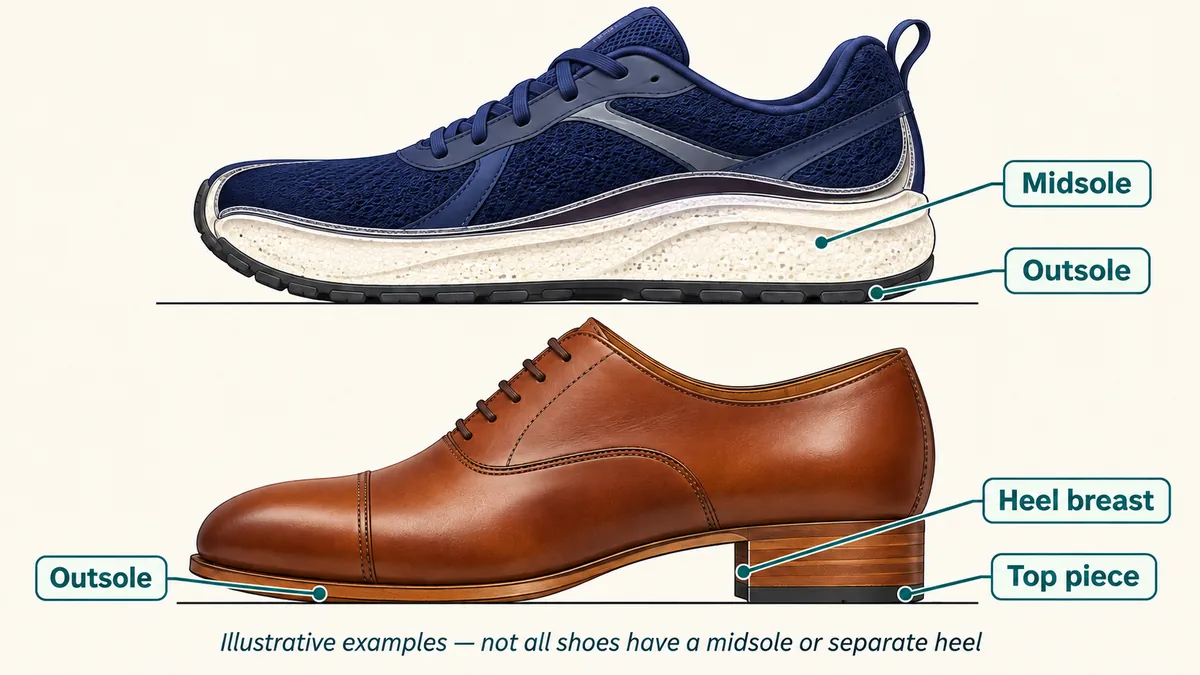
The outsole is the bottom layer, the part that meets the ground. Outsoles are made in leather, rubber and other materials; some carry a tread pattern and others are smooth. How a given outsole grips a particular surface and how it wears depend on its compound and design. On some welted shoes a worn outsole may be replaceable, depending on the construction and the condition of the shoe.
A midsole, where there is one, sits between the insole or strobel and the outsole. Its role depends on the shoe. In many athletic shoes it is a foam layer for cushioning. In a welted dress shoe, a midsole layer may add thickness and durability to a more substantial sole. Many shoes have no separate midsole: a single-layer leather sole, a simple cemented sole or a thin, flexible sneaker sole may run straight from the insole or strobel to the ground.
Heel Block, Breast and Top Piece
On shoes with a separate heel, the heel is the raised block under the back of the foot, built from stacked leather layers, a single piece of rubber or another material. The breast is the heel's forward-facing side, the surface facing toward the toe. The top piece is the heel's bottom layer, the part that touches the ground, and is usually leather or rubber. Just ahead of the heel, the waist is the narrow part of the sole beneath the arch.
These belong to the sole. The upper's heel area, with its counter and lining, sits above it, and the two are easy to confuse because both get called the heel.
Where Upper Meets Sole: Foxing and Welt
Foxing is a band of material around the sole edge or heel that overlaps the upper. Some sneakers use it to reinforce the joint between upper and sole and to add structure. A welt is a strip, usually leather, running around the outside edge of a welted shoe and used to join the upper to the sole with stitching. It may run breast to breast, stopping at either side of the heel, or all the way around. Many shoes have neither.
Inside the Shoe
Structural Insole vs Strobel Base
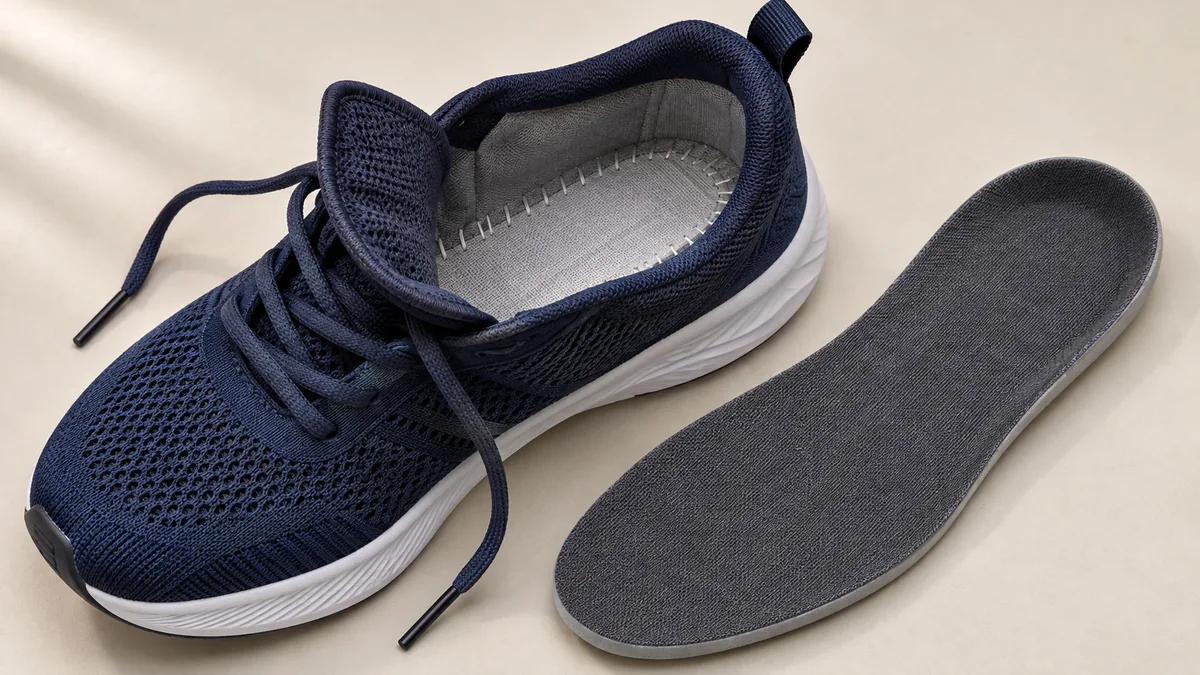
Some constructions build the shoe on a structural insole that forms its base. In a welted dress shoe this is often a leather insole. Other shoes use an insole board of synthetic or cellulose material. Many athletic and casual shoes use a strobel instead, a fabric layer sewn across the bottom of the upper, directly under the foot, that closes the upper like a sock. The midsole and outsole attach below it. Either way, this layer is part of the shoe's structure and isn't designed to come out.
Sockliner or Footbed: Fixed or Removable
The sockliner, also called the footbed and often loosely called the insole, sits on top of the structural insole or strobel. It is the surface your foot touches. In many athletic shoes it is a removable foam piece you can lift out and replace. In other shoes it is glued or cemented in. The terms also overlap: some welted dress-shoe makers call the structural leather insole the footbed, and that wording alone doesn't say whether a separate cover sits on top. If a listing doesn't say whether the footbed is removable, ask the maker or retailer rather than pulling at a layer that may be bonded.
Lining, Filler, Stiffeners and a Possible Shank
The lining covers the inside of the upper. Leather is common in dress shoes and fabric in many athletic shoes, often with separate heel and collar linings where the foot rubs. Some summer styles are made unlined for a softer, more flexible feel.
The toe stiffener and heel counter sit between the lining and the outer upper. In a welted shoe, a filler, usually cork, fills the hollow space under the insole that forms during construction. A shank may sit under the arch, between the insole and the outsole, adding structure through the middle of the sole. Some welted shoes use a wooden shank, others use different materials, and some shoes have none.
Two Shoes Compared: Athletic vs Welted Dress Shoe
The table compares two illustrative examples: a knit-upper running-style sneaker and a welted leather dress shoe. Real shoes mix these features. Some sneakers have stitched leather uppers, some dress shoes have rubber soles, and a part listed on one side can turn up on the other.
| Zone | Example athletic shoe | Example welted dress shoe |
|---|---|---|
| Upper | One-piece knit; vamp, tip and quarter are zones | Stitched leather panels, often with a toe cap |
| Base under the foot | Sewn strobel | Structural leather insole |
| Footbed | Removable foam sockliner | Leather insole; ask whether a separate cover is fitted |
| Between base and outsole | Foam midsole | Cork filler and a shank; sometimes a midsole layer |
| Upper-to-sole joint | Bonded; foxing on some designs | Stitched welt around the edge |
| Ground contact | Rubber outsole with tread | Leather or rubber sole layers; stacked heel with top piece |
| Hidden structure | Heel counter; sometimes overlays | Toe stiffener and heel counter |
Both examples have a vamp, quarters, a tongue, a heel counter and an outsole. They differ in the base, the footbed, what fills the space under the foot and how the upper meets the sole.
Why Laced, Slip-On, Open and Heeled Shoes Don't Share Every Part
Each part exists because a design needs it, so a different design drops some parts and adds others. A slip-on loafer may have no facings, eyelets or laces while keeping a vamp, quarters and a counter; some slip-ons use elastic side panels instead. An open-toe sandal may have no tip or toe stiffener, and an open-back mule may have no heel counter. A boot extends the quarters upward and often adds a padded collar.
Heels vary too. Some flat styles carry a separate low heel with its own top piece, while others use one integrated sole with no separate heel, so heel height alone doesn't tell you how the bottom is built. The way the upper and sole are joined also changes which inside parts exist; our guide to how shoes are made walks through those construction routes.
Frequently Asked Questions
What is the difference between the midsole and the outsole?
The outsole is the bottom layer that touches the ground and carries the tread, if the shoe has one. The midsole, when a shoe has one, sits between the insole or strobel and the outsole. In athletic shoes it is often foam for cushioning; in welted dress shoes it may be an extra layer that adds thickness. Many shoes have an outsole but no separate midsole.
Is the insole the same as the sockliner?
Not always, though the words are often used interchangeably. A structural insole is part of the shoe's base, the layer the shoe is built on, and strobel-based shoes use a sewn fabric base in its place. The sockliner or footbed sits on top and is the surface your foot touches, and it may be removable or glued in. Some makers of welted shoes also call the structural leather insole the footbed, so the word alone doesn't tell you whether a separate cover is fitted. The product description or the retailer can confirm which layers a shoe has.
What does a heel counter do?
It helps the back of the shoe keep its shape around the heel. It usually sits between the lining and the outer upper, so you feel it rather than see it. Stiffness varies by style, from a thin, flexible piece in soft casual shoes to a firm one in structured shoes and boots, and some open-back styles have none.
Is the toe box the same as the toe cap?
No. The toe box is the space inside the front of the shoe where the toes sit, created by the tip, vamp and sole together. A toe cap is a separate, visible piece of material on top of the toe. A third part, the toe stiffener, is hidden between the lining and the upper and helps the toe hold its shape.
Do all shoes have a midsole?
No. Athletic shoes often have a foam midsole, and some welted dress shoes add a midsole layer for thickness, but many shoes have no separate midsole. A single-layer leather sole, a thin flexible sneaker or a simple sandal may go straight from its base layer to the outsole. Stacked layers are sometimes visible at the sole edge, but the side view can't confirm what is inside; the maker's description or the retailer can.
About TLSTAGE
Since 2012, TLSTAGE has been your trusted one-stop fashion supply partner from Guangzhou, China—specializing in women's footwear, apparel, bags, and accessories.
What started as a specialized footwear supplier has grown into a full-range fashion supply partner, driven by client trust and proven by consistent quality across every product category.
- 20+Years Industry Expertise
- 30+Countries Served
- 300+Global Buyers Trust Us
- FlexibleMOQ by style and project