
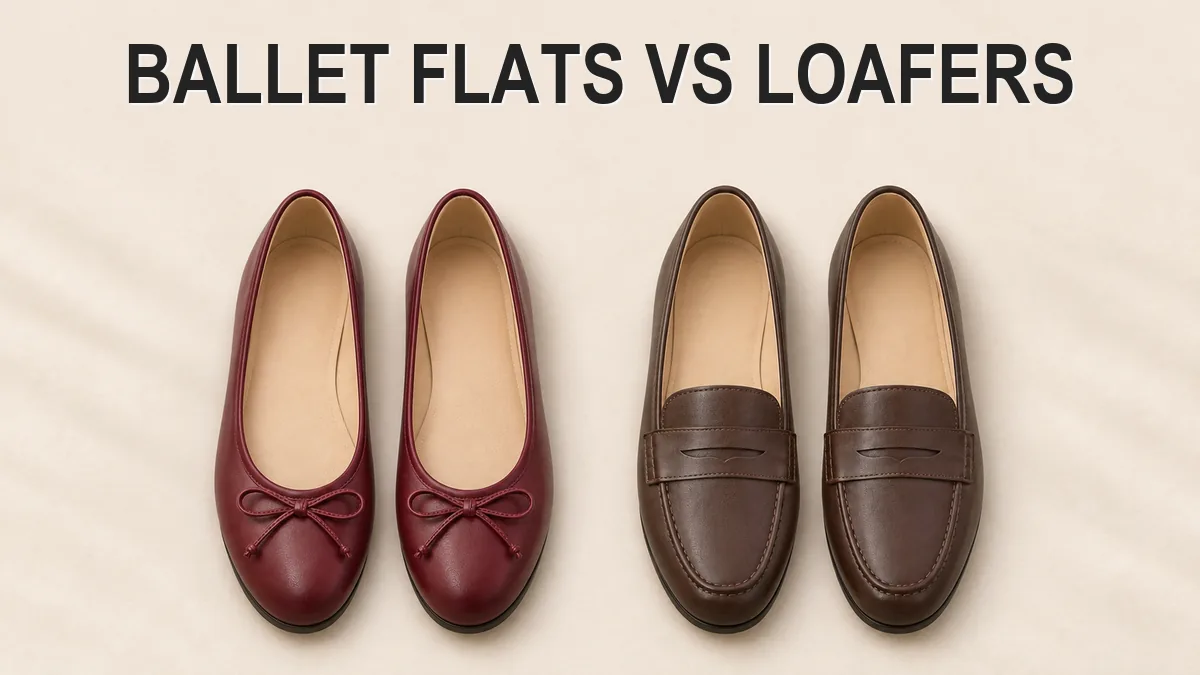
Ballet flats vs loafers comes down to the actual pairs you are considering. Classic ballet flats generally expose more of the instep, with a low-cut topline. Classic loafers usually have a more covered vamp and a slip-on upper with no laces. Beyond that, real pairs differ. Toe shape, the size of the opening, the heel and sole profile, whether any part actually closes or adjusts, and fit all vary from pair to pair.
Compare your candidates against what you need them to do. Depending on your requirements, one pair may suit you, both may cover different days, or neither may be right. Neither category wins on comfort or durability by default.
What the Labels Usually Mean and Where Real Pairs Depart
Classic ballet-flat tendencies
The ballet flat is modeled on the ballet slipper. The classic version has a low-cut topline that leaves much of the top of the foot exposed, a rounded toe, a thin sole and a plain upper with little decoration. Treat that as a starting point. It says nothing fixed about what the upper or sole is made of, and it does not promise that a given pair will feel right on the first wear. Read the listing for the pair you are looking at.
Classic loafer tendencies
A classic loafer is a slip-on shoe with no laces and no fastening. It has a closed toe and leaves the ankle exposed, and its vamp, the front part of the upper, covers more of the instep than a classic ballet flat does. Penny loafers add a strap across the vamp with a cut-out slit. Horsebit loafers carry a metal bar across the vamp. Tassel loafers have tassels hanging from the front.
Modern variants and the scope of this guide
Both labels now cover a wide spread of shoes. Ballet flats come with pointed, square and open toes, ankle straps and embellishments. Loafers come with chunky soles, lug soles and heels, and as backless loafer mules. Not every loafer is flat, closed-back, leather, wide or rigid.
The detailed comparison here covers two flat, closed-back candidates: a ballet flat and a loafer that both sit low to the ground. A heeled or backless pair needs its own assessment, because the heel checks below assume a closed back and a flat stance.
Decoration Versus Parts That Actually Open or Adjust
Bows, penny bands, horsebits, tassels and toe seams
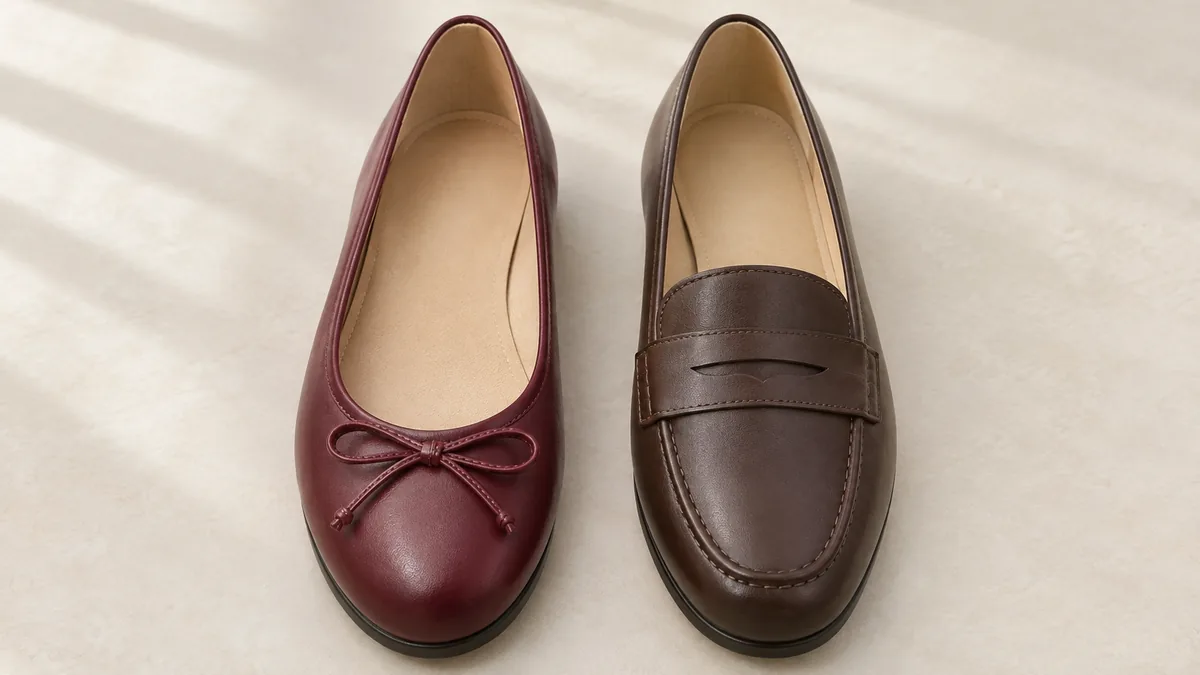
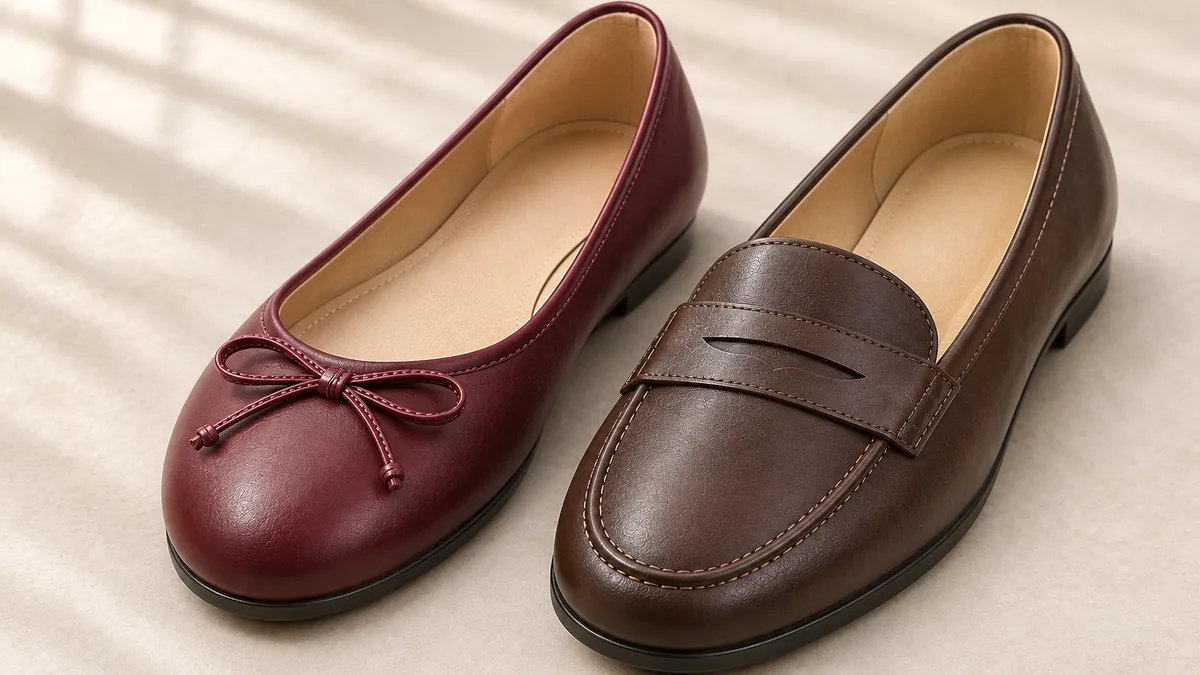
Many of the details that give each style its look are appearance cues, including a bow on a ballet flat, a penny band or horsebit across a loafer vamp, tassels, or a visible seam around the toe or apron. On their own, they do not tell you whether anything on the shoe tightens, loosens or fastens. A bow may be stitched in place. Hardware may be fixed. A loafer's fuller upper covers more of your foot, but that coverage does not guarantee your heel will stay put.
Checking function on the pair in hand
Sort each detail into one of four groups, based on what the listing, label or seller states:
- Decoration: stated as decorative.
- Working closure or adjuster: a buckle, drawstring, strap or similar part the maker says you can operate to change the fit.
- Passive elastic give: a stretch panel or elasticated edge that flexes on its own. You can't set it, so record it apart from an adjuster.
- Unclear: nothing stated.
Don't tug, untie or pry at a detail whose function you don't know. A bow that looks like the end of a drawstring does not prove a drawstring exists. Ask the seller how the part is meant to work and note the answer. Forcing a fixed decoration can damage a pair you may still want to return.
A Side-by-Side Record of What Each Pair Declares
Before trying anything on, write down what each pair tells you. Make one copy of this table for the ballet flat and one for the loafer, with the same rows, so gaps show up side by side.
| Row | What the listing or label states | What you can see | Still unknown |
|---|---|---|---|
| Upper coverage and opening | |||
| Declared heel and forefoot profile | |||
| Closure | |||
| Lining | |||
| Footbed | |||
| Sole attachment | |||
| Upper material composition | |||
| Maker care instructions |
Fill the "still unknown" column honestly. If the listing names the upper as leather but says nothing about the lining, the lining is unknown. Writing "probably leather" turns a guess into something you might later rely on.
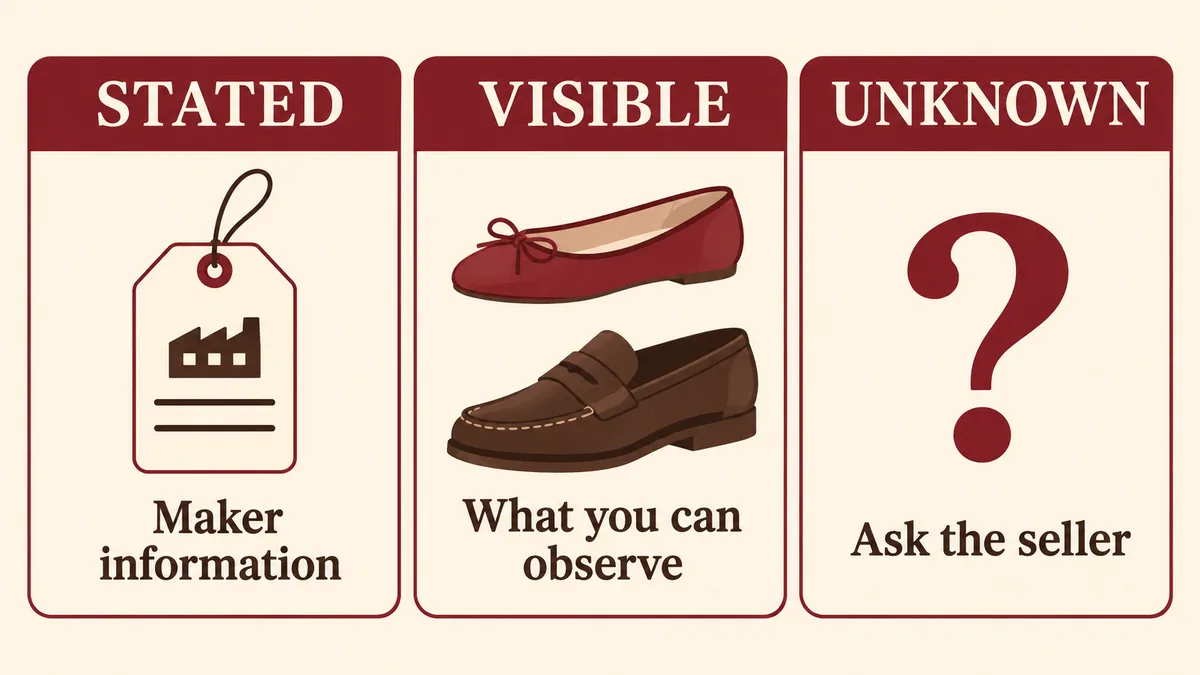
A style name describes a look. It does not certify how a shoe was built, what it is made of or how long it will last, and two loafers sold under the same style name can differ in all three. Visible stitching has a similar limit. A seam around the toe or apron does not, on its own, show how the sole is attached underneath. Record the seam under what you can see and the sole attachment under what the maker states, and mark it unknown if the listing says nothing. For general background, this overview of how shoes are made explains the process, though you don't need it to fill in the record.
Profile works the same way. If the listing states a heel height or describes the forefoot, write it down. If it only shows photos, note what you see and leave the exact figures as unknown.
Try-On Checks at Heel, Instep, Toes and Edges
Run the same checks on both pairs in one session if you can, so the conditions match.
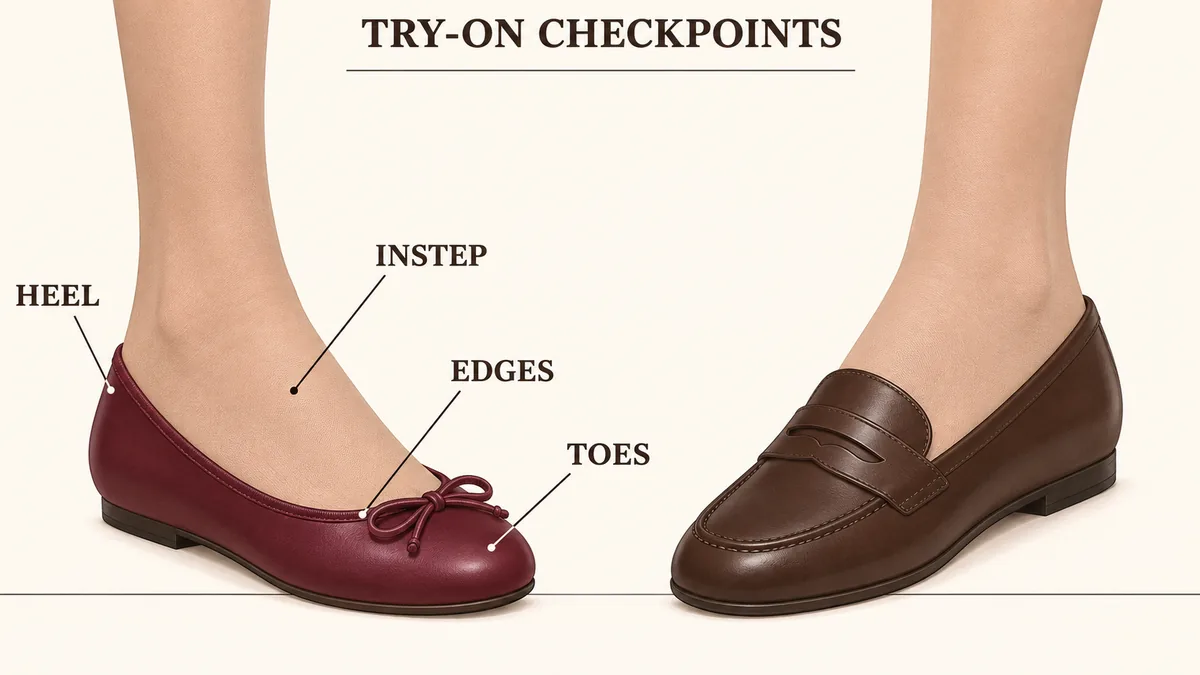
Heel and back
Walk a few steps at your normal pace. Notice whether your heel lifts out of the back or slides side to side. While standing, look at the back of the shoe and note any visible gap between your heel and the rear upper. Feel for rubbing along the topline at the back. Write down what you notice so you can compare the two pairs or raise it with the seller. A gap or some movement on its own doesn't tell you the cause or the right size.
Instep and topline
On the loafer, check whether the vamp or a band presses on the top of your foot as you stand and step. On the ballet flat, check whether the low topline cuts in along the sides or across the toes, and whether the opening gapes away from your foot at the sides as you walk.
Toes and forefoot
Stand and walk normally. Notice whether your toes press against the front or sides, and whether the upper's edges rub at the little toe or near the big-toe joint. Watch how the forefoot behaves through ordinary steps, and don't bend the shoe by hand. A short indoor walk shows how the pair feels now. It cannot reveal hidden structure or material quality, or predict how the shoe will feel after months of wear.
Socks, hosiery and returns
Try each pair with the socks, tights or hosiery you plan to wear with it, where the retailer permits. Even a thin layer can change how the heel and toes sit. Walk on clean indoor surfaces and read the retailer's return conditions first, since outdoor wear or sole marks may affect a return.
When pressure or slipping persists
If the heel keeps slipping or a spot keeps pressing, treat that as information about this pair in this size. Sizing down to stop a slip may move the pressure elsewhere, and stretching or a promised break-in may not fix it, so don't buy on that hope. Try another size or width the maker offers, ask the seller whether they have guidance for the issue, or return the pair under the retailer's actual terms, since return periods and try-on rules vary. Fit guidance differs by maker and design, so one fixed allowance for room or slip won't cover every pair. What counts is whether this pair stays on and feels manageable on your foot during your checks.
A Hypothetical Paired-Listing Record
This example is hypothetical. Listing A and Listing B are invented to show how the record works. They are not real products, and no one has worn them, so the own-wear column stays blank.
| Listing | Stated or visible features | Missing information | Questions for the seller | Own-wear observations |
|---|---|---|---|---|
| A: ballet flat | Low topline, rounded toe, front bow, upper material named | Lining material, sole attachment and bow function not stated | Is the bow decorative or a working drawstring? What is the lining? How is the sole attached? | Blank until try-on |
| B: loafer | Covered vamp, penny band, low profile in photos, upper care instructions given | Heel height, footbed material and band function not stated | Is the band fixed or adjustable? What is the heel height? What is the footbed made of? | Blank until try-on |
In this record, Listing A's bow appears under visible features while its function sits under missing information, because a photo of a bow cannot answer that question. Listing B's photos show a low profile, but with no stated heel height, the figure stays unknown. Each gap becomes a question for the seller.
When answers come back, update the table. If the seller says Listing A's bow is stitched in place, record it as stated decoration. If no answer comes, the item stays unknown, and you decide whether that gap matters enough to rule the pair out.
One, Both or Neither for Your Routine and Wardrobe
Commute, office and occasion questions
With both records and try-ons done, test each pair against how you'll wear it:
- How far do you walk on a typical day, and on what surfaces, such as pavement, transit stairs, carpet or polished floors?
- How long do you stand at a stretch?
- Does your workplace or an event you have in mind expect a particular look, and does this pair meet it?
- Does the shoe need to move between settings in one day, such as commute, office and dinner?
- Did you try it with what you plan to wear on your feet?
Start with the requirements that matter most, such as a dress code, long standing time or the surfaces you walk on, then weigh what each listing states about intended use alongside what you noticed in the try-on. A pair that misses one of those key requirements isn't your pick, however many smaller answers it fits. If one pair meets them and passed your try-on checks, that pair is your pick. If both do and they suit meaningfully different days, owning both can make sense. If an important question about your routine is still unanswered, keep looking. A short try-on indoors shows how a pair sits on your foot, but it can't confirm how the pair will handle a full day or wet ground.
Material and care checks from the maker
Suede, smooth leather and textile uppers need different care, and finishes vary within each. Read the care instructions on the actual maker's label or listing for each pair. If none are given, ask the seller before you buy, and weigh any extra upkeep against how often you'd wear the pair.
When neither fits the job
Neither is a valid result. Both pairs can fail the try-on in every size offered, or both can be wrong for your routine. Walking away means only that these two pairs didn't work. It says nothing about either category on price, durability, flexibility, wet use or comfort. Return them within the conditions and widen your search.
Compare Your Two Actual Pairs: Next Step
Copy the side-by-side table for both pairs and fill in what each listing states, what you can see and what is still unknown. Send the seller your open questions about closures, lining, footbed and sole attachment. Run the heel, instep, toe and edge checks with the socks or hosiery you plan to wear, on a clean indoor surface. Add your own-wear notes to the record, then decide on one, both or neither before the return window closes.
Frequently Asked Questions
Are loafers more comfortable than ballet flats?
Not as a category. Comfort comes down to the specific pair and your foot: how well the heel stays in place, how much room your toes have, how the forefoot flexes in ordinary steps, and where the topline or vamp meets your foot. A loafer with a fuller upper can still slip, and a ballet flat can still pinch. Run the try-on checks on both actual pairs with your intended hosiery and compare what you notice.
Does a bow or penny band adjust the fit?
You can't tell from the look. A bow or band could be fixed decoration, a working closure such as a drawstring or buckle that you operate, or part of an elastic section that gives on its own without letting you set the fit. These behave differently, so check what the listing or label states. If it says nothing, ask the seller how the part is meant to work instead of pulling on it to find out.
What should I do if my heel slips out of a flat or loafer?
First, retest with the socks or hosiery you plan to wear, since a different layer can change how the heel sits. If it still slips, try another size or width the maker offers, or ask the seller whether they have guidance for that style. If nothing on offer solves it, return the pair within the retailer's conditions. Don't count on sizing down or breaking the pair in to fix the slip.
Do I need to wear socks with loafers or ballet flats?
The style name alone doesn't decide it. Your choice depends on the occasion or dress expectations you need to meet, any guidance the maker gives for the pair, and your own preference. Decide what you intend to wear with each pair, whether that is socks, tights, hosiery or bare feet, and use that during a permitted try-on so the fit you test matches the way you'll wear the shoes.
How should I care for ballet flats and loafers?
Care follows the material and finish, so the style name won't tell you much. A suede loafer and a smooth leather loafer may need different care, and the same goes for ballet flats with leather, textile or synthetic uppers. Use the care instructions on the actual maker's label or listing. If the pair came with no care information, ask the seller before cleaning or treating it, since the wrong product could mark the finish.
About TLSTAGE
Since 2012, TLSTAGE has been your trusted one-stop fashion supply partner from Guangzhou, China—specializing in women's footwear, apparel, bags, and accessories.
What started as a specialized footwear supplier has grown into a full-range fashion supply partner, driven by client trust and proven by consistent quality across every product category.
- 20+Years Industry Expertise
- 30+Countries Served
- 300+Global Buyers Trust Us
- FlexibleMOQ by style and project