
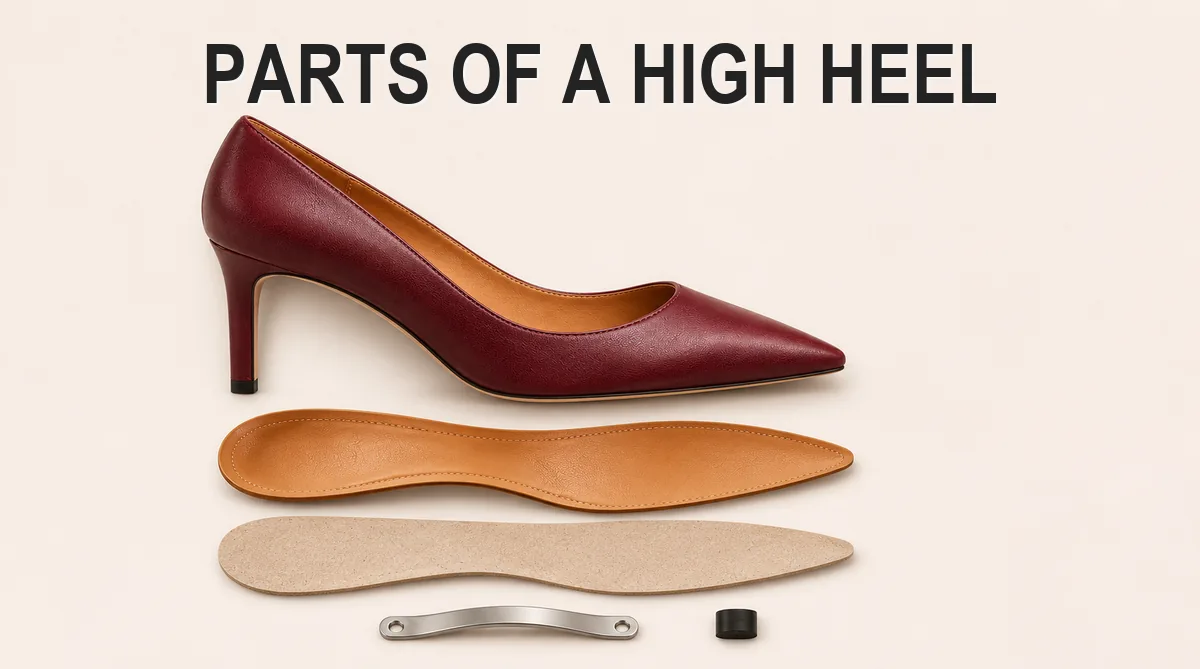
The parts of a high heel fall into three zones, using a closed-back pump as the reference shoe. The upper covers the foot: vamp, toe box, quarter, counter, topline and lining. Underneath, the outsole and the top lift at the heel tip meet the ground, while the seat, heel and heel breast make up the rest of the lower structure. Inside, the insock is the layer you see and stand on. It covers the hidden structure: the insole board, any padding, and the shank, a rigid strip that reinforces the arch area so the shoe holds its shape.
Construction varies, so not every heel has every part. An open-back mule can do without a counter, and an open-toe sandal has no enclosing toe box. A few of these terms also get mixed up often, even in shoe guides. Quarter and counter get blurred together, “insole” is used for two different layers, and pitch is treated as another word for heel height. The right names make it easier to tell a retailer or a cobbler exactly what went wrong with a pair.
The Three Zones at a Glance
Use this as a quick reference. Each part is covered in more detail below.
| Zone | Part | Where it is | What it does |
|---|---|---|---|
| Upper | Vamp | Front panel over the top of the foot | Covers the forefoot |
| Upper | Toe box | Front of a closed-toe upper | Encloses the toes; sets toe shape |
| Upper | Quarter | Rear and sides, behind the vamp | Forms the back of the upper |
| Upper | Counter | Back of the shoe, around the heel | Keeps the rear in shape |
| Upper | Topline | Edge of the foot opening | Finishes the edge; joins outer to lining |
| Upper | Lining | Inside of the upper | Covers interior seams |
| Lower | Outsole | Underside of the shoe | Meets the ground |
| Lower | Platform (optional) | Under the forepart | Raises the ball of the foot |
| Lower | Seat | Where heel meets shoe body | Joins the heel to the shoe |
| Lower | Heel | Raised block at the rear | Lifts the back of the foot |
| Lower | Heel breast | Front face of the heel | Faces forward under the arch area |
| Lower | Top lift | Base of the heel | Replaceable wear surface |
| Inside | Insole board | Base the upper is attached to | Structural foundation |
| Inside | Padding | Beneath the insock, around the foot-contact layers; arrangement varies | Adds cushioning |
| Inside | Insock | Top layer under the foot | Covers the insole board |
| Inside | Shank | Between insole and outsole, heel to arch area | Rigid reinforcement |
Upper Parts: From Toe to Topline
Vamp and Toe Box
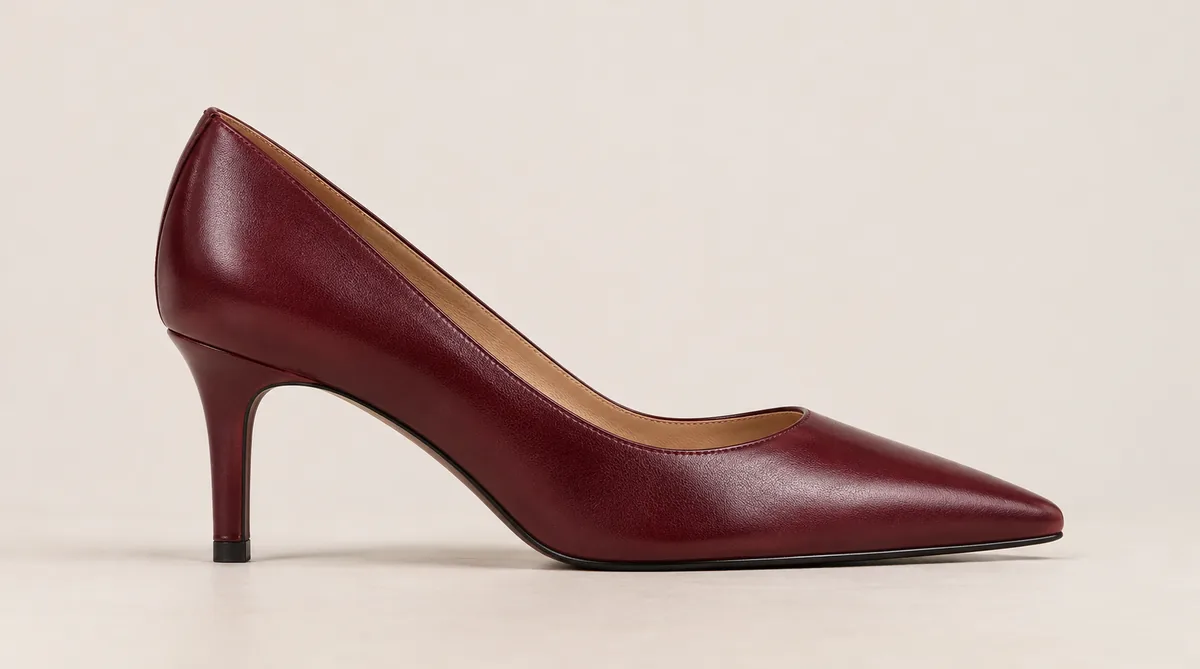
The vamp is the front panel of the upper, covering the top of the foot from the toe area back to the quarter. A low vamp shows more of the toes and the top of the foot, and a high vamp covers more. On a sandal, the strap across the front of the foot does the vamp's job and goes by the same name.
The toe box is the part of the vamp that encloses the toes on a closed-toe shoe. Its shape is what you're naming when you call a pump pointed, almond, square or round. Open sandals generally have no enclosing toe box. A peep-toe can keep an enclosed toe area with an opening cut into the front, so it may still have a toe box even though some toes show.
Topline and Lining
The topline is the finished edge around the shoe's opening. On many heels it is top-stitched, and that stitching joins the outer material to the lining while shaping the edge.
The lining is the inner layer your foot touches, often leather or fabric. It covers the seams and rough edges of the upper's construction. Because lining and outer meet at the topline, that edge is one of the places a loose lining can show.
Quarter vs Counter vs Stiffener
These three terms overlap, and some guides blur them so far that the quarter ends up described as part of the heel block. It isn't.
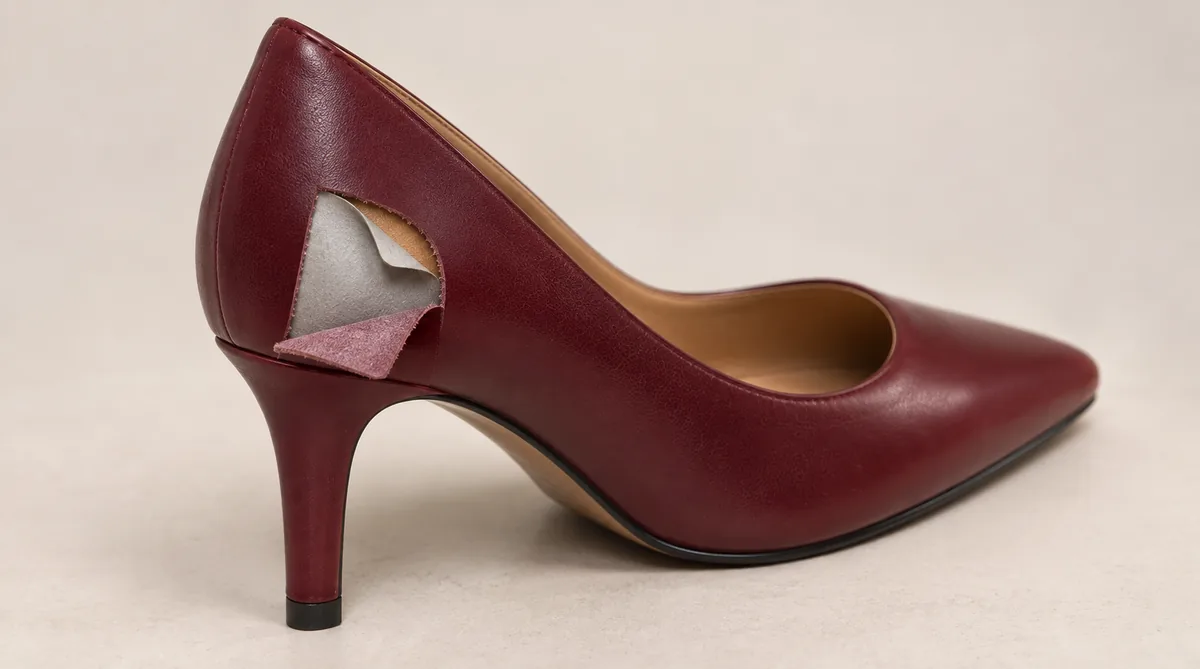
The quarter is a section of the upper. It covers the back and sides of the shoe, starting where the vamp ends and wrapping around the rear. Trace a pump's upper from the toe backward, and everything after the vamp is quarter.
The counter is the rear area of the upper that cups the back of your heel and is built to keep its shape. That firmness comes from a stiffener, a sturdy piece of material set between the outer upper and the lining at the back of the shoe. The stiffener is what stops the back from folding flat when you press it.
Shoemakers often use “counter” for the stiffener itself as well as for the firm area it creates, so you'll see both usages. They aren't always two separate physical pieces. Think of the stiffener as the hidden material and the counter as the firm back it produces.
To keep them straight, remember that the quarter is the panel, the counter is the firm back of that panel, and the stiffener is what makes it firm.
Lower Parts: Sole, Seat, Heel and Top Lift
In the broad sense, the sole is everything below the upper, heel included. These are the lower parts you can see from underneath or from the side.
Outsole and Platform
The outsole is the layer that touches the ground. On dress heels it is often leather or a leather-look synthetic. A platform is a raised layer under the forepart, beneath the vamp and toe box, that lifts the ball of the foot higher. Not every heel has one.
Seat
The seat is where the heel joins the body of the shoe. On most heels the join looks seamless, though some designs make it a visible feature. Use this term when a heel moves, rocks or wobbles, because it tells the reader exactly where the movement happens.
Heel and Heel Breast
The heel is the raised block under the rear of the shoe. It can be slim or chunky, in stacked leather, wood, plastic, metal or other materials, but in the anatomy its job stays the same: raising the back of the foot.
The heel breast is the heel's forward-facing surface, the side that faces the toe and sits under the arch area. On some shoes, often higher-end ones, the covering material runs continuously from the sole down the heel breast.
Attachment varies by construction. In one shoemaker's mule tutorial, the covered heel is fastened through the insole board, and the heel tip goes on at the same stage. Treat that as one method, not the rule.
Top Lift
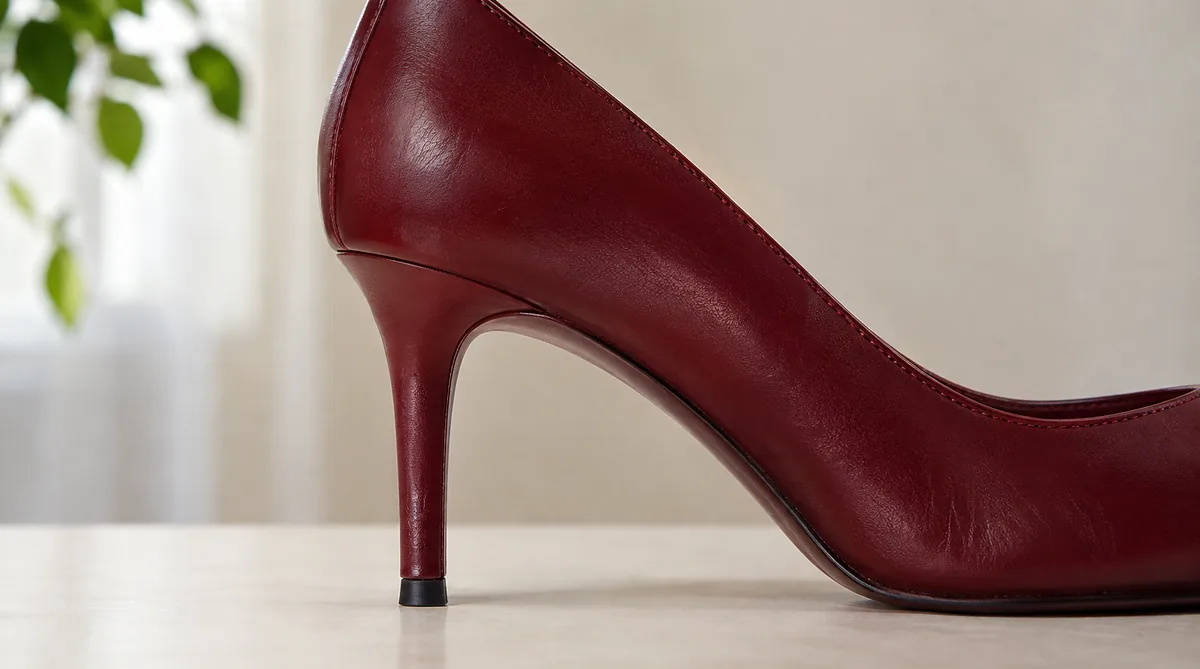
The top lift is the small piece at the very base of the heel that meets the floor. It's also called the top piece, heel tip or heel cap. It is often a hard-wearing plastic, and it takes most of the wear. A cobbler can often replace a worn one, though how easily depends on how the heel was built.
Pitch vs Heel Height
Heel height and pitch describe different things.
Heel height is a vertical measurement: how tall the heel is. Pitch is the slope the foot sits on, from the back of the foot down to the ball of the foot. Shoemakers set that slope with the last, the form the shoe is built on, and the insole board has to match it.
A platform is where the two separate. Picture two hypothetical shoes with the same tall heel, one flat under the forepart and one with a platform. Both heels measure the same, but the foot in the platform shoe sits on a gentler slope because the front is lifted too. The platform reduces the effective pitch without shortening the heel.
So “how high is the heel?” and “how steep is the shoe?” can have different answers. When you compare or describe heels, say which one you mean.
Insole Board vs Insock: Two Different Layers
The word “insole” gets used for two different layers, and “footbed” and “sock liner” get mixed in too.
The insole board is structural. It is the firm, foot-shaped base that the upper is attached to during lasting, the step where the upper is shaped over the last. In heeled shoes it is often a shanked insole, with the shank built into it. You don't see the insole board in a finished shoe, and it isn't meant to come out.
The insock, also called the sock liner or sock insole, is the top layer your foot touches. It sits above the structural insole board and can add cushioning. How much padding a shoe has under the insock, and how it is arranged, varies from shoe to shoe.
Some insocks are fixed in place and some can be removed; it depends on the shoe. To find out about your own pair, check the product description or ask the retailer. Don't pry the insock up to test it, since a glued one can be damaged.
The Shank: The Hidden Reinforcement
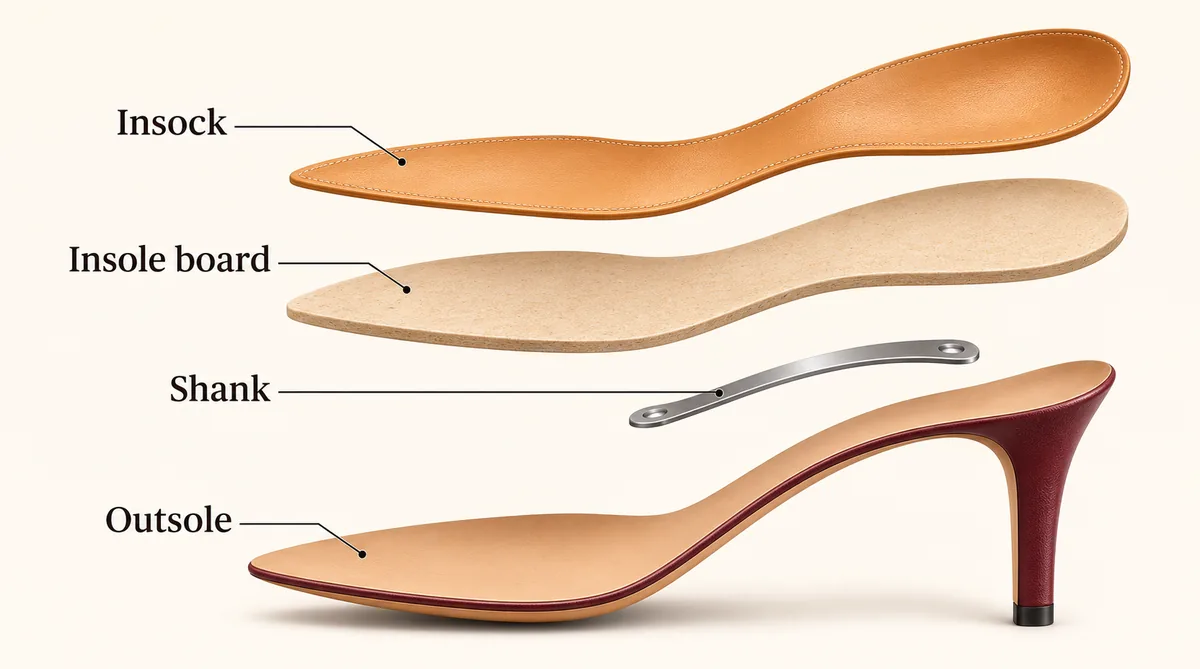
The shank is a narrow, rigid piece built into the bottom of the shoe, between the insole and the outsole. It runs from the heel area toward the arch area. Shanks are commonly metal, plastic or wood.
Its job is reinforcement. The shank keeps the arch area of the shoe rigid, so the bottom of the shoe holds its shape between the heel and the forepart instead of bending there.
You can't see a shank in a finished shoe because it is sealed between layers during construction, with the insole board and insock above it and the outsole below. A product description that mentions a steel shank or a shanked insole is often the only clue a shopper gets.
A shank or rigid arch listed in a product description doesn't tell you the heel is securely attached. How firmly the heel is fastened is a separate question. Footwear test labs measure heel attachment strength and the rigidity of the back part of the shoe with their own methods, and those methods have limits: SATRA's TM113, for example, covers most footwear with separately attached heels but is not normally suitable for heels lower than 30 mm.
The Last: The Tool Behind the Shape
The last is the foot-shaped form a shoe is built on. The upper is shaped over it and attached to the insole board, and the last sets the shoe's toe shape and pitch. A heeled last is made for a particular heel height, and the insole board has to match its pitch. In one shoemaker's mid-heel mule example, a mid-height last calls for a mid-height shanked insole and a mid-height heel.
The last is removed during manufacture and can be reused for other pairs. It doesn't remain in the finished shoe, so it never appears among the parts you can point to. For the full sequence from cutting to finishing, see how shoes are made.
Using Part Names to Describe a Problem
A retailer or cobbler can act on a description that names the part and says what it is doing. The wording below is hypothetical, written to show how the terms translate rather than drawn from real cases.
- Instead of “the heel feels wobbly,” say: “The right heel moved at the seat, where it joins the shoe, while I was walking.”
- Instead of “the bottom is clicking,” say: “The left heel clicks on hard floors, and the top lift at the tip looks worn down.” Mention the wear only if you can see it; otherwise describe the sound and where it seems to come from.
- Instead of “the back has gone soft,” say: “The counter on the right shoe has collapsed and doesn't hold its shape.”
- Instead of “the inside is peeling,” say: “The lining is coming loose at the topline on the inner side of the left shoe.”
A few details make any of these clearer. Say which shoe, left or right, and which side, inner or outer. Say when it happens, such as standing, walking or only on hard floors. Attach photos, one of the whole shoe from the side and a close-up of the part you're naming. For a seat problem, a photo from behind showing the heel's angle helps. If the shoes have been repaired before, mention it.
The same wording works in a written return request. A retailer can pass “the heel moves at the seat” straight to whoever assesses it, and a cobbler reading “worn top lift” knows which part to look at before the shoe is on the bench.
Frequently Asked Questions
Can you see or feel the shank in a high heel?
Generally no. The shank is sealed between the insole and the outsole during construction, so it is hidden in a finished shoe and isn't meant to be felt as a separate part. Its role is to keep the arch area of the shoe rigid. A listing that mentions a steel shank or shanked insole is usually the only sign it's there.
Is the insole in high heels removable?
It depends which layer you mean. The insole board is structural. The upper is attached to it, and it stays in the shoe. The insock, the top layer your foot touches, may be glued in or removable depending on the shoe. Check the product description or ask the retailer rather than prying it up.
What is the small tip at the bottom of a heel called?
It's the top lift, also called the top piece, heel tip or heel cap. It's the part that meets the floor, often a hard-wearing plastic. When it wears down, a cobbler can often replace it, but how easily depends on the heel's construction, so ask before assuming it's a quick fix.
Is the counter the same as the quarter?
No. The quarter is the rear and side panel of the upper, behind the vamp. The counter is the firm back of the shoe that cups your heel. A stiffener between the outer and the lining gives the counter its shape, and shoemakers often use “counter” for that stiffener too.
What should I say if my heel feels loose?
Describe where it moves and what you can see, without guessing the cause from a noise. If the whole heel shifts or rocks where it joins the shoe, say “the heel moves at the seat.” If you hear clicking, say where it seems to come from, and mention a worn or loose top lift only if you can see it. Add which shoe, left or right, and send photos of the heel from the side and behind. Stop wearing the pair until the retailer or a cobbler has looked at it, and don't bend or press on the heel to test it.
About TLSTAGE
Since 2012, TLSTAGE has been your trusted one-stop fashion supply partner from Guangzhou, China—specializing in women's footwear, apparel, bags, and accessories.
What started as a specialized footwear supplier has grown into a full-range fashion supply partner, driven by client trust and proven by consistent quality across every product category.
- 20+Years Industry Expertise
- 30+Countries Served
- 300+Global Buyers Trust Us
- FlexibleMOQ by style and project