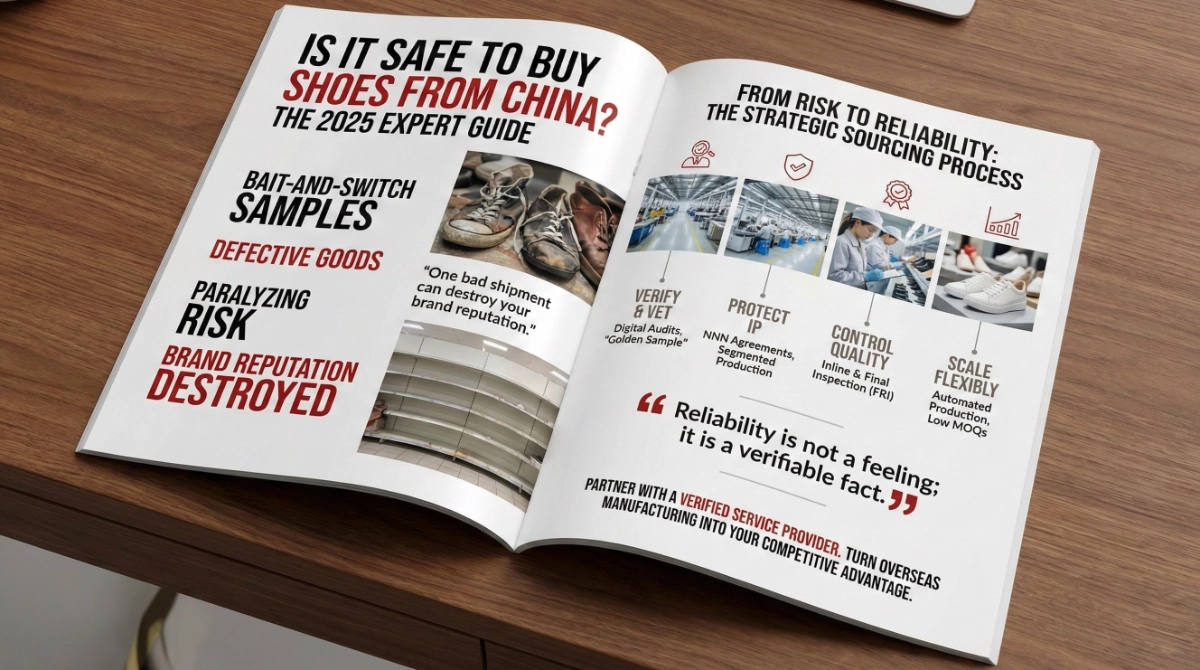
You are a fashion buyer facing a critical dilemma: you need the unbeatable margins and massive production capacity of the Asian market, but you are terrified of the horror stories. We have all heard them. The bait-and-switch samples. The suppliers who ghost you after the deposit is paid. The containers that arrive full of moldy or defective goods.
Imagine launching your new season’s collection only to find the heels are unstable or the “leather” is actually cheap synthetic material. Here’s the deal: One bad shipment can destroy your brand reputation, drain your bank account, and leave your retail shelves empty while your competitors thrive. The risk feels paralyzing because your business’s survival hangs on the integrity of a factory thousands of miles away.
Sourcing is safe, but only if you navigate the landscape with a professional strategy. It is not about luck; it is about process. By partnering with a verified service provider like TLSTAGE, you gain the safety of on-site quality control, legal protection, and “one-stop” consolidation. This guide reveals exactly how to secure your supply chain and turn overseas manufacturing into your strongest competitive advantage.
1. Is Every Shoes Manufacturer in China Reliable?
The manufacturing landscape in China is a vast spectrum. On one end, you have world-class facilities that produce for luxury giants like Prada and Nike, operating with surgical precision and strict compliance. On the other end, there are “fly-by-night” trading scams and unregistered workshops that exist solely to capture deposits from inexperienced Western buyers. You might be wondering: Why do these scams still happen in a modern economy? The answer lies in the lack of verification on open B2B marketplaces where anyone can upload a glossy photo and claim to be a factory.
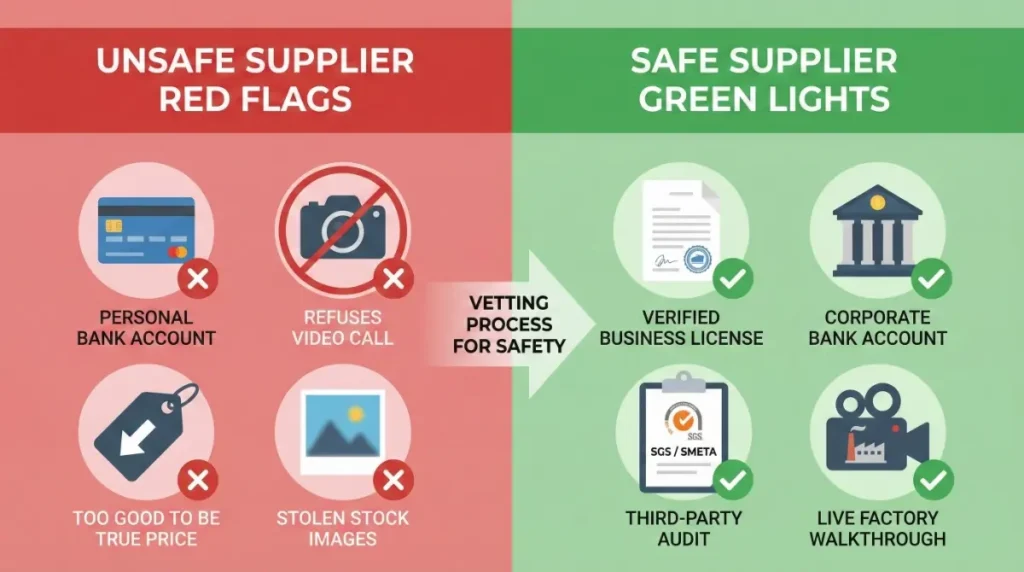
When searching for partners, you must be vigilant for specific red flags. A legitimate manufacturer will never refuse a video call or ask for payment into a personal bank account. If a supplier offers a price that seems too good to be true, it almost certainly is. These entities often use stock images stolen from legitimate brands to lure you in. But here’s the kicker: Professional scammers often have the best-looking websites because they invest in marketing rather than machinery.
Reliability is not a feeling; it is a verifiable fact. You must insist on seeing business licenses and third-party audit reports such as SGS or SMETA. A trusted partner like TLSTAGE pre-vets every factory in its network, conducting physical on-site inspections to ensure the machinery, labor force, and management systems are real. This elimination of “blind trust” is the first step toward safety.
| Verification Check | Unsafe Supplier Indicator | Safe Supplier Indicator |
|---|---|---|
| Business License | Refuses to show or sends blurred image | Clear, verifiable with local AIC database |
| Payment Method | Western Union / Personal Bank Account | Corporate Bank Account / Letter of Credit |
| Factory Audit | “Not convenient right now” | Welcomes 3rd party inspection (SGS/Intertek) |
| Sample Policy | “Free if you order right now” | Structured sampling cost & clear timeline |
2. Why Pick a Shoes Manufacturer in China Now?
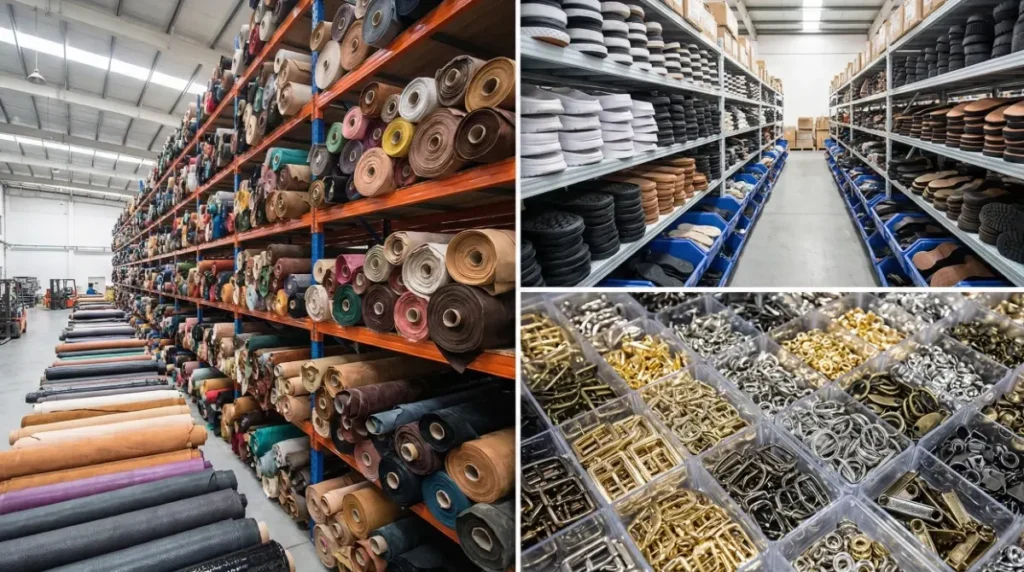
China is not merely a place for assembly; it is the world’s most complete supply chain ecosystem. While other countries offer cheap labor, they often lack the localized components industry. In Guangzhou or Dongguan, a factory can source specialized heels, custom buckles, specific leather grains, and eco-friendly glues within a 50-mile radius. Look: No other country offers this density of supply chain, which translates directly into speed and stability. China currently produces nearly 55% of the world’s footwear, a statistic that speaks to its dominance and capability.
There is a persistent myth that “China equals cheap and low quality.” This is outdated. Today, you are paying for efficiency and advanced infrastructure, not just cheap labor. Advanced automated cutting machines and computerized stitching systems allow Chinese manufacturers to produce high-quality footwear at a unit cost that is impossible to match in Europe or the US. What’s the real story? You are accessing an industrial machine that has been refined over forty years to deliver maximum value.
Furthermore, China has become a leader in innovation. Factories are pioneering the use of recycled materials and automated assembly lines that reduce human error. By working with a forward-thinking partner like TLSTAGE, you leverage these technological advancements. You get access to the latest material trends and production techniques before they hit the mainstream market, giving your brand a distinct edge.
| Benefit Category | Western Manufacturing | Shoes Manufacturer in China |
|---|---|---|
| Raw Material Access | Imported (Slow & Expensive) | Local/Immediate (Fast & Cost-effective) |
| Labor Cost | High ($20+/hr) | Competitive (Efficiency-driven) |
| Production Scale | Limited Capacity | Massive Scalability |
| Turnaround Time | 6-8 Weeks | 3-4 Weeks (Optimized) |
3. How to Vet a Shoes Manufacturer in China?
The digital audit is your first line of defense. Do not rely on static photos provided on a website. You must demand a live video walkthrough of the production floor. Ask the sales representative to walk over to a specific machine or show you the current date written on a piece of paper next to a production line. Stop right there: If they make excuses about why a video call is impossible, walk away immediately. You should also verify their certifications, such as ISO 9001 for quality management or BSCI for social compliance, ensuring these documents are current and valid.
Communication is the heartbeat of a safe supply chain. You need to assess their responsiveness during the initial inquiry phase. Do they reply within 24 hours? TLSTAGE, for example, builds its reputation on a rapid response protocol because we know that time is money in fashion. Here is the truth: Poor communication is usually a precursor to poor quality. If they cannot understand your email about pricing, they will definitely misunderstand your technical specification regarding heel height or material tolerance.
The ultimate vetting tool is the “Golden Sample.” You should never, under any circumstances, place a bulk order without a perfect prototype in your hand. This sample becomes the binding contract standard for mass production. You must inspect the stitching tension, the smell of the glue, the balance of the shoe, and the feel of the material. If the sample is flawed, the production run will be a disaster.
| Vetting Step | Purpose | Success Metric |
|---|---|---|
| Video Call | Verify physical existence | Real-time view of machinery and workers |
| Reference Check | Verify reputation | Contactable past clients in your region |
| Sample Order | Verify technical capability | Sample matches tech pack 100% |
| Cert Check | Verify compliance | Valid ISO/BSCI documents verified online |
4. Will a Shoes Manufacturer in China Steal IP?
Intellectual property theft is a valid concern for any designer. You have poured your creativity into a unique heel shape or a custom print, and the thought of seeing it on a competitor’s shelf or Alibaba the next month is terrifying. Let’s be honest: IP theft does happen, but it is most common when dealing with unverified, low-tier factories that have no reputation to protect. Manufacturers who invest in long-term relationships with Western brands understand that theft is bad for business.
To protect yourself legally, you need more than a standard Western NDA. You need an NNN Agreement (Non-Use, Non-Disclosure, Non-Circumvention) that is enforceable under Chinese law. This contract prevents the factory from using your molds for other clients or selling your rejects out the back door. You need to know: A contract is only as good as your ability to enforce it, which can be difficult and expensive for a small business located overseas.
The most practical strategy is to use a trusted intermediary to safeguard your designs. Partners like TLSTAGE protect your private label by segmenting the supply chain. We can have the outsole mold made at one facility and the upper stitched at another, with final assembly happening under strict supervision. This ensures that no single factory has the complete picture of your proprietary design until the final assembly stage, which we monitor.
| IP Protection Strategy | Effectiveness Level | Implementation Cost |
|---|---|---|
| Western NDA | Low (Unenforceable) | Low |
| China NNN Agreement | High (Legal standing) | Moderate |
| Trademark Registration | Very High (Customs protection) | Moderate |
| Trusted Intermediary | High (Relationship-based) | Included in Service |
5. Can a Shoes Manufacturer in China Scale Up?
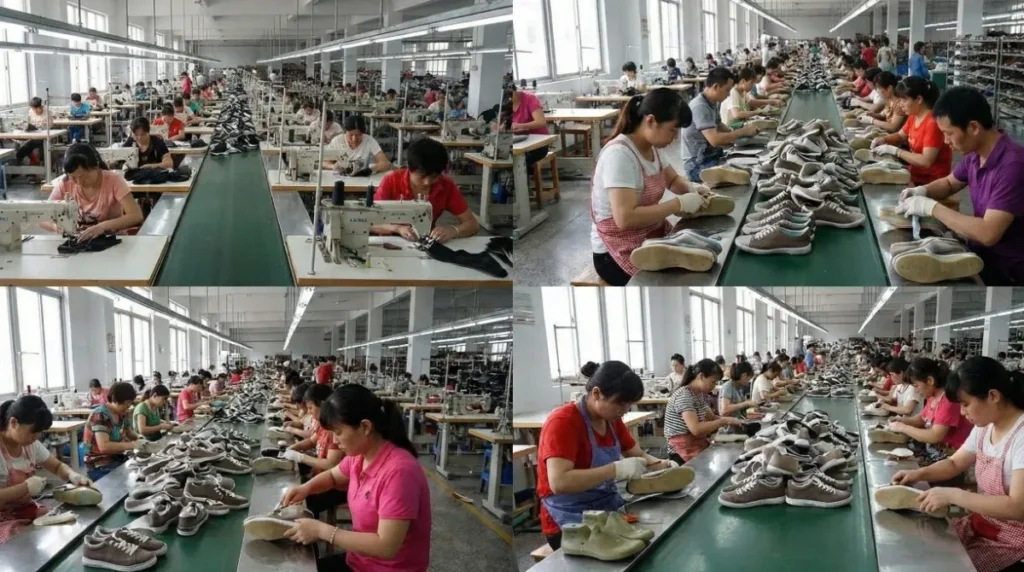
For buyers like David, who manages procurement for a large chain store, the primary fear is a supply chain rupture. If a style goes viral and you need 50,000 pairs in four weeks, a small workshop will collapse under the pressure. Think about it: Can your current supplier handle a sudden massive reorder without sacrificing quality? China is unique because of its ability to surge labor capacity seasonally. Large factories have relationships with satellite workshops and labor pools to ramp up production instantly.
Speed to market is critical for e-commerce buyers like Alex, where trends rise and fall in weeks. Here’s the deal: You need a supplier who can prototype in 7 days, not months. If your sample takes six weeks, the trend is over before you have even placed the order. TLSTAGE utilizes flexible production lines designed for speed, allowing us to move from concept to physical sample faster than traditional factories that are bogged down by bureaucracy.
However, scale is meaningless without consistency. The challenge is maintaining color fidelity and stitching accuracy across 10,000 pairs. This requires robust Standard Operating Procedures (SOPs). Tier 1 manufacturers in China use automated cutting to ensure every piece of leather is identical, and automated lasting machines to ensure every shoe has the same shape. Without this automation, scaling up invariably leads to quality fade.
| Scaling Factor | Small Workshop | Shoes Manufacturer in China (Tier 1) |
|---|---|---|
| Daily Output | <100 pairs | 2,000+ pairs |
| Material Stock | Purchase on demand | Warehoused inventory |
| Lead Time (Reorder) | 45-60 Days | 15-30 Days |
| Quality Variance | High (Manual dependency) | Low (Automated QC) |
6. Does a Shoes Manufacturer in China Do Low MOQ?
High Minimum Order Quantities (MOQs) are the biggest barrier for boutique owners like Chloe. Factories typically demand 1,000 pairs per style to make the production run efficient. It’s a catch-22: The factory wants volume to cover their setup costs, but you need variety to keep your store fresh and manage your cash flow. If you are forced to buy 1,000 pairs of a risky new style, you are gambling your business’s liquidity.
The solution lies in flexible sourcing. ODM partners bridge this gap by aggregating orders from multiple clients or having special agreements with production lines reserved for smaller batches. Good news: TLSTAGE offers flexible MOQs ranging from 100 to 1,000 units. This allows brands to test the market with a “mixed container” strategy—buying shoes, bags, and belts in smaller quantities to create a diverse collection without the massive financial exposure.
You need a partner who grows with you, not one who blocks you. Many large factories will ignore you until you are big, but a service-oriented partner values the long-term potential. We help you transition from 100 pairs to 10,000 pairs using the same quality standards. This scalability protects your brand continuity as you expand from a single boutique to a regional chain.
| MOQ Scenario | Direct Factory | Flexible Partner (TLSTAGE) |
|---|---|---|
| Minimum Pairs | 1,000+ per style | 100+ per style |
| Color Options | 1 color per order | Mixed colors allowed |
| Initial Investment | High Risk ($20k+) | Low Risk ($2k+) |
| Inventory Risk | High (Overstocking) | Low (Just-in-time) |
7. How Does a Shoes Manufacturer in China Do QC?
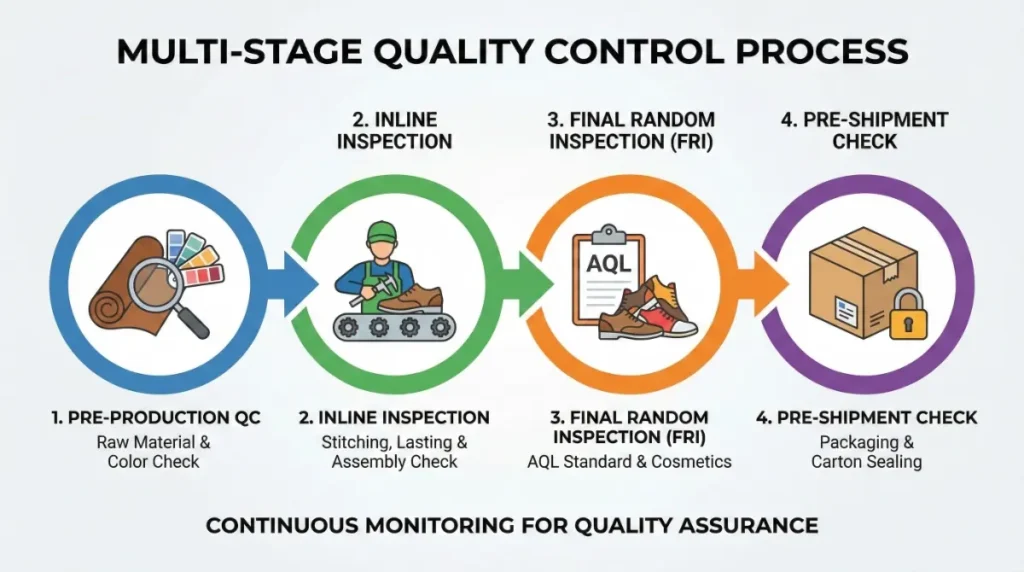
Quality control is not a single event that happens at the end; it is a continuous process. It begins with the pre-production check. Listen closely: Once the leather is cut, it is too late to fix material defects. We verify the “master sample” against the bulk materials arriving at the factory to ensure the color, thickness, and grain match exactly what you approved. If the raw material is wrong, the entire production run is doomed from day one.
Inline inspection is the next critical layer. This involves monitoring the lasting, stitching, and gluing processes while they are happening. But wait, there’s more: We do not just look for cosmetic flaws; we check for structural integrity. Is the shank properly inserted? Is the heel attached securely? Is the glue applied at the right temperature? TLSTAGE’s team is physically present during these stages to catch issues early, preventing a scenario where you have 5,000 pairs of finished shoes that all squeak when walked on.
Finally, you must mandate a Final Random Inspection (FRI) based on AQL (Acceptable Quality Limit) standards. Key Takeaway: Trust, but verify. Before the goods are packed into cartons, we inspect a statistically significant percentage of the order. You should always demand to see the QC report before the goods leave the factory gate. Once the container is sealed, your leverage is gone.
| QC Stage | What is Checked? | Risk Mitigated |
|---|---|---|
| Pre-Production | Raw Materials, Molds, Tooling | Wrong color/material usage |
| Inline | Stitching, Lasting, Gluing | Structural defects & assembly errors |
| Final (Pre-Ship) | Appearance, Packing, Barcodes | Cosmetic defects/Damages |
| Lab Testing | Chemicals, Bond Strength | Regulatory compliance failures |
8. Shipping via Shoes Manufacturer in China: Safe?
For wholesalers like Maria, logistics can destroy profit margins if not managed correctly. Understanding Incoterms is vital. Buying “Ex Works” (EXW) places all the risk on you from the factory door. Buying “Free on Board” (FOB) means the supplier is responsible until the goods are on the ship. You might be surprised: For beginners, DDP (Delivered Duty Paid) is often the safest option because the supplier handles all the risk and paperwork until the goods arrive at your warehouse door.
Packaging is an often-overlooked safety factor. The ocean environment is harsh, with high humidity and temperature fluctuations. Shoes can arrive covered in mold if anti-fungal chips or silica gel packets are not used correctly. Furthermore, weak cartons can crush under the weight of stacking, destroying the retail boxes inside. TLSTAGE enforces strict packaging standards, using reinforced corrugated cartons and proper moisture control to ensure your high heels arrive in pristine condition.
Customs compliance is the final hurdle. Key Takeaway: Paperwork errors cause the longest delays. Incorrect HS Codes or missing Country of Origin labeling can lead to your shipment being seized or heavily fined. Consolidating shipments—putting shoes, bags, and accessories into one container—not only saves on freight costs but also simplifies the clearance process.
| Shipping Term | Buyer Risk | Buyer Control | Recommended For |
|---|---|---|---|
| EXW (Ex Works) | Maximum | Maximum | Experts with own logistics |
| FOB (Free on Board) | Moderate | Moderate | Standard B2B Buyers |
| DDP (Delivered) | Minimum | Minimum | First-time Buyers |
| CIF (Cost Insur. Freight) | Low | Low | Wholesalers |
9. Agent vs. Shoes Manufacturer in China: Best?
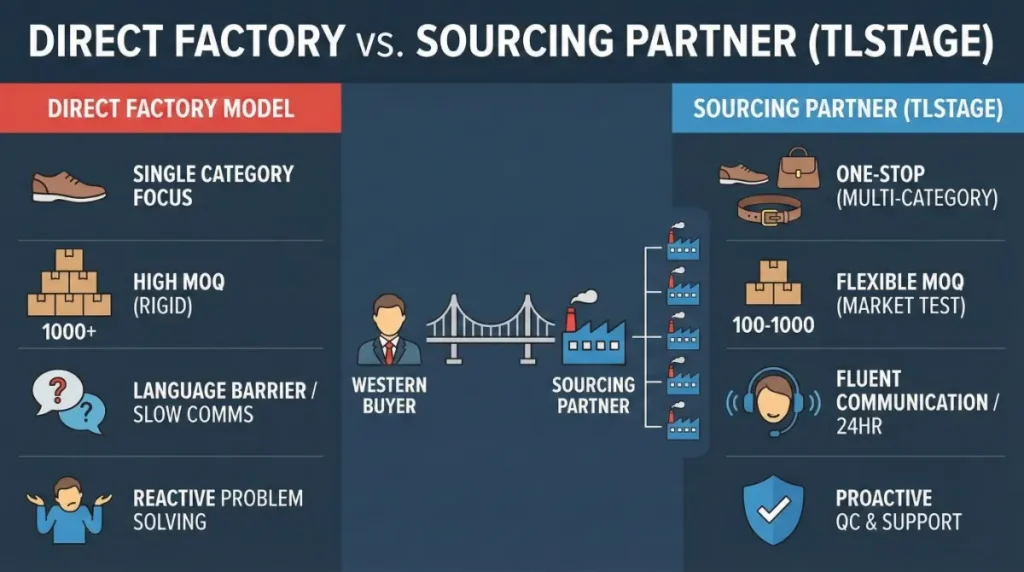
Western buyers often debate whether to go direct to the factory or use a sourcing partner. The direct factory model offers the lowest theoretical price, but it comes with rigid MOQs, poor communication, and zero extra service. Let’s face it: Direct factories focus on production efficiency, not customer service. They will often ignore small errors or packaging requests that a Western buyer would consider critical.
The Sourcing Agent or Trader model, which TLSTAGE operates under, offers a safety buffer. We act as your “eyes and ears” on the ground. Why it matters: While there might be a slight service premium, it is paid for by the value of risk mitigation. We handle the QC, we negotiate the lower MOQs, and we manage the logistics. For most Western SMEs, this layer of professional management is the difference between a successful import and a disaster.
One-Stop Sourcing is the safest approach for modern fashion brands. Key Takeaway: Consolidation reduces points of failure. Instead of managing five different factories for jeans, belts, shoes, and bags, you manage one trusted partner. This simplifies your quality control, unifies your shipping, and drastically reduces your administrative burden. Visit our blog to see how consolidation saves clients up to 30% on logistics costs.
| Feature | Direct Factory | Sourcing Partner (TLSTAGE) |
|---|---|---|
| Communication | Often slow/Language barrier | Fluent English/24hr Response |
| Product Range | Single Category (e.g., only heels) | Multi-Category (Shoes, Bags, Denim) |
| QC Loyalty | Loyal to production manager | Loyal to the client (You) |
| Problem Solving | “It is what it is” | Proactive resolution & support |
10. Future of the Shoes Manufacturer in China?
The future of sourcing is moving rapidly toward sustainability and ethics. Western consumers are demanding transparency, and Chinese manufacturers are responding. Get ready: We are seeing a massive shift toward water-based glues, recycled rubbers, and vegan leathers. Factories are undergoing SMETA audits to prove they provide fair wages and safe working conditions. This ethical alignment is becoming a non-negotiable safety factor for brands that want to avoid public relations scandals.
Digitization is also revolutionizing safety. 3D modeling and digital sampling allow buyers to see exactly what the shoe will look like before a single piece of leather is cut. This reduces physical waste and speeds up the approval process. Real-time production tracking via apps gives buyers visibility into the factory floor, creating a level of transparency that was previously impossible.
Finally, while the “China Plus One” strategy is popular, China remains the hub for high-complexity footwear. Key Takeaway: For intricate products like high heels, the skilled labor pool in the Guangzhou cluster is irreplaceable. While basic t-shirts move to other regions, the technical expertise required for quality footwear ensures that China will remain the primary engine of the industry for years to come.
| Trend | Impact on Buyer | Safety Implication |
|---|---|---|
| Eco-Materials | Higher marketability | Requires strict cert verification |
| Digital Sampling | Faster speed to market | Reduces “surprise” designs |
| Automated Production | Lower defect rates | Higher consistency & stability |
| Transparency Tech | Better visibility | Lower fraud risk |
Conclusion
Buying shoes from China is not just safe; it is the strategic engine powering the world’s top fashion brands. However, safety is not automatic. It is the result of a deliberate process: vetting rigor, legal clarity, and on-the-ground quality control. You cannot simply send money and hope for the best. You must verify, inspect, and manage.
Don’t let the fear of the unknown paralyze your business growth. By partnering with TLSTAGE, you replace risk with reliability. From our flexible MOQs (100-1000 units) to our 24-hour quotation promise and “One-Stop” sourcing for shoes, denim, and accessories, we act as your dedicated team in Guangzhou. We handle the complexities so you can focus on selling.
Ready to source with confidence? Don’t gamble with your inventory. Contact TLSTAGE today to start your risk-free sourcing journey and build a supply chain that delivers quality, every single time.
FAQ
Q1: Is it safe to pay a shoes manufacturer in China upfront?
No, you should never pay 100% upfront for a new order. A standard and safe practice is a 30% deposit to start production and the remaining 70% only after a successful Quality Control (QC) inspection and before shipment. This maintains your leverage to ensure the goods meet your standards.
Q2: How do I know if the factory is actually ethical?
You verify their third-party social compliance audits. Look for manufacturers who can provide valid, current reports from organizations like SMETA (Sedex) or BSCI. These audits verify labor conditions, safety standards, and fair wages, ensuring your brand isn’t exposed to ethical reputational risks.
Q3: Can I really return defective products to China?
Technically yes, but practically it is rarely worth the cost. Shipping goods back to China is expensive and complicated due to customs. The “safe” approach is to catch defects before they leave the factory through third-party inspections, or negotiate a credit/refund clause in your contract for any defect rates exceeding 2-3%.
Q4: What is the best way to protect my shoe designs from being copied?
You must legally register your IP in China and use a segmented supply chain. Signing an NNN agreement (not just an NDA) is the first legal step. For maximum safety, use a trusted partner like TLSTAGE who can separate component production so no single factory has your full design until final assembly.
Q5: Why should I use a sourcing company instead of going direct to the factory?
You gain safety, flexibility, and communication speed. While direct factories are great for massive volume, a sourcing partner like TLSTAGE offers “One-Stop” consolidation (shoes + accessories), lower MOQs for testing markets, and acts as your independent quality inspector, significantly lowering your overall business risk.