
Imagine a world where every step across a jagged rock, every trek through frozen slush, and every march across scorching desert sands is felt directly against the raw skin of your soles. For our earliest ancestors, the environment was not a path to be walked, but a gauntlet of biological hazards. Sharp flint, extreme thermal shifts, and parasitic infections were constant threats that limited human migration and survival. Without a barrier between the foot and the earth, the expansion of the human species into colder, harsher climates would have been physiologically impossible.
However, the human foot is a delicate complex of 26 bones and dozens of tendons that, while agile, is remarkably vulnerable to impact and abrasion. For millennia, the lack of adequate protection meant higher rates of infection, limited mobility, and shortened lifespans. As humans began to migrate further from the temperate cradles of Africa and the Middle East, the necessity for a functional interface between the body and the terrain became a critical survival bottleneck.
The solution came in the form of the first footwear—a monumental leap in human engineering that transformed the foot from a vulnerable biological limb into a shielded tool of locomotion. This article explores the chronological and technical evolution of the shoe, from the thinning of ancient phalanges to the high-precision custom shoe manufacturing processes of the modern era.
Quick Facts: The Shoe Invention Timeline
- Indirect Anthropological Evidence: ~40,000 BCE (observed thinning of the small toe bones).
- Oldest Woven Footwear: Fort Rock Sandals (~8,000 BCE), made of sagebrush bark.
- Oldest Leather Shoe: Areni-1 (~3,500 BCE), a single-piece cowhide construction.
- Oldest Mummified Footwear: Ötzi the Iceman’s shoes (~3,300 BCE), featuring complex multi-material insulation.
- Left/Right Differentiation: 1817 AD (standardization of asymmetrical lasts).
- Industrial Revolution Milestone: 1883 AD (Jan Ernst Matzeliger’s lasting machine).
40,000 Years Ago: The Invisible History of Footwear
Determining exactly when the first shoe was “invented” is a challenge for archaeologists because the primary materials used—animal hides, plant fibers, and raw furs—are highly biodegradable. Unlike stone tools or pottery shards, prehistoric footwear usually rots away long before it can be recovered by modern researchers.
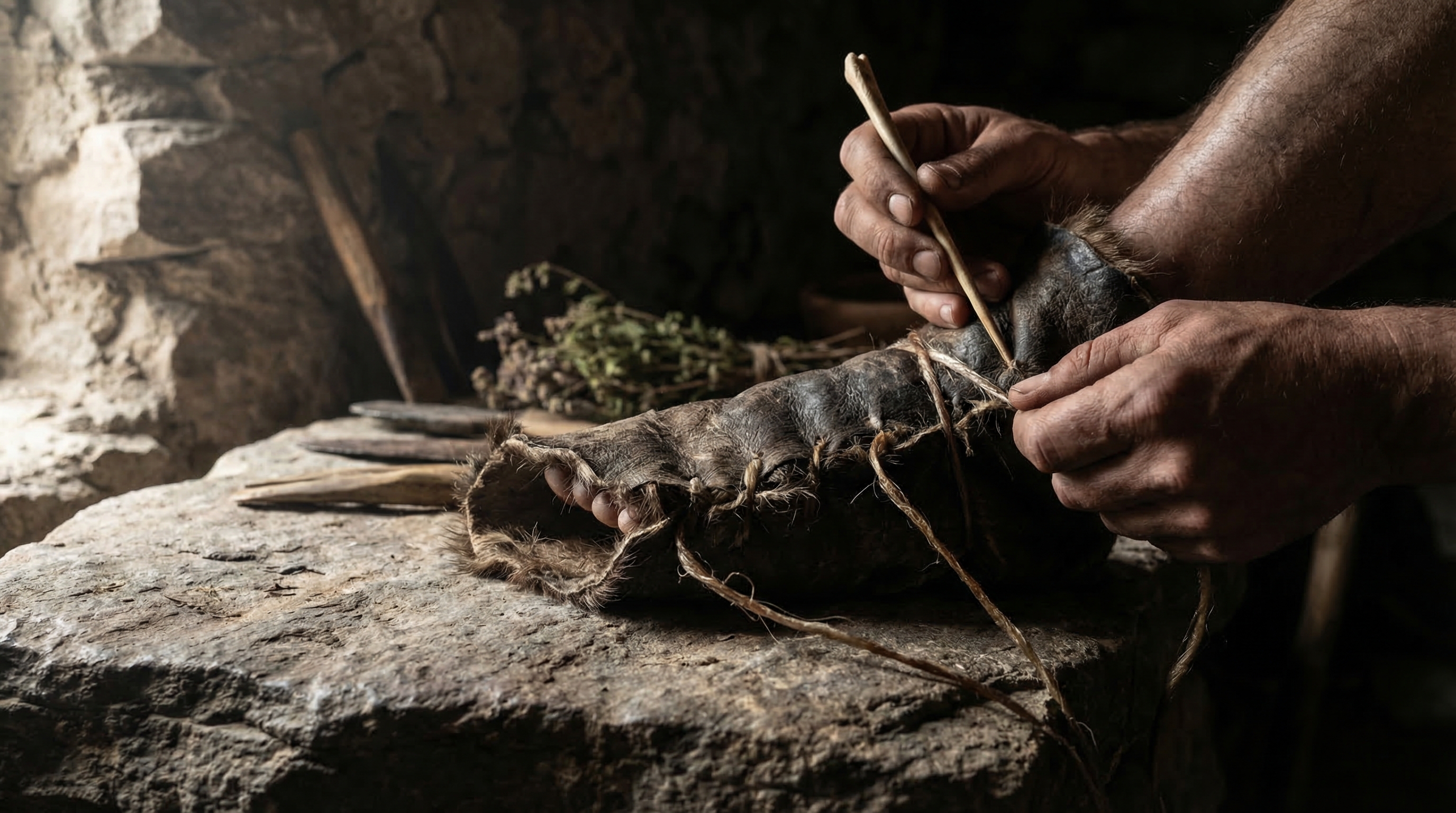
However, the evidence for early footwear is written in our bones. Anthropologist Erik Trinkaus discovered a significant shift in human anatomy occurring between 40,000 and 26,000 years ago. He noticed that the proximal phalanges (the small bones of the toes) began to thin and become less robust compared to those of earlier ancestors. This “thinning of the phalanges” suggests a reduction in the mechanical stress placed directly on the toes. When humans walk barefoot, the toes must grip the ground and build bone density to handle the impact. Once a supportive sole is introduced, the toes are relieved of this duty, leading to the anatomical changes observed in the fossil record.
Why No Physical Samples Exist
The decay of organic materials is the primary hurdle. In most environments, the combination of moisture, bacteria, and oxygen consumes leather and fiber within decades. We only find physical evidence in “extreme” preservation environments: high-altitude glaciers (Ötzi), hyper-arid caves (Areni-1), or anaerobic bogs. From a technical perspective, these early “shoes” were likely simple foot-wraps—unstructured hide pouches secured with sinew—lacking the lasting tension we associate with modern footwear.
The Fort Rock Sandals: 10,000 Years of Weaving Technology
The oldest physical evidence of actual footwear comes not from the Old World, but from the Fort Rock Basin in Oregon, USA. Discovered by Luther Cressman in 1938, these sandals date back approximately 9,300 to 10,500 years.

These were not mere wraps; they were sophisticated examples of fiber engineering. Made from shredded sagebrush bark, the sandals utilized a complex twining technique. The construction featured a flat sole and a “toe-wrap” design, providing protection against the volcanic terrain of the Great Basin.
Sagebrush Bark: The First High-Performance Material
Sagebrush bark was selected for its specific tensile strength and availability. The fibers were twisted into cordage to create a durable, flexible lattice. In modern terms, this was an early form of “textile upper” construction. The weavers had to maintain consistent tension to ensure the sandal didn’t unravel under the shearing forces of walking. While they lacked the PU cement used in modern global footwear production, the friction-lock of the twining provided a remarkably stable platform for the foot.
The Areni-1 Discovery: The World’s Oldest Leather Shoe
In 2008, a perfectly preserved leather shoe was found in a cave in Armenia. Known as the Areni-1 shoe, it dates to 3,500 BCE (roughly 5,500 years ago). This find was revolutionary because it showcased a level of leatherworking that surpassed simple wraps.
The Areni-1 shoe is a “moccasin” style made from a single piece of cowhide. From a manufacturing standpoint, this is what we call “one-cut” construction. By using a single piece of leather, the maker minimized the number of seams—which are traditionally the weakest points in any shoe. The shoe was tailored to the wearer’s foot using a leather cord passed through eyelets, a precursor to modern lacing systems.
Single-Piece Construction: The “One-Cut” Design
The structural simplicity of the Areni-1 is misleading. To create a three-dimensional shape from a flat hide without a modern last requires incredible spatial awareness. The artisan had to account for the leather’s natural stretch and the volume of the human heel. By removing the need for a separate sole and upper, the maker created a durable interface that could withstand the rocky Armenian highlands.
Grass Stuffing: Ancient Moisture Management
The shoe was found stuffed with dried grass. While some suggest this was to maintain the shape (acting as a primitive “last”), it also served as an insulating layer and a moisture-management system. The grass created air pockets for warmth while wicking sweat away from the skin—a function now performed by specialized synthetic linings in custom shoe manufacturing.
Footwear Engineer Insight: Structural Integrity
Technical Parameter: Lasting Tension
In modern assembly, we apply specific lasting tension (measured in N/cm) to pull the upper tightly over the mold (the last). The Areni-1 shoe achieved a primitive version of this by using the wearer’s foot as the last and tightening the leather cord. However, without a rigid midsole, ancient shoes often suffered from delamination of the fibers if they became too wet, as they lacked the chemical bonding of modern PU cement.
Material Science of the Ancients: From Papyrus to Cowhide
As civilizations consolidated, the “manufacturing” of shoes moved from an individual survival skill to a specialized craft. The choice of material was dictated by geography and social rank.
- Ancient Egypt: Predominantly used papyrus and palm leaf sandals. For royalty, these were often gilded or made of fine leather. The construction focused on “thong” styles, which are the direct ancestors of modern flip-flops.
- Mesopotamia: Utilized heavier leathers and started implementing early “turned” seams to protect the stitching from abrasion.
- The Tanning Evolution: Early tanning involved rubbing the hide with fats or smoking it. By the time of the Roman Empire, vegetable tanning using oak bark and mineral salts allowed for leather that was more water-resistant and durable.
Regional Manufacturing Divergence
In colder climates, the focus was on “closed” footwear (boots/moccasins), requiring high-tensile sinew for stitching. In warmer climates, “open” footwear (sandals) dominated, focusing on breathable plant fibers. This divergence is why our shoe factory background at TL Stage emphasizes a diverse material library to accommodate different global climates and functional needs.
Footwear in the Cradle of Civilization: Status and Utility
In Rome and Greece, shoes were more than protection—the footwear was a legal and social signifier. The Caligae (military boots) were a marvel of ancient engineering. Unlike the civilian Calceus, the Caligae featured a thick leather sole reinforced with iron hobnails. These nails provided traction, durability, and weight—acting as a weapon in close-quarters combat. The construction of the Caligae required a deep understanding of foot biomechanics, ensuring the lacing allowed for the swelling of the feet during 20-mile marches without causing necrosis or blistering.
The Medieval Shift: Fashion, Pointy Toes, and the Turnshoe
The Middle Ages introduced the “Turnshoe” method, which dominated European shoemaking from the 10th to the 15th centuries. A turnshoe was sewn inside-out and then “turned” right-side out once the stitching was complete. This hidden the seam inside the shoe, protecting the thread from wear and tear. However, this required the leather to be extremely supple and wet during the turning process, making it impossible to have a very thick, rigid sole.
The Poulaine Craze
By the 14th century, fashion began to override function. The Poulaine—a shoe with an absurdly long, pointed toe—became a status symbol. Some toes were so long they had to be tied to the knees with silver chains. While functionally useless, the Poulaine pushed the limits of brand-specific footwear production of the time, requiring internal stiffeners made of whalebone or moss.
The Industrial Revolution: Modernizing the Craft
For most of history, shoes were “straights”—meaning there was no difference between a left and a right shoe. It wasn’t until 1817 that the use of asymmetrical lasts became standard in industrialized production. The transition from artisan cobbling to mass manufacturing required a fundamental shift in how components were bonded and shaped.
1883: The Lasting Machine
Before 1883, “lasting” (shaping the shoe upper to the sole) was done by hand, a slow process that limited production to a few pairs per day. Jan Ernst Matzeliger, an immigrant in Lynn, Massachusetts, invented the “Great Lasting Machine.” It could hold the leather over the last, pull it tight with consistent lasting tension, and tack it into place—completing the task in one-tenth of the time of a human hand-laster. This invention effectively birthed the modern footwear industry, making quality shoes affordable for the masses and allowing a leading shoe manufacturer like TL Stage to eventually scale global operations.
Vulcanized Rubber: The Birth of the Sneaker
In 1839, Charles Goodyear discovered the process of vulcanization. By treating rubber with sulfur and heat, he created a material that was durable, flexible, and non-sticky. By the late 19th century, this led to the “plimsoll” and eventually the sneaker. The ability to bond rubber to canvas using early adhesives laid the groundwork for modern athletic footwear.
From Ancient Artifacts to Modern Factories: Bridging the Gap
The journey from a 10,000-year-old sagebrush sandal to a high-performance sneaker is a story of material science and mechanical precision. While the intent remains the same—protecting the foot—the execution has reached levels of complexity ancient cobblers could never imagine.
At TL Stage, our manufacturing history is rooted in these heritage techniques. We still use the “lasting” logic pioneered in the 19th century, but we enhance it with 3D modeling and computer-controlled tensioning. Whether we are executing a “one-cut” leather design reminiscent of the Areni-1 or developing a multi-layered synthetic sole for a private label, we are standing on the shoulders of the ancient engineers who first decided that the earth was too rough to walk on barefoot.
Technical Synthesis: Ancient vs. Modern
| Feature | Ancient (Areni-1 / Fort Rock) | Modern (TL Stage Production) |
|---|---|---|
| Material | Raw Hide / Sagebrush Bark | Full-grain Leather / GRS Synthetics |
| Bonding | Sinew / Friction-lock | PU Cement / Vulcanization |
| Shape | Ambidextrous (Straights) | Anatomical Left/Right Lasts |
| Tension | Manual / Hand-pulled | Pneumatic Lasting Tension |
| Insulation | Dried Grass / Fur | EVA Foam / Thinsulate |
Frequently Asked Questions (PAA)
Who invented the first shoe?
There is no single inventor. Footwear was developed independently by various human populations across the globe as a survival necessity. It was a collective evolutionary response to migrating into diverse and harsh environments.
What is the oldest shoe ever found?
The oldest woven footwear is the Fort Rock Sandals from Oregon (approx. 10,000 years old). The oldest leather shoe is the Areni-1 shoe from Armenia (approx. 5,500 years old).
When did humans start wearing left and right shoes?
While some ancient Roman military boots showed slight differentiation, the widespread standardized manufacture of distinct left and right shoes did not occur until 1817 in the United States and Europe.
Why did early shoes have pointed toes?
In the Medieval period, pointed toes (Poulaines) were a status symbol. The length of the toe indicated the wearer’s social rank and wealth, as they were impractical for physical labor.
What were the first shoes made of?
The earliest shoes were made from perishable organic materials including animal hides (deer, bear, cow), plant fibers (sagebrush, papyrus, grass), and wooden platforms.
As a professional shoemaking services provider, we understand that every modern design is a continuation of this 40,000-year history. If you are looking to develop your own line of footwear based on these timeless principles and modern technology, please contact our shoe factory for a detailed consultation.