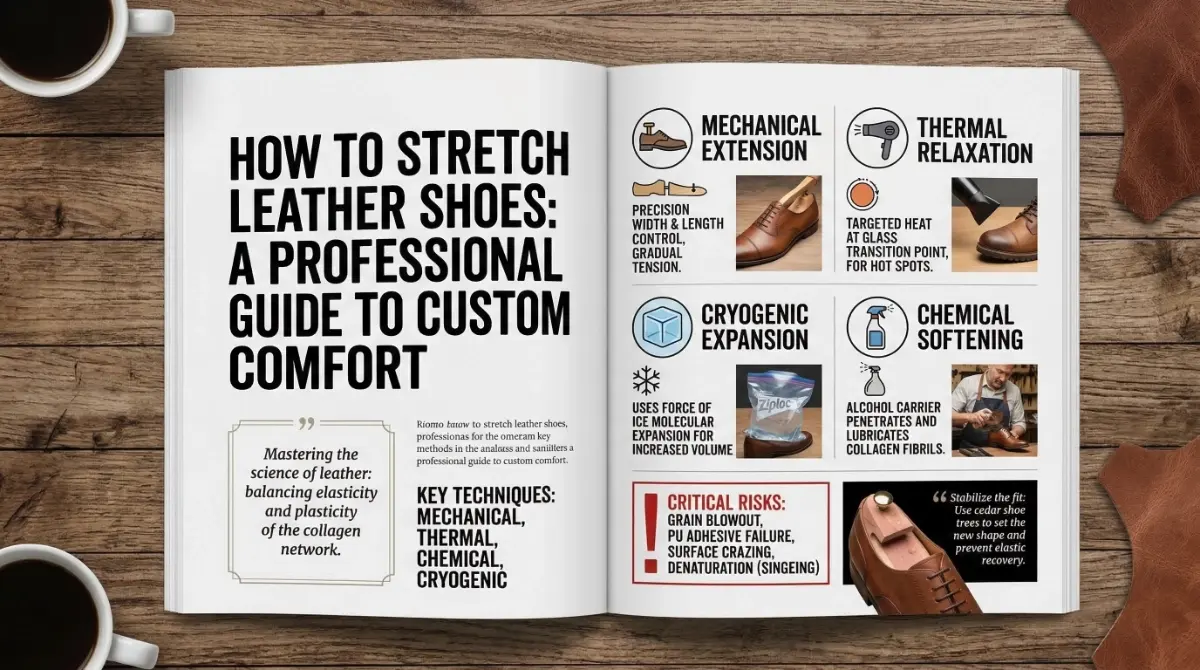
The architecture of a premium leather shoe is a masterpiece of micro-engineering. In the world of high-end professional shoe making heritage, a single Oxford or Derby might involve over 200 individual operations, from precision clicking of the upper to the meticulous 12-stitches-per-inch (SPI) needle counts that define structural integrity. Every curve is designed to follow a “last”—a mechanical model of the human foot—yet even the most precise cutting cannot account for the infinite variations in human anatomy. When a shoe is slightly too tight, it isn’t just a matter of discomfort; it is a fundamental mismatch between the leather’s internal geometry and your biological needs.
The problem often begins the moment you step into a new pair of handcrafted boots or dress shoes. You feel the sharp pinch at the metatarsals or the restrictive pressure against the heel counter. This agitation isn’t merely a “break-in” phase; it is the material resisting your anatomy. In the modern landscape, many fashion brands prioritize aesthetic silhouettes over ergonomic variability. This often leads to a phenomenon known as “lasting tension” issues, where the leather is pulled so tight over the mold during custom footwear manufacturing that it leaves zero room for natural foot expansion. When you force your foot into such a restricted environment, you risk more than just blisters. Excessive pressure can lead to “delamination,” where the adhesive bonds—often high-performance PU cement—begin to fail under the lateral stress of your stride.
Leather is a biological material, a complex collagen network that possesses both elastic and plastic properties. Understanding how to manipulate these fibers without snapping them is the difference between a custom-fit feel and a ruined investment. To achieve the perfect fit, one must apply controlled “pressing force” and environmental triggers that allow the material to exceed its original dimensions safely. This guide provides the solution, bridging the gap between DIY practicality and footwear engineering.
Quick Expansion Comparison
| Method | Best For | Complexity | Risk Level |
|---|---|---|---|
| Mechanical Stretcher | Precision width/length | High | Low |
| Hairdryer Heat | Targeted hot spots | Medium | Moderate |
| Freezer/Ice | Overall toe box volume | Low | High |
| Alcohol Spray | Instep and general softening | Medium | Low |
Why Do Leather Shoes Pinch and How Does Lasting Tension Work?
The root cause of footwear discomfort usually lies in the “Lasting” process. During manufacturing, the leather upper is stretched over a plastic or wooden “last” and secured to the insole. If the tension applied by the lasting machine is too high, the leather fibers are already at their limit of elastic deformation before you even put them on. This leaves no “give” for the natural swelling of the human foot throughout the day.
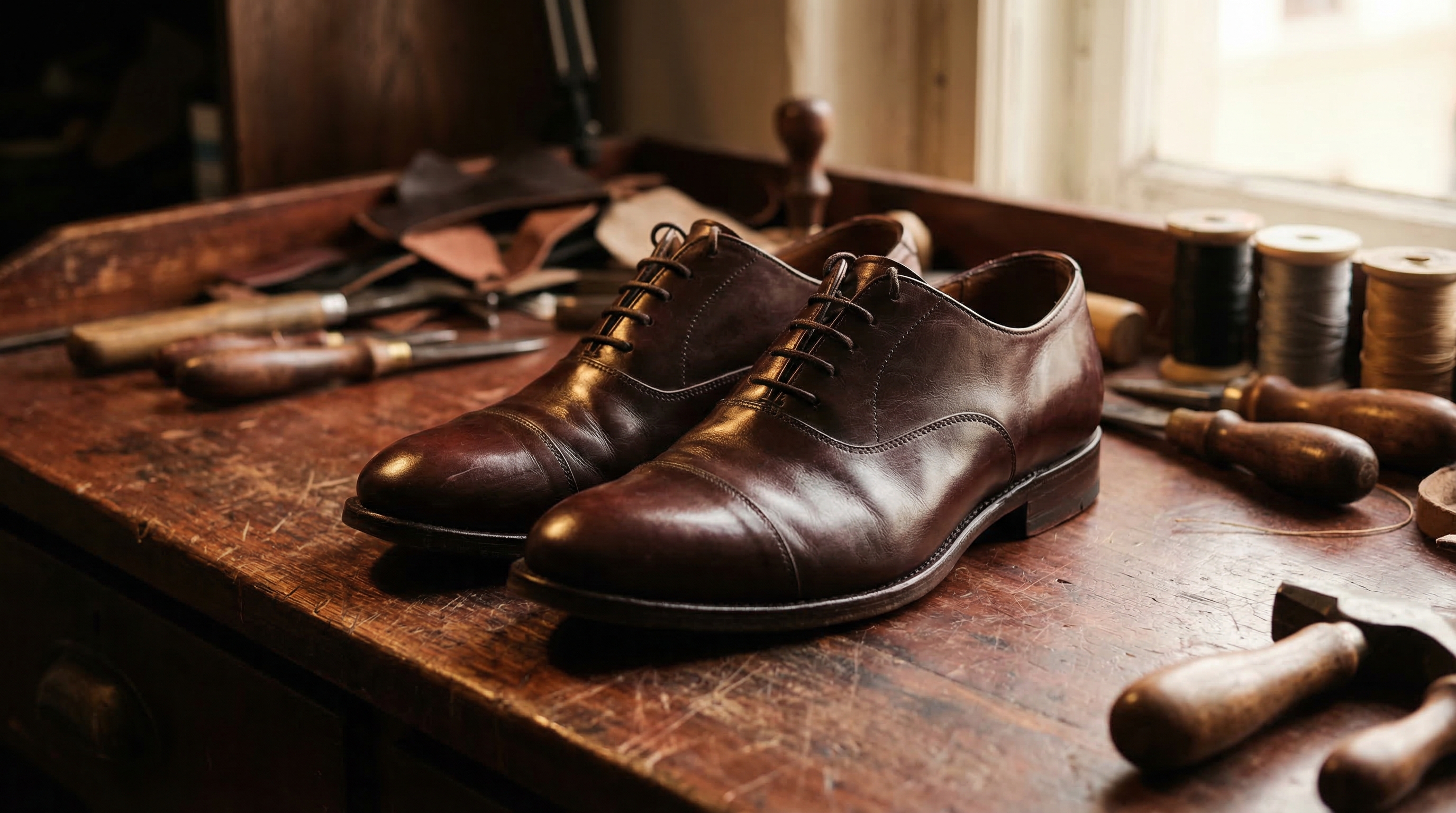
Furthermore, the internal reinforcements, such as the toe puff and heel counter, are designed to prevent the shoe from losing its silhouette. These components are often made of resin-impregnated fabrics or thermoplastics that do not stretch like natural hide. When your foot feels “squeezed,” you are often fighting against these structural stabilizers as much as the leather itself. Understanding that the shoe is a multi-layered assembly—comprised of the grain, the corium, the lining, and the adhesives—is essential before applying any stretching force.
How Does the Material React to Stretching at a Molecular Level?
To stretch leather is to manipulate its collagen network. Leather consists of interwoven protein fibers that provide its legendary tensile strength. When we apply force, we are performing “stress relaxation.” This is a process where the internal tension of the fibers is gradually dissipated, allowing the fibers to slide past one another and re-bond in a more elongated state.
The success of this intervention depends on the “yield point” of the specific hide. If you exceed the yield point too quickly, you cause permanent structural failure, known as a “grain blowout.” Conversely, if you don’t apply enough force, the leather will simply exhibit “elastic recovery,” snapping back to its original shape as soon as the pressure is removed.
Assessing Material Resistance and Fiber Density
Before intervention, one must identify the “GSM” (Grams per Square Meter) or weight of the leather. A heavy-duty work boot uses a much higher GSM hide than a delicate calfskin pump. The higher the density, the more mechanical force is required to achieve a permanent set.
| Method | Target Area | Fiber Impact | Risk Level | Permanence |
|---|---|---|---|---|
| Thermal Expansion | Targeted pressure points | Molecular Relaxation | Moderate | High |
| Cryogenic Expansion | Overall volume/Toe box | Mechanical Displacement | High | Moderate |
| Mechanical Tension | Width and Length | Structural Elongation | Low | Very High |
| Chemical Softening | Insteps and Quarters | Solvent-based Lubrication | Low | Moderate |
Manufacturer Pro Tip: Structural Integrity
During the manufacturing process, we use skiving to thin the edges of leather pieces where they overlap to prevent bulk. When stretching a shoe, these skived areas are the most vulnerable to tearing. If your shoe has intricate edge painting, excessive stretching can cause the paint to crack or “check,” requiring a professional touch-up with specialized acrylic dyes.
Can You Use Heat to Stretch Leather Shoes Safely?
The hairdryer method is a favorite for addressing specific “hot spots” like the pinky toe or the bunion area. It relies on the physics of the Glass transition point ($T_g$). This is the temperature range where the leather’s internal polymers transition from a hard, glassy state to a soft, rubbery state, making them susceptible to reshaping.
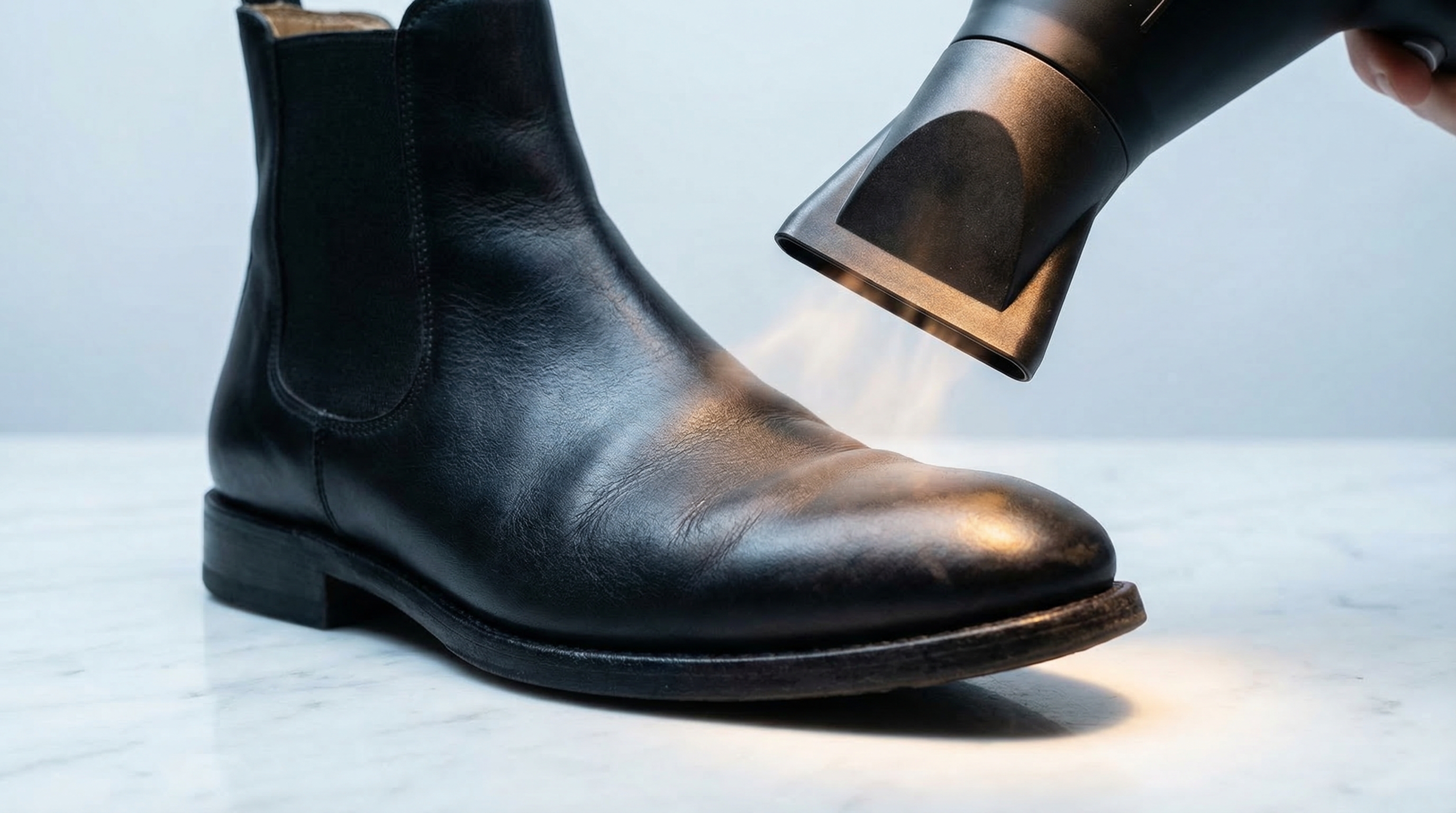
In footwear engineering, bovine leather typically reaches its glass transition point between 100°F and 110°F (38°C – 43°C). When you reach this temperature, the hydrogen bonds within the collagen network become significantly more pliable. However, exceeding 120°F can cause denaturation—a process where the collagen strands shrink and tighten permanently, effectively “cooking” the leather and rendering it brittle.
To implement this correctly:
- Wear Thick Socks: Put on two pairs of wool socks to act as an internal “human last.”
- Apply Targeted Heat: Use a hairdryer on medium heat, focusing on the tight area for 30 seconds while constantly moving the nozzle.
- Flex and Cool: Flex your foot and walk until the leather has completely cooled. This “locking phase” is critical; if you remove the shoe while warm, the fibers will contract.
Is the Freezing Method Safe for High-End Footwear?
The freezing method is rooted in a simple scientific fact: water expands by approximately 9% when it turns into ice. This expansion provides a consistent, multi-directional pressure that can increase the overall volume of a shoe. This is particularly effective for shoes made by a high-quality leather shoe supplier that uses dense, high-ounce leathers.
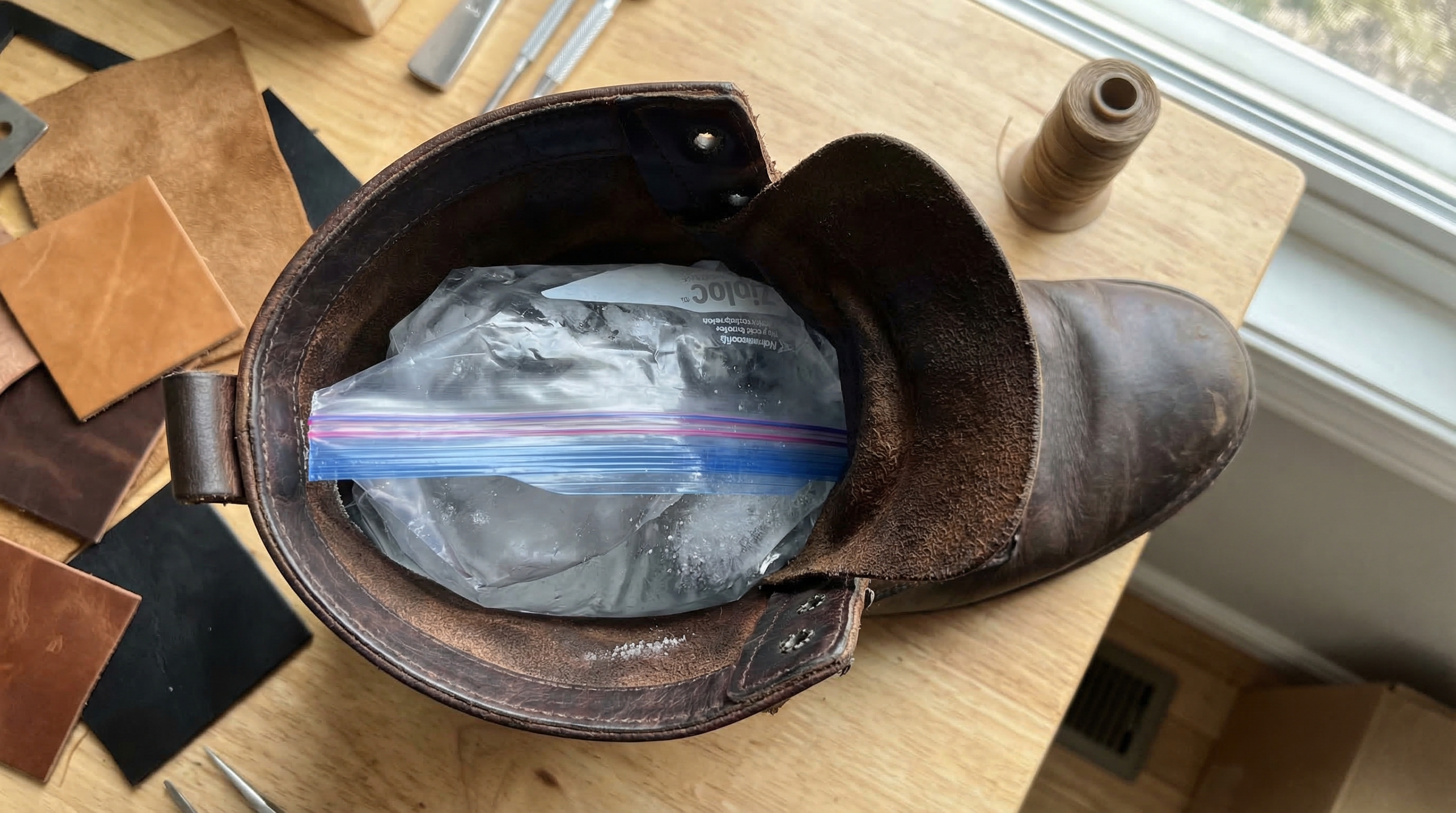
Unlike heat, which relaxes the fibers, ice forces the fibers apart through brute molecular expansion. As water freezes, it forms a hexagonal lattice structure that occupies more space than its liquid form. This creates a slow, steady “hydrostatic pressure” inside the shoe, pushing against the vamp and the quarters without the unevenness of a mechanical tool.
However, there is a significant engineering risk: PU cement. Most modern luxury shoes use Polyurethane adhesive to bond the outsole. At sub-zero temperatures, these adhesives can become brittle. If the ice expands too rapidly, it can cause the adhesive layer to “snap” or delaminate.
Manufacturer Pro Tip: The PU Cement Threshold
In our laboratories, we test PU cement stability down to -10°C. If you use a deep freezer that reaches lower temperatures, you risk permanent crystallization of the adhesive. This weakens the bond’s “flex life.” Always allow the shoes to return to room temperature naturally; never use heat to thaw them, as the rapid temperature swing will cause the leather grain to “crackle.”
What Are the Most Precise Mechanical Stretching Tools?
For those who demand precision and want to avoid the risks of extreme temperatures, mechanical shoe stretchers are the gold standard. These tools allow you to apply specific, measured tension to both the width and the length of the footwear. They utilize a threaded rod to convert rotational motion into linear force, allowing for a controlled pressing force that can overcome even the toughest lasting tension.
Mechanical stretchers often come with “bunion plugs”—small inserts that fit into pre-drilled holes. These allow for localized relief in the metatarsal area without affecting the overall silhouette of the shoe. To maximize effectiveness:
- Insert the stretcher and expand until you feel significant resistance.
- Increase the tension by a half-turn every 6 hours.
- Allow a “dwell time” of at least 24 to 48 hours to ensure the leather “sets.”
This method is highly recommended for professionals who deal with custom footwear manufacturing where precision is paramount.
How Do Chemical Softeners Affect Leather Fibers?
Chemical stretching agents are designed to penetrate the leather’s surface and temporarily “unlock” the collagen network. Most commercial stretching sprays are a refined mixture of isopropyl alcohol and distilled water. The alcohol acts as a carrier, allowing the moisture to penetrate deep into the corium.
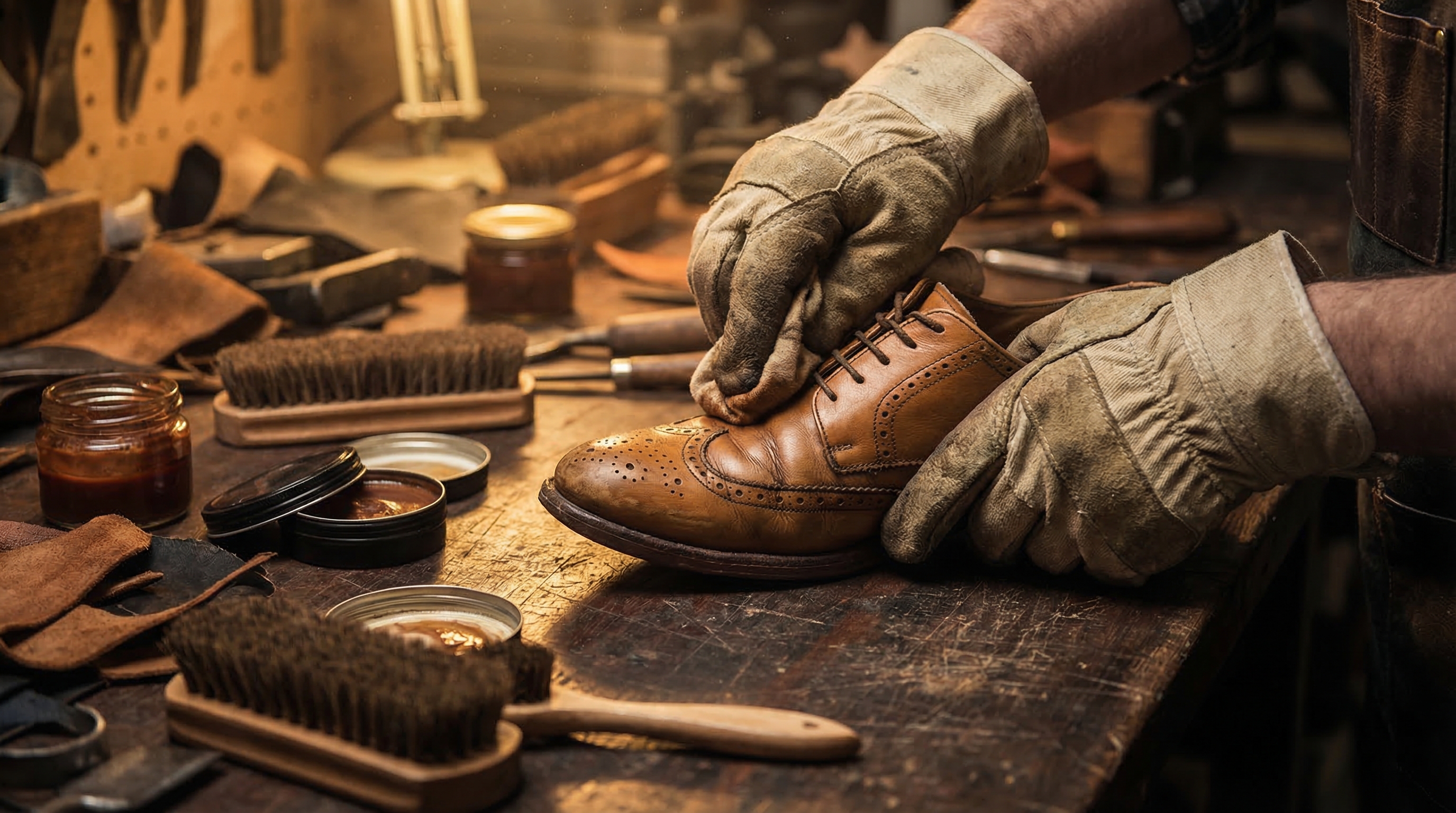
Once inside, the mixture lubricates the collagen fibrils, allowing them to slide past one another more easily under tension. As the alcohol evaporates, it leaves the water behind, which eventually evaporates too, leaving the fibers in their new, elongated state. However, because alcohol is a degreaser, it strips away natural oils. Failure to re-condition the leather after using a stretching spray is the leading cause of “surface crazing”—tiny cracks that appear on the grain.
Manufacturer Pro Tip: Stitching SPI and Tension
In premium construction, we aim for a Stitching SPI of 10-12. This creates a dense, strong seam. However, high SPI counts mean more punctures per inch. If you over-stretch chemically softened leather, these punctures can “elongate,” leading to a weakened seam that will eventually fail. Always apply stretching force gradually over 48 hours.
What Are the Critical Risks of Over-Stretching?
Stretching is a subtractive process in terms of material strength. You are essentially thinning the leather to gain volume. Understanding the limits of the material is vital to avoiding a ruined pair of shoes.
One of the most common issues is “Grain Blowout.” If you apply too much force too quickly, the top layer of the leather (the grain) separates from the underlying fiber network, creating a bumpy, “orange peel” texture. This distortion is irreversible and significantly reduces the value of the footwear. Furthermore, over-saturation with water or alcohol can lead to “spew”—the migration of tanning salts to the surface, appearing as white crystalline patches.
| Issue | Cause | Appearance | Solution |
|---|---|---|---|
| Grain Blowout | Excessive Mechanical Force | Bumpy, uneven surface | Professional Sanding/Refinishing |
| Delamination | Extreme Cold / Poor Adhesive | Sole separating from upper | Re-bonding with PU Cement |
| Surface Cracking | Alcohol-based drying | Spiderweb micro-cracks | Deep conditioning with Mink Oil |
| Singeing | High-intensity heat | Darkened, brittle patches | Irreversible (Cover with polish) |
When Should You Seek Professional Cobbler Services?
As much as we love a DIY project, there are limits. A general rule in the industry is the “Half-Size Rule.” Most leather shoes can safely be stretched about half a size in width or volume. If you need more, you are entering the territory of structural modification.
Exotic skins—alligator, lizard, or python—are particularly risky. They are composed of scales connected by soft membranes. Stretching these can cause the membrane to “unzip” or tear. A professional cobbler has access to specialized internal expanders and steam-shaping tools that manage these risks. Additionally, components like the “heel counter” and “toe puff” are often made of thermoplastics that won’t respond to home methods. A cobbler can “relast” the shoe—taking it apart and rebuilding it on a larger mold—to achieve a true size change.
If your shoes represent a significant investment (above $500), the risk of a DIY mistake is rarely worth the savings. Professionals provide a “set” that is far more permanent. For advice on high-end maintenance, consult our guide on professional shoe making heritage.
How to Maintain the Fit and Prevent Shrinkage?
Leather has an “elastic memory.” Because it was originally stretched and dried over a specific last, it will always have a slight tendency to return to that shape. This is known as “elastic recovery.” To prevent your shoes from shrinking back after a successful stretch, you must use cedar shoe trees.
Cedar is preferred because it is hygroscopic—it absorbs moisture (sweat) while providing the necessary internal tension to keep the leather in its expanded state. Think of shoe trees as “retainers” for your shoes. Without them, the leather will contract as it dries. Stabilizing the collagen network with regular conditioning and consistent internal pressure is the only way to ensure the longevity of your custom fit. If you are looking for shoes built with these ergonomic considerations in mind, check out our high-quality leather shoe supplier resources.
FAQ: Common Leather Stretching Questions
How much can leather shoes actually stretch?
Most leather shoes can safely stretch about 1/4 to 1/2 of a shoe size in width. It is nearly impossible to stretch the length of a shoe significantly because the length is determined by the rigid sole and the reinforced heel and toe boxes.
Does stretching leather damage the waterproof coating?
Yes, stretching can “open up” the grain and create micro-fissures in the finish. If the shoe has a DWR (Durable Water Repellent) coating, stretching will likely compromise it. You should always re-apply a waterproofer or wax after the stretching process is complete.
Can I stretch patent leather shoes?
Patent leather is extremely difficult to stretch because it is coated in a thick layer of polyurethane or acrylic. This plastic coating does not have the same fiber structure as natural leather and is prone to cracking if stretched. Only very minor mechanical stretching is recommended.
How long should I leave a shoe stretcher inside the shoe?
For permanent results, you should leave a mechanical stretcher in for 24 to 48 hours. Increasing the tension slightly every 6-8 hours allows the fibers to undergo “stress relaxation” without snapping.
Will my shoes shrink back after I stretch them?
Yes, if they are not maintained. Leather is influenced by humidity and temperature. To prevent “elastic recovery,” always store your stretched shoes with cedar shoe trees to maintain the internal volume.
If you have questions about the structural limits of your specific footwear or need a professional consultation, feel free to visit our contact page to speak with a footwear engineer.