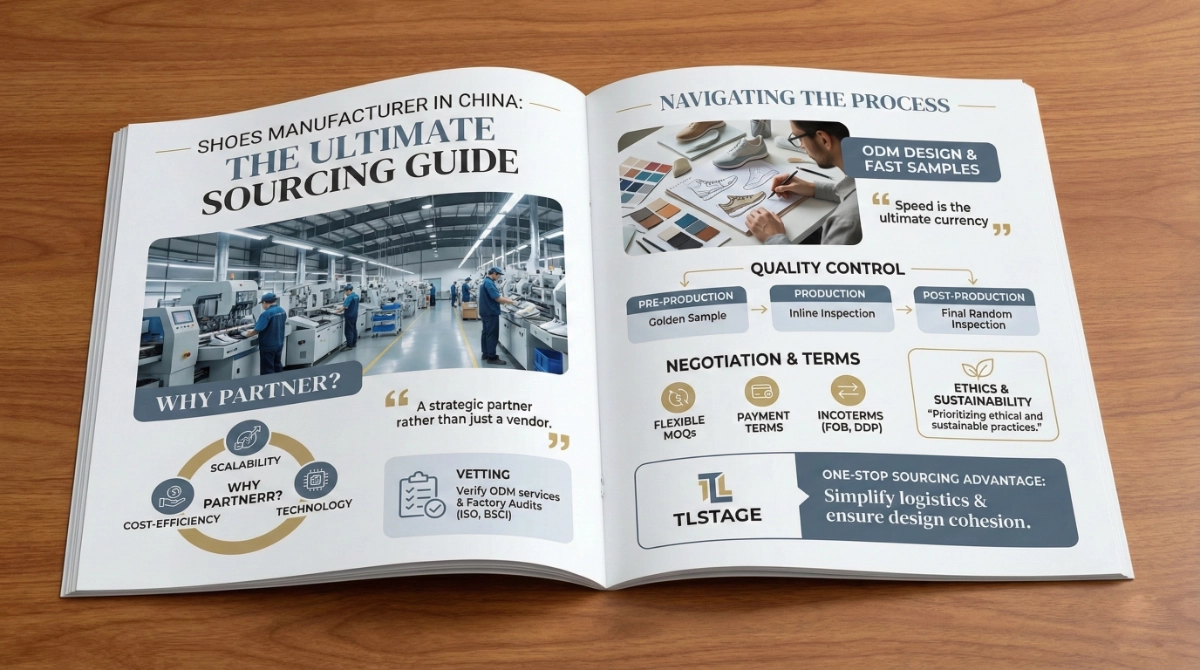
You are staring at a stagnant inventory report, watching potential revenue evaporate because your current supplier missed yet another critical seasonal deadline. It is agonizing to see agile competitors launch trending collections while you are trapped waiting for production updates that never arrive. Whether you are looking for custom footwear production or simple sourcing, choosing the right partner is key. To successfully scale your fashion brand, you need a strategic partner rather than just a vendor—specifically, you need to master the art of sourcing from a reliable shoes manufacturer in china.
1. Why Partner with a Shoes Manufacturer in China?
Can you significantly lower production costs?
Sourcing from China remains the most effective financial strategy for maximizing your gross profit margins in a competitive global market. By leveraging established industrial clusters, you gain access to economies of scale that domestic manufacturing simply cannot replicate. Consider these critical financial factors:
- Lower raw material costs due to proximity to textile and leather production hubs.
- Efficient labor markets that provide skilled craftsmanship at competitive rates.
- Integrated supply chains that minimize transport costs between component suppliers.
Is the supply chain truly scalable?
China’s manufacturing ecosystem is engineered for massive volume, allowing you to grow from a boutique operation to a global chain without switching partners. This infrastructure eliminates the bottleneck of production capacity that often stifles growing brands. Here is the reality of the market:
- High production capacity capable of handling tens of thousands of units per month.
- Rapid scalability that allows for quick ramp-ups during peak holiday seasons.
- Advanced infrastructure ensuring seamless logistics from factory floor to port.
What about technology integration?
Modern Chinese factories are no longer just manual workshops; they are high-tech hubs utilizing advanced machinery for precision and speed. Adopting this technology ensures that even the most complex designs, such as intricate private label shoes, are executed flawlessly. Think about this technological advantage:
- Automated cutting machines that reduce material waste and ensure identical sizing.
- 3D design modeling for rapid prototyping and virtual sample approval.
- Digital inventory tracking that provides real-time updates on your order status.
Key Takeaway: Partnering with a Chinese manufacturer offers a powerful triad of cost-efficiency, massive scalability, and technological precision that protects your bottom line.
| Benefit Category | Strategic Advantage | Impact on Margin |
|---|---|---|
| Cost Structure | Reduced unit costs via volume | High |
| Scalability | Seamless production ramp-up | Medium |
| Technology | Precision in complex designs | High |
Analysis: A strategic partnership in China directly correlates to improved bottom-line performance through significant cost reductions and high-tech operational efficiencies.
2. Identifying a Reliable Shoes Manufacturer in China
Where should you look first?
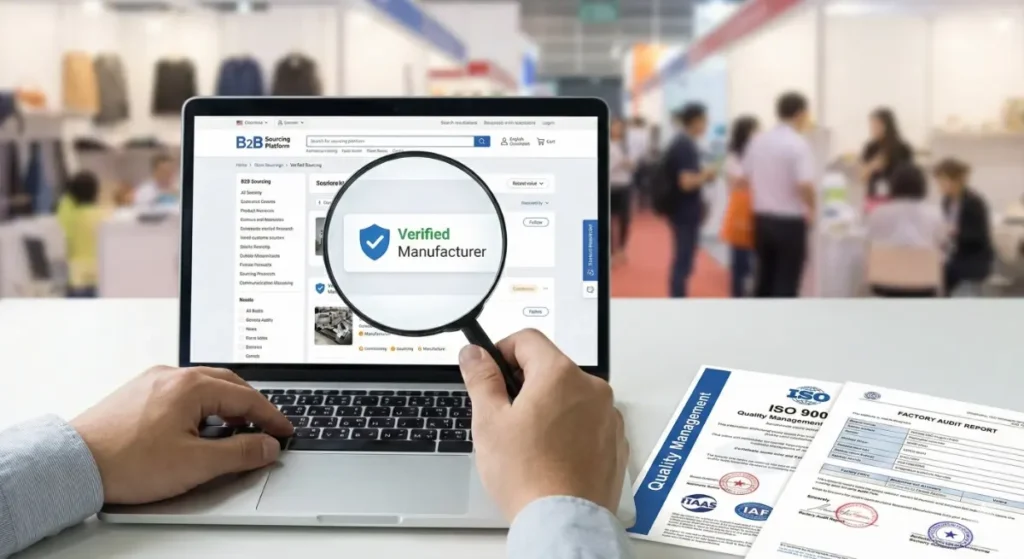
Finding a trustworthy partner requires navigating two primary paths: digital discovery platforms and direct physical interactions at trade events. Utilizing a manufacturer with a professional, self-built B2B website often indicates a higher level of business maturity and service orientation. Try these proven sourcing channels:
- Online B2B marketplaces like Alibaba or Global Sources for initial lists.
- International trade shows such as the Canton Fair or MICAM for face-to-face vetting.
- Direct factory websites that demonstrate their specific expertise and brand portfolio.
How do you assess capability?
You must rigorously verify if a potential partner is a trading company acting as a middleman or a true manufacturer with their own facilities. A genuine partner offers comprehensive ODM services to assist in developing original concepts, handling everything from women’s high heels to casual sneakers. Look for these capability indicators:
- Factory audit reports (ISO, BSCI) that prove operational standards.
- Production line photos and videos showing the actual machinery in use.
- ODM/OEM service listings confirming they can customize designs, not just resell stock.
What signals a red flag?
Not every supplier on the internet is trustworthy, so you must remain vigilant against scams and low-quality intermediaries. If a supplier cannot provide basic business verification documents, you must walk away immediately to protect your capital. Watch out for these warning signs:
- Lack of a physical address or an address that maps to a residential area.
- Refusal to send samples or demanding exorbitant fees for basic prototypes.
- Unusually low pricing that falls significantly below the market average for raw materials.
Key Takeaway: Thorough vetting through multiple channels and strictly checking for ODM capabilities ensures you filter out risky traders and find a true factory partner.
| Vetting Criteria | Positive Signal | Negative Signal |
|---|---|---|
| Online Presence | Professional B2B Website | Generic Email Address |
| Service Type | OEM & ODM Capabilities | Stock Only / No Custom |
| Transparency | Open to Factory Audits | Refuses Video Calls |
Analysis: Prioritizing suppliers with professional digital footprints and transparent audit policies significantly reduces the risk of fraud and quality disputes.
3. Evaluating Quality from a Shoes Manufacturer in China
Why are samples critical?
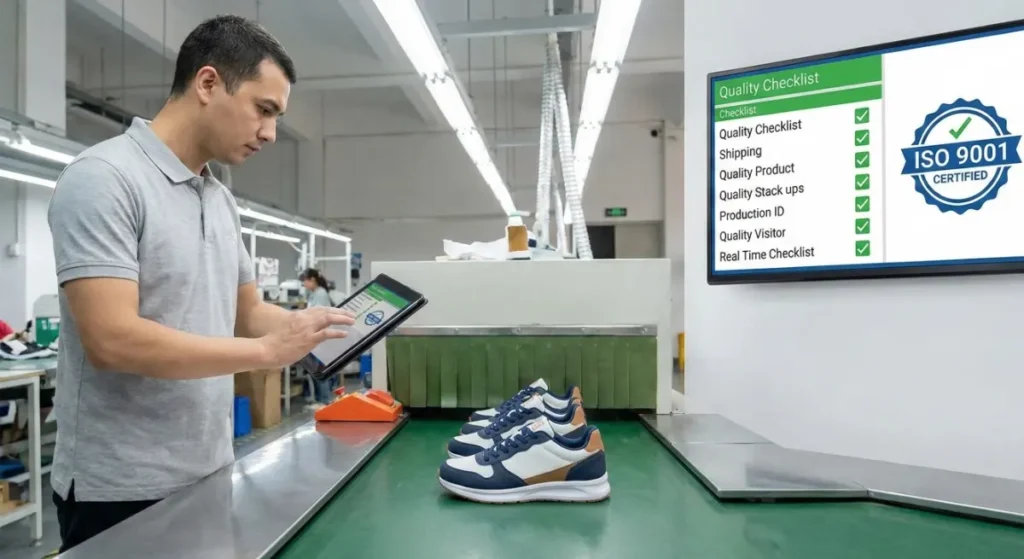
You should never place a bulk production order without first approving a physical “confirmation sample” that sets the standard for the entire run. This step is the only way to bridge the gap between a digital design file and a wearable product. Here is why sampling is non-negotiable:
- Verifies material touch to ensure the leather or fabric meets your luxury standards.
- Confirms fit and sizing so that the shoe is comfortable for your end consumer.
- Tests color accuracy to match your brand’s specific seasonal palette.
What certifications matter?
Compliance certifications protect your brand from legal liability and reputational damage in Western markets. For professional buyers, these documents are not optional; they are the baseline requirement for doing business. Check for these essential standards:
- ISO Quality Standards (like ISO 9001) indicating consistent management systems.
- Ethical sourcing audits ensuring the facility meets human rights standards.
- Material safety certs (like REACH) proving the absence of harmful chemicals.
How is consistency maintained?
A perfect sample means nothing if the bulk shipment arrives with defects or variations in color and stitching. You need a shoes manufacturer in china that implements rigorous quality control protocols at every stage of manufacturing. Demand this quality assurance protocol:
- Pre-shipment inspections conducted by your team or a third-party agency.
- Standardized QC checklists that factory workers must sign off on daily.
- Material testing reports verifying durability and colorfastness before cutting begins.
Key Takeaway: Rigorous sampling and strict adherence to international quality certifications are the only ways to safeguard your brand reputation against returns.
| QC Phase | Action Item | Benefit |
|---|---|---|
| Pre-Production | Approve “Confirmation Sample” | Sets the standard |
| Production | Inline Inspection | Fixes issues early |
| Post-Production | Final Random Inspection | Ensures consistency |
Analysis: Implementing a comprehensive three-phase quality control system provides a robust safety net against inconsistent production runs and costly returns.
4. Negotiating MOQs with a Shoes Manufacturer in China
Can small businesses compete?
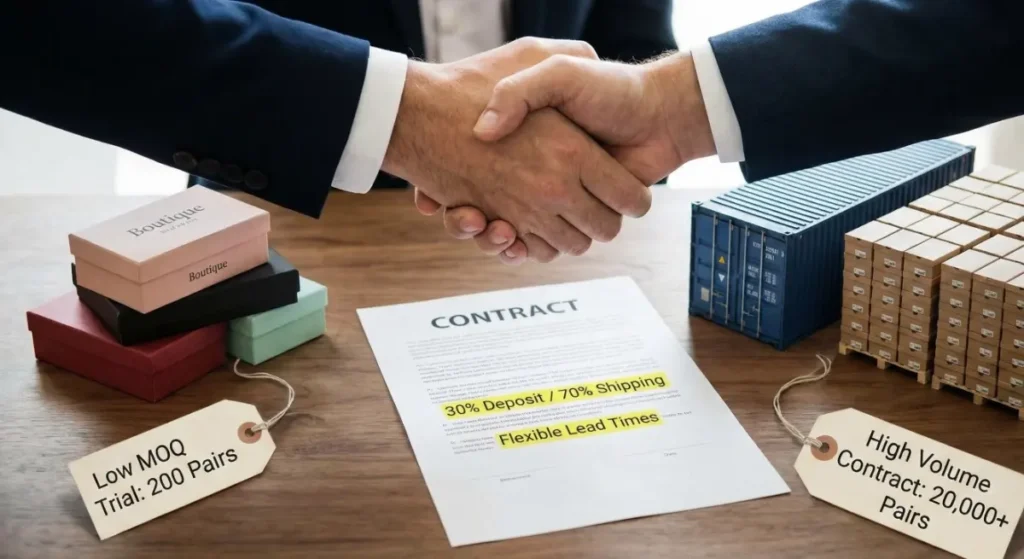
High Minimum Order Quantities (MOQs) often scare off emerging boutiques, but many manufacturers are willing to grow with promising brands. Suppliers offering flexible requirements are essential for independent retailers who need to test the market. But consider this strategy:
- Pay a slightly higher unit price to offset the factory’s setup costs for small runs.
- Order generic stock with custom branding added later to lower the barrier.
- Negotiate trial runs to prove the concept before committing to thousands of pairs.
How do you leverage volume?
If you are a larger buyer or a chain store, you must use your purchasing power to drive down unit costs and secure priority production slots. Factories prefer the stability of large orders and will offer significant concessions to secure them. Use these negotiation tactics:
- Forecast annual volume to show the factory the long-term value of your account.
- Consolidate orders into fewer, larger batches to maximize production efficiency.
- Commit to long-term contracts in exchange for locked-in pricing and material costs.
Are terms flexible?
Everything is negotiable in international trade, including payment schedules and currency adjustments. A good partner understands your cash flow needs and will work with you to find a mutually beneficial arrangement. Discuss these financial terms:
- 30% deposit, 70% upon shipping is the industry standard you should aim for.
- Lead time buffers that penalize the factory for late deliveries.
- Currency options to pay in your local currency or USD to hedge against fluctuation.
Key Takeaway: Flexibility in MOQs and payment terms is often available if you approach the negotiation with a professional, long-term partnership mindset.
| Negotiation Point | Small Buyer Strategy | Large Buyer Strategy |
|---|---|---|
| MOQ | Pay premium for low Qty | Demand strict tiers |
| Price | Focus on value/quality | Focus on unit cost |
| Terms | Deposit flexibility | Net 30/60 days |
Analysis: Tailoring your negotiation strategy based on your specific volume gives you the leverage to secure better terms, pricing, and production priority.
5. Designing & Custom Footwear Production with Manufacturers
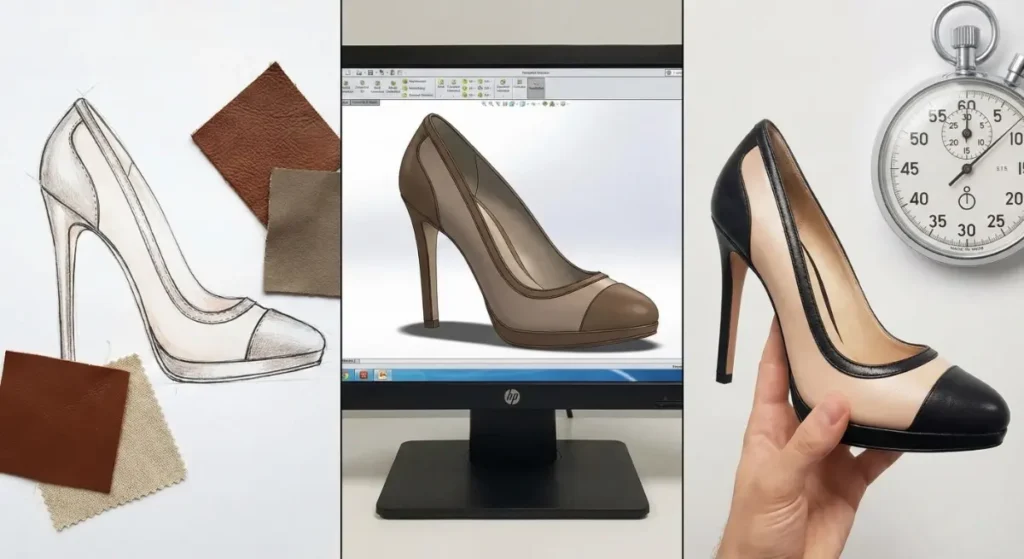
Do they offer design support?
You might not have a full in-house design team, which is why partnering with an ODM (Original Design Manufacturer) is a massive advantage. An ODM can take a simple sketch or mood board and transform it into a retail-ready product using their internal expertise. Look for these design services:
- Internal design teams that understand Western fashion trends and ergonomics.
- Trend forecasting inputs that help you select selling colors and styles.
- CAD drawing services to visualize the shoe specifications before sampling.
How fast is the turnaround?
Speed is the ultimate currency in the modern fashion industry, especially for fast-fashion and e-commerce brands. Fast sample production is a competitive advantage of top-tier suppliers like TLSTAGE, allowing you to iterate quickly. Ask these timing questions:
- Sample lead time (ideal is 7 days or less for initial prototypes).
- Production lead time (typically 30-45 days depending on complexity).
- Shipping estimates to plan your marketing launch calendar accurately.
Can you customize materials for footwear production?
Differentiation in the market often comes down to unique components, fabrics, and hardware. Your shoes manufacturer in china should have deep connections with local material markets to source exactly what you envision. Ensure they can source:
- Custom leathers and fabrics that match your specific texture and durability needs.
- Branded hardware like buckles and zippers with your logo engraved.
- Eco-friendly alternatives such as vegan leathers or recycled rubbers.
Key Takeaway: Utilizing a manufacturer’s ODM capabilities and local material access accelerates product development and enhances your brand’s uniqueness.
| Design Service | Traditional Factory | Modern ODM Partner |
|---|---|---|
| Concepting | Client provides strict spec | Factory assists design |
| Materials | Standard stock only | Custom sourcing |
| Sampling | 2-4 Weeks | 3-7 Days |
Analysis: Shifting from traditional factories to modern ODM partners dramatically reduces time-to-market for new designs, allowing you to capture trends faster.
6. Navigating Logistics with a Shoes Manufacturer in China
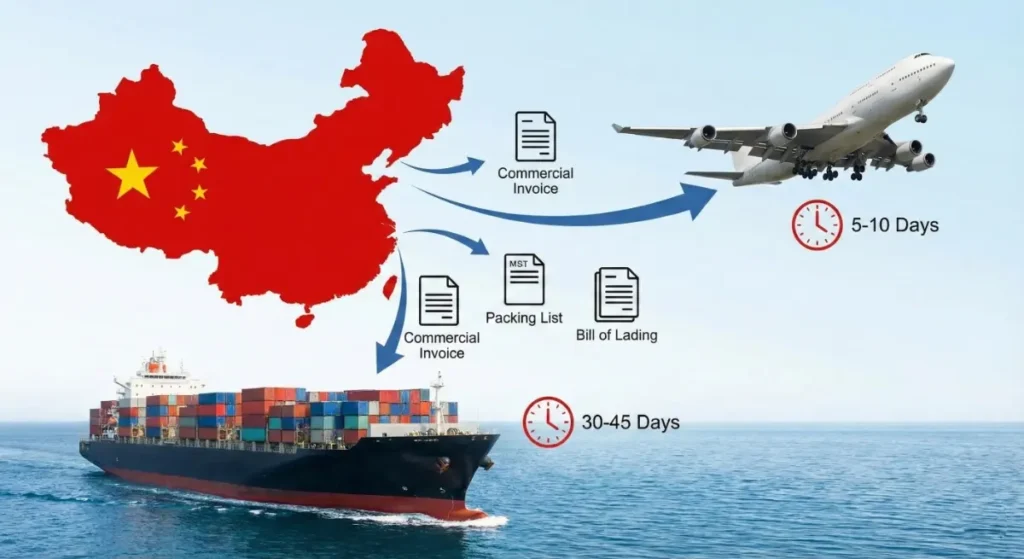
Who handles the shipping?
You need to clearly define the point where risk transfers from the seller to the buyer to avoid insurance and loss disputes. Most professional buyers prefer FOB (Free on Board), where the factory handles all local logistics up to the shipping vessel. Know these essential Incoterms:
- FOB (Free on Board): You control the freight and costs from the Chinese port.
- EXW (Ex Works): You are responsible for picking up goods from the factory door.
- DDP (Delivered Duty Paid): The supplier handles everything to your doorstep.
What about customs docs?
Incorrect or missing paperwork can lead to expensive delays, storage fees, and even seizure of goods at customs. An experienced manufacturer knows exactly what documents your specific export market requires for clearance. Require these critical documents:
- Commercial Invoice detailing the value and description of goods.
- Packing List matching the physical count of cartons and weight.
- Certificate of Origin to potentially qualify for reduced import duties.
How long does delivery take?
Your lead times must account for the transit method, not just the manufacturing time. Stable lead times are a hallmark of reliability, and you must build buffers into your inventory planning to account for port congestion. Plan for these transit windows:
- Sea freight is the most cost-effective but takes 30-45 days.
- Air freight is rapid but expensive, taking 5-10 days.
- Customs clearance usually adds another 3-7 days upon arrival.
Key Takeaway: Understanding Incoterms and planning for realistic transit times prevents supply chain disruptions and unexpected logistics costs.
| Shipping Method | Cost Profile | Speed Profile | Ideal For |
|---|---|---|---|
| Sea Freight | Low | Slow | Bulk Orders |
| Air Freight | High | Fast | Samples/Restocks |
| Rail (to EU) | Medium | Medium | Heavy Goods |
Analysis: Balancing sea freight for bulk orders and air freight for urgent trends optimizes both your logistics budget and inventory turnover speed.
7. Communication Tips for Your Shoes Manufacturer in China
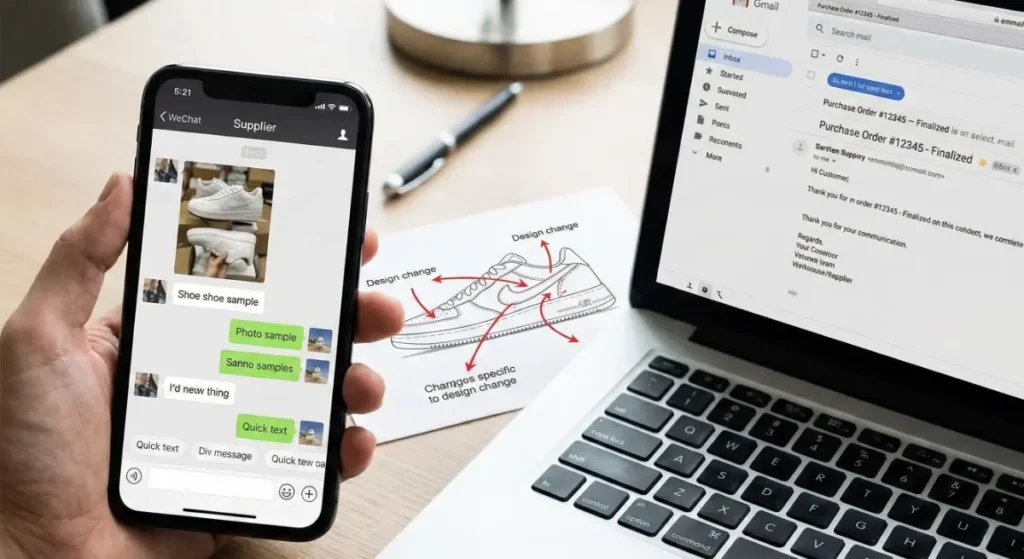
Which channels work best?
While email is excellent for formal records and contracts, instant messaging is superior for the speed required in daily operations. Suppliers like TLSTAGE are service-oriented and utilize modern tools to keep you updated in real-time. Use these communication tools:
- WeChat or WhatsApp for instant answers, photos, and quick updates.
- Zoom or Teams for face-to-face meetings and virtual showroom tours.
- Email for finalizing purchase orders, invoices, and legal agreements.
How do you overcome barriers?
Misunderstandings due to language barriers can be incredibly costly if they result in production errors. Clear, simplified communication ensures your specifications are understood exactly as intended. Follow these rules for clarity:
- Use simple English without idioms, slang, or overly complex sentence structures.
- Use visual diagrams with arrows and labels to explain design changes.
- Summarize points in lists at the end of every meeting to confirm agreement.
Why is responsiveness vital?
Time zone differences can slow down development, so you need a partner who bridges that gap. A timely quotation or response indicates they value your business and are organized enough to handle your volume. Look for this level of service:
- Replies within 24 hours regardless of the time difference.
- After-hours support during critical production phases or launches.
- Proactive updates where they inform you of status before you have to ask.
Key Takeaway: Establishing clear, multi-channel communication protocols bridges the cultural gap and prevents costly production errors due to misunderstandings.
| Channel | Purpose | Response Expectation |
|---|---|---|
| Contracts / Specs | 24 Hours | |
| Instant App | Daily Updates | 2-4 Hours |
| Video Call | Relationship / QC | Scheduled |
Analysis: Utilizing a mix of formal and instant communication channels ensures both legal clarity and operational agility in your supply chain.
8. Ensuring Ethics at a Shoes Manufacturer in China
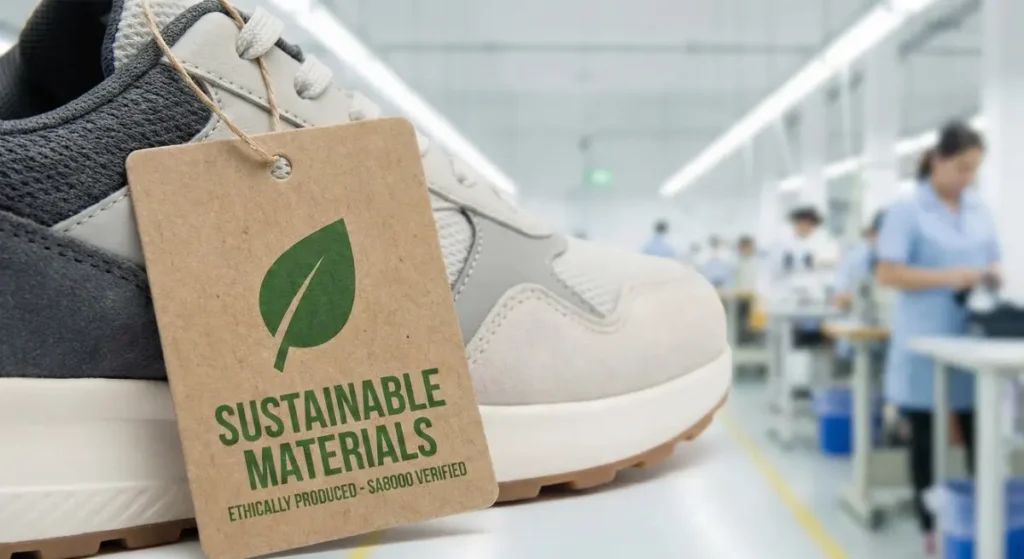
Are labor standards met?
Today’s ethical consumers demand transparency and will punish brands that are associated with sweatshops or poor labor practices. Sourcing from a compliant shoes manufacturer in china protects your brand image and ensures you are on the right side of history. Ask about these human resources policies:
- Worker safety protocols that prevent accidents on the factory floor.
- Fair wage practices that comply with or exceed local labor laws.
- Strict no child labor policies that are verified by third-party audits.
Is the process sustainable?
Sustainability is a growing requirement for entry into many Western retail chains and for appealing to Gen Z consumers. Discussing these environmental factors early shows you are a serious buyer with a long-term vision. Verify this environmental commitment:
- Waste management systems that properly dispose of chemical byproducts.
- Non-toxic glues and water-based adhesives to reduce VOC emissions.
- Recycled packaging options to lower the carbon footprint of your logistics.
How do you verify claims?
Trust is important, but verification is essential when your brand reputation is on the line. Do not rely solely on the manufacturer’s word; use objective measures to validate their ethical standing. Implement this due diligence:
- Third-party social audits from recognized bodies like SA8000 or BSCI.
- Personal factory visits to see the working conditions with your own eyes.
- Requesting valid certifications and verifying them with the issuing body.
Key Takeaway: Prioritizing ethical and sustainable practices is no longer optional; it is a critical component of brand value and corporate risk management.
| Aspect | Standard Requirement | Verification Tool |
|---|---|---|
| Labor | Fair Wages / Safety | SA8000 / BSCI |
| Environment | Waste Reduction | ISO 14001 |
| Materials | Non-Toxic | REACH / Prop 65 |
Analysis: Incorporating ethical audits into your sourcing strategy mitigates reputational risk and appeals to the growing market of conscious consumers.
9. One-Stop Sourcing via a Shoes Manufacturer in China
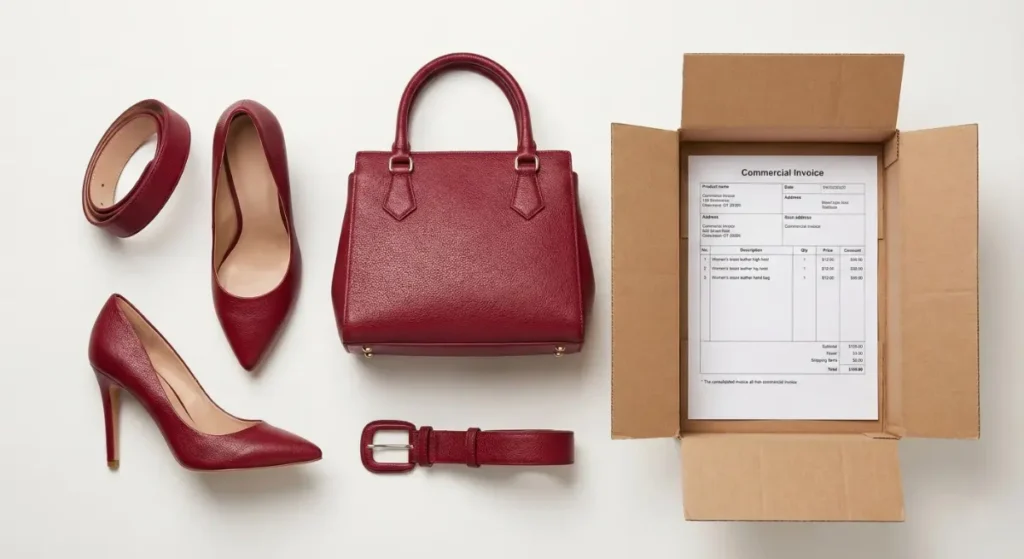
Can they produce accessories?
Consolidating your suppliers saves massive headaches by reducing the number of relationships you need to manage. TLSTAGE offers this powerful one-stop sourcing advantage, allowing you to curate a full look from a single partner. Imagine sourcing these together:
- Women’s clothing that perfectly matches the season’s footwear trends.
- Bags and belts using the exact same leather as your shoe collection.
- Socks and hats to increase your average order value at checkout.
Does this save admin time?
Managing ten different suppliers across different time zones is exponentially harder than managing one strategic partner. This efficiency is perfect for buyers managing diverse inventories who need to focus on marketing rather than logistics. You save significantly on:
- Logistics coordination by combining goods into fewer shipments.
- Payment processing fees by reducing the number of international wire transfers.
- Communication overhead by having a single point of contact for all categories.
Is color matching easier?
Coordinating shades of “navy blue” across three different factories is often a nightmare that results in mismatched collections. Buying jeans, bags, and heels from the same source ensures a cohesive aesthetic. Benefit from these design synergies:
- Unified color palettes ensuring the red in the bag matches the red in the shoe.
- Consistent material quality across all your product categories.
- Cohesive collection design that looks professional on the rack and online.
Key Takeaway: Leveraging a one-stop sourcing partner simplifies logistics, reduces administrative burden, and ensures design cohesion across multiple product categories.
| Category | Single Supplier | Multiple Suppliers |
|---|---|---|
| Logistics | 1 Consolidated Shipment | Multiple Shipments |
| Admin | 1 Invoice / Contact | Multiple Invoices |
| Design | Unified Look | Mismatched Tones |
Analysis: One-stop sourcing models significantly reduce operational complexity and logistical costs for multi-category retailers.
10. Future-Proofing with a Shoes Manufacturer in China
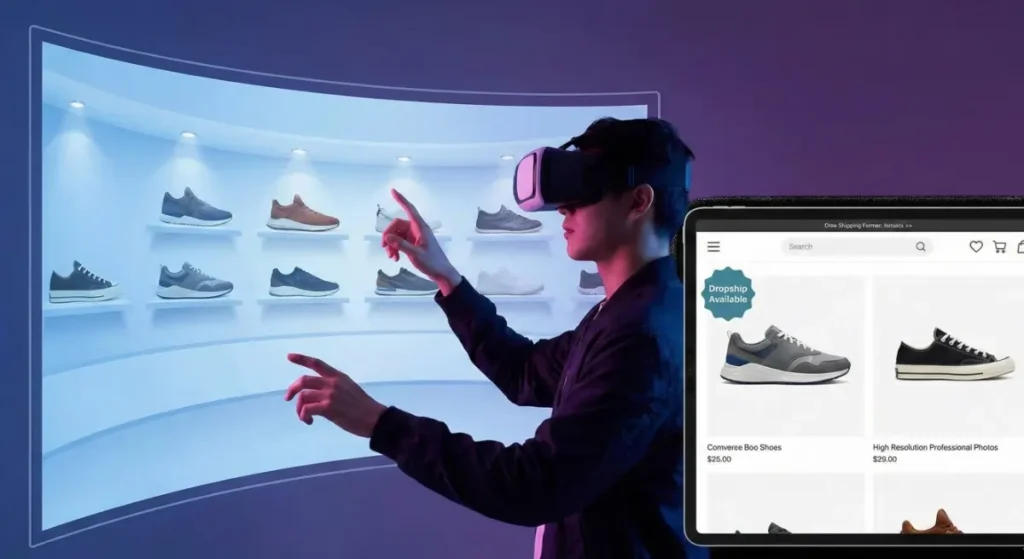
Are they adapting to trends?
The future of sourcing is digital, and you need a partner who is investing in the tools that will define the next decade of manufacturing. A forward-thinking shoes manufacturer in china utilizes technology to stay relevant. Look for these innovations:
- Virtual showrooms that allow you to browse collections remotely in high definition.
- AI-driven demand planning to help predict material needs and reduce waste.
- Digital prototyping to reduce the time and cost of physical sampling.
Do they support e-commerce?
Online business moves faster than traditional retail, requiring a supply chain that is agile and responsive. E-commerce buyers need a partner who understands the need for speed and low inventory risk. You need these specific capabilities:
- High-res photography support so you can list products before they arrive.
- Dropshipping capabilities or support for direct-to-consumer logistics.
- Small batch restocking to quickly replenish winners without overstocking losers.
Will they grow with you?
You want a true business partner, not just a transactional vendor who disappears after the check clears. Building a relationship with a stable company like TLSTAGE pays dividends as they prioritize your growth. Seek these partnership traits:
- Strategic planning sessions to align their production capacity with your sales goals.
- Priority during peak seasons ensuring your goods are made first.
- Loyalty discounts that improve your margins as your order volume increases.
Key Takeaway: Aligning with a manufacturer that embraces digital transformation and e-commerce agility ensures your supply chain is future-proof and ready for growth.
| Trend | Old School Factory | Future-Ready Partner |
|---|---|---|
| Sales Model | Container Load Only | Flexible / E-comm Support |
| Innovation | Reactive | Proactive / Digital |
| Relationship | Transactional | Strategic Alliance |
Analysis: Choosing a digitally mature partner provides a competitive edge in speed and adaptability for the evolving retail landscape.
FAQ
Can I order products other than shoes from a shoe manufacturer?
Yes, provided you choose a versatile partner with broad capabilities. Companies like TLSTAGE offer comprehensive sourcing, allowing you to order women’s clothing, bags, and accessories alongside footwear to simplify your logistics and ensure design consistency.
What is the best way to communicate with Chinese suppliers?
Instant messaging apps are the superior choice for daily operational speed. While email is standard for formal contracts, using WeChat or WhatsApp ensures you get faster responses and builds a better, more personal working relationship with your account manager.
How do I know if a manufacturer is truly reliable?
You must look for transparency, professional digital assets, and third-party verification. Reliable partners have verified B2B websites, offer fast sample production within 7 days, and openly welcome third-party factory audits to prove their quality standards.
What is a typical Minimum Order Quantity (MOQ)?
MOQs vary significantly by factory and product complexity. However, service-oriented manufacturers often provide flexible MOQs (e.g., 100-200 pairs) to help growing businesses test new designs without taking on excessive inventory risk.
How long does it typically take to get a custom sample?
Speed is a key indicator of a manufacturer’s capability and organization. A top-tier manufacturer can often deliver a custom sample in as little as 7 days, whereas traditional or less organized factories might take weeks to complete the same task.
Conclusion
Sourcing from China is no longer just about finding the lowest price; it is about finding a strategic ally who understands your market and empowers your brand. Whether you need the volume capacity for a chain store or the flexible design options for a boutique, the right shoes manufacturer in china can transform your business from a struggle into a success story.
You have the roadmap for success—now it is time to take decisive action. TLSTAGE stands ready to be that partner, offering reliable lead times, consistent quality, and a unique one-stop sourcing experience for shoes, apparel, and accessories. Stop worrying about your supply chain and start building your brand legacy today.
Visit www.tlstage.com to explore our women’s high heels, clothing, and comprehensive sourcing solutions.